
Emergency vehicles stretched to the limit
Graham County emergency services have come a long way.
A handmade two-wheel cart with fire hose served in lieu of a fire engine in the late 1940s, and a hearse served as the county’s only ambulance until the early 1960s.
Today, there are four branches of emergency services in Graham County:
* Graham County Fire Department, with more than 90 volunteers between fire stations in Robbinsville (Station 1), Snowbird (Station 2), Santeetlah (Station 3), and Meadow Branch (Station 4), each with at least two fire engines;
* Graham County Rescue Squad;
* Graham County Emergency Medical Services (EMS), which operates the county’s ambulances;
* Stecoah Township Fire & Rescue, which operates fire engines and ambulances serving eastern Graham County.
All four agencies face a problem of aging vehicle fleets and limited funding. Supply chain issues mean that even when new equipment is ordered, it will take up to three years before delivery.
Before going further, it should be noted that Graham County fire and emergency services are reliable and fully functioning.
The N.C. Office of the State Fire Marshal notified the Graham County Volunteer Fire Department on May 20 that it has met all requirements for a rated and certified department. Most of that is due to the volunteers who staff Graham County’s fire stations.
Graham County’s volunteer firefighters do more than donate their time and sweat, responding at all hours under all conditions. They receive a minimum of three hours of training each week. They donate their own money, help raise funds, apply for grants, and as much as possible, work on their own fire engines and equipment to keep them running and passing inspections.
Fire protection
The Graham County Fire Department has a roster listing 91 volunteer firefighters spread out over four volunteer fire stations.
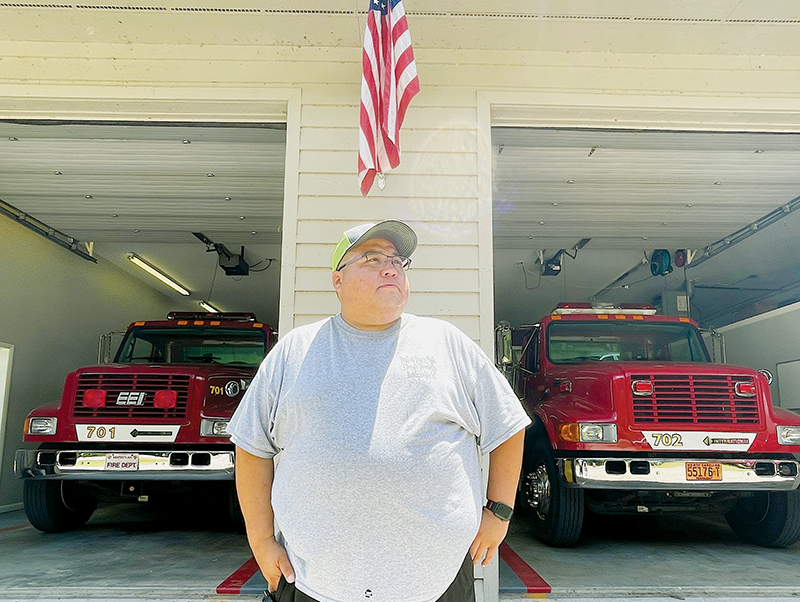
Each station has at least two fire engines, with the newest engine delivered in 2003. It bears repeating – among most of the county’s fire stations, the newest fire engine is almost 20 years old.
Several are twice that old.
The Snowbird station has a larger fleet of newer vehicles thanks to contributions from the Eastern Band of Cherokee Indians. Santeetlah has two water tankers, but one – donated by the state – is out-of-commission and too costly to repair.
On the other hand, Meadow Branch has two fire engines that are among the oldest in the county at around 40 years.
The line blurs between the Fire Department and the Rescue Squad.
Jeff Millsaps, the chief of Fire Station 1 (Robbinsville), is also the chief of the Rescue Squad. Rescue Squad vice chiefs are Brian “Taco” Johnson, who is chief of Station 3 (Santeetlah), and Keith Eller, who is Graham County fire chief. Most volunteer firefighters also volunteer with the rescue squad.
The Rescue Squad has the same issue: its vehicles are old enough to retire, with no funding for replacements in sight.
Johnson has been a volunteer firefighter for 18 years, and chief of the Santeetlah station since September.
The state normally conducts spot inspections to ensure compliance and reliability, Johnson said. The most recent inspection was more comprehensive, he said, but the main issue it uncovered was that they need to do a better job with paperwork.
Johnson was at the Santeetlah station last week and had just finished mowing the grass. He was prepping for the station’s weekly meeting later that day.
Like most others in the department, his station has two fire engines. One – built in 1999 – has required several thousand dollars worth of repairs and maintenance recently, including more than $6,000 just to fix the pump. It returned to full service just that morning.
The other, a 1995 model, has held up better.
It’s a constant struggle making ends meet, he said. He’s been thinking about installing an ice machine and sell ice to passing motorists to raise money, for example, but the station falls under the design requirements of a Home Owners Association (HOA), and he didn’t think the HOA would approve.
Grants are another way to make ends meet. His station had just took delivery of brand new turnout gear and $53,000 worth of self-contained breathing apparatus, all paid for by grants. The existing station was not built with expansion in mind, so the 15-or-so volunteers there have saved up $80,000 over the past several years to build a 50-foot-by-50-foot metal building with three bays.
But the fact remains that its two fire engines were built in the last century, and one of its two water tankers sits out in the elements, deadlined and out of commission.
The Graham County Board of Commissioners budgeted $50,000 for the 2022-23 fiscal year to help fund replacement fire engines, about half what is needed to pay for just one basic engine. The rest of the funding will have to come from other sources, such as grants and fundraising.
Emergency services
Graham County EMS is separate from the local fire departments and is a branch of Graham County government.
Unlike fire and rescue – which have all-volunteer staffs – Graham County EMS has a paid staff that includes a director, 20 full-time and four part-time emergency medical technicians and paramedics.
EMS personnel work 24-hour shifts, followed by 72 hours off. Their working hours are consumed by responding to dispatches, maintaining equipment and participating in mandatory training.
In addition, a grant-funded service called “paramedicine” started in 2020. The paramedicine program provides routine medical services for residents in the county who have limited mobility.
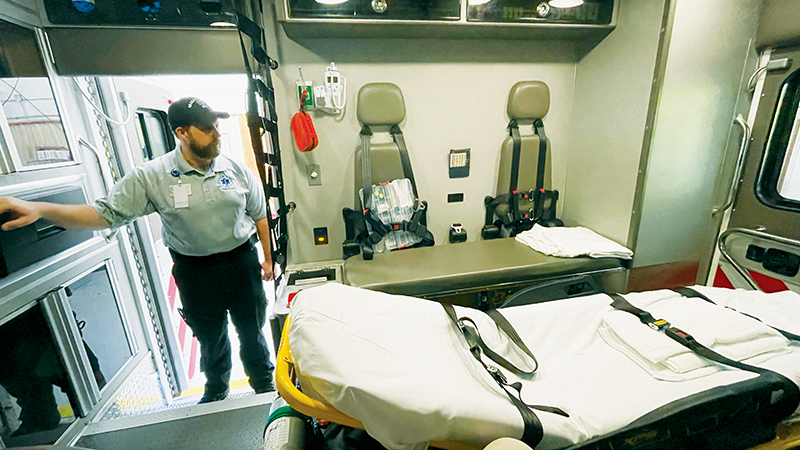
The EMS station on West Fort Hill Road includes a day lounge and sleeping accommodations next to the equipment bay, where three newer-model ambulances are housed when not dispatched. Several older ambulances are parked outside and could be brought back into service if necessary.
EMS Director Brian Stevens had been interim director until February, when “interim” was dropped from his title.
He said the department ordinarily acquires one new ambulance each year, replacing the oldest front line ambulance, which is taken off rotation and put into reserve.
The Graham County Board of Commissioners budgeted for two new ambulances in the 2022-23 budget, which takes effect July 1. Ideally, the department orders one new ambulance each year, but funding was not available in the 2021-22 budget cycle.
It has been at least two years since the department received its newest ambulance, and it may be another three before new ones are delivered and replace the two oldest front-line ambulances. But by that time, the third ambulance will also be due for replacement.
Stevens said the county’s ambulances operate under demanding conditions, and with ambulances, reliability is crucial.
“We absolutely have to be able to get there,” he said. “If you break down on the road, it’s an inconvenience. If we break down on the way to the hospital, it could be life-threatening.”