
Size, safety concerns addressed by 43rd district
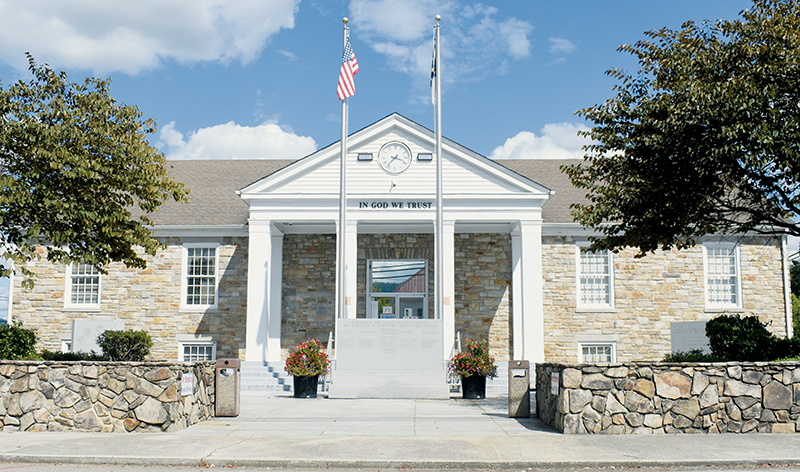

Robbinsville – It has been over six years since the Graham County Board of Commissioners were first given a directive: speed up the gameplan for a justice center.
To date, a site has yet to be selected. Surveys and inspections of multiple locations have taken place around Robbinsville – and even select areas beyond the municipality’s borders – but so far, not a single layer of Earth has been moved to signify that the project is underway.
On Aug. 21, commissioners received another nudge – and the second one from a Senior Resident Superior Court Judge. After recently being appointed to fill the seat vacated by Bill Coward’s retirement earlier this year, Sellers had barely donned her robe before sending an 8-page letter to the current commissioners, as well as interim county manager Kim Crisp about the current state of how judicial proceedings are carried out in Graham.
The biggest takeaway: the commissioners have 60 days to present a plan to Judicial District 43A (Cherokee, Clay, Graham, Macon and Swain counties) – something that an order from Coward originally decreed in 2017 – and district representatives have requested to be on the commissioners’ Oct. 15 agenda.
In the letter, Sellers breaks down numerous issues with the 82-year-old facility: many of which mirror Coward’s order seven years ago.
Inspiration
Sellers’ letter begins by detailing her history of working in Graham County, which she cited as beginning in 2007. She noted that her first role in the assistant district attorney’s office was an assignment in Graham, where she “prosecuted seatbelt cases to murder cases,” according to the letter.
During an Aug. 2 Graham County Superior Court session, Sellers had a grand jury summoned to assemble. She explained that when the quorum call was made at 10 a.m., no jury was present – so she elected to try again at 11 a.m., while it was pointed out that nine new grand jurors are selected to serve every six months.
Following the 11 a.m., gathering, Sellers was troubled.
“When I released the potential grand jurors, I had nowhere to send them,” Sellers said in the letter. “The potential grand jurors could not stay in the courtroom while business was being conducted so I had to tell them they could congregate in the hallways, sit outside or go to their cars while they waited.
“Thankfully, it was not raining but the temperature almost reached the ninety degree (sic) mark and I could not direct them to a secure place to wait.”
It is obvious in the letter that Sellers has both personally observed and heard about the issues faced when simply trying to hold court in Graham County, as she moved on to pointing out deficiencies throughout the two-story building.
History
Built in 1942, the courthouse is centrally located in downtown Robbinsville, at the corner of East and North Main streets.
The county’s detention center is located in the bottom floor of the facility, as is the Public Defender, Magistrate, Probation and tax offices. Upstairs is the Clerk of Court and Register of Deeds, as well as the only courtroom in the building.
In the 82 years that have followed, the world outside its doors has simply outgrown the service the courthouse was erected to provide. The jail can only house eight inmates; typical rooms like a jury assembly are not available; parking is limited (even with a public lot adjacent to the property) and the safety of the public is brought into question each time a court session convenes.
A 2016 attempt to fund renovations to the courthouse was presented as a ¼-cent sales tax referendum on the general election ballot. Two-out-of-three struck down the concept when votes were cast, which would have brought an estimated $225,000 of yearly funding to the county for the project.
Undeterred, commissioners voted to put the referendum back on the 2018 general ballot – and on the second try, the measure passed resoundingly: 2,198-1,318.
Coward’s Aug. 28, 2017 order condemned the courthouse, calling it “unsafe.” The directive also stipulated that all future jury trials would need to be held in Cherokee County – and that Graham was on the hook for all expenses, including transportation for jurors, deputies, county personnel, bailiffs and defendants.
Then-county manager Becky Garland had until Oct. 25, 2017 to estimate what it would cost to hold a jury trial in Cherokee County, which was projected to be $33,000 a week. At the time, she called it a “certainty” that Superior Court sessions would be moved out of Graham in 2018.
Coward pointed out 10 different areas of concern that needed to be addressed if the county wished to continue holding court locally. Sellers’ Aug. 21 letter echoes many of the same sentiments.
But with the 2018 referendum in mind, the order was not strictly enforced. Jury trials have been few and far between since 2018, especially since the pandemic struck just 16 months after the referendum passed.
COVID also ravaged the cost of goods, including building materials.
Davenport and Associates estimated that the county could borrow $7.2 million to either build a new courthouse or renovate the existing one in June 2018, but commissioners today are hearing a price tag four times that amount.
Concerns
The bulk of Sellers’ letter zeroes in on different areas of the courthouse that are lacking:
* The courthouse lacks a jury assembly room, which should be the area where the jury venire (potential jurors) can wait during the selection process. Sellers cited North Carolina General Statute 15A-977(e), “A motion to suppress made during trial may be made in writing or orally and may be determined in the same manner as when made before trial. The hearing, if held, must be out of the presence of the jury,” as the current jury pool has to wait inside the courtroom with the general public.
* The jury deliberation room is significantly undersized. Located in the right corner of the courtroom, the cramped quarters is not only expected to hold 12 people, but has no restroom; a window unit for heating/air; and is susceptible to eavesdropping, as there is only a thin, older wall separating the two rooms. “It is impermissible for the jury to hear such matters and learn of statements made by witnesses or other evidence which could be suppressed by the court and not admitted at trial,” said Sellers. “Yet, there is a high probability the jury can hear what is said in court during their absence.”
* Courthouse bathrooms are antiquated. In addition to the lack of a restroom for jurors – which leads to a necessity of lingering in a public setting, which can damage the integrity of a juror’s role – there is simply not enough restroom space in the building. The only public restrooms are downstairs from the courtroom itself and often, toilets will not flush and hot water is not available. Only having one set of public restrooms also creates a safety hazard, as not only jurors but witnesses, attorneys and victims might have to cross paths with defendants in the restroom setting.
* Knowledge of custody cannot be protected. Currently, anyone brought into the courtroom that is in custody of the Graham County Detention Center are ushered up a set of back stairs from the jail below and into court through the jury deliberation room. “The jury can easily surmise that if some defendants exit through the main courtroom door with witnesses, jurors and others there must be a specific reason why yet other defendants must exit using the rear door leading to the jail,” Sellers wrote. “This Constitutional mandate is paramount for the Court to try to protect in criminal proceedings.”
* Courtroom entrance not secure. Though metal detectors and scanners are installed in the front lobby, there is one main entrance for the public, jurors, attorneys and defendants not in custody all to use to access the courtroom. “…Due to there being only one entrance it necessarily follows that the defendant not in custody will be in contact with and mingling among jurors during recesses and before and after court,” said Sellers. The senior judge went on to add that attorneys have no sufficient space to discuss matters with clients.
* A single courtroom is no longer enough. Hearings conducted by both the Graham County departments of health and social services are often forced to hold outside a courtroom setting, which Sellers termed “unacceptable.” There is also a lack of security at any other facility and proceedings held elsewhere cannot be properly documented, which is a violation of state statutes 7A-198, 7B-806 and 7B-1109. “Holding regular court sessions in either the Graham County DSS or Health Department buildings is simply inadequate,” Sellers said.
* The single-courtroom setting cannot withstand today’s needs. A central heating and air system installed years ago is noisy when active, making it difficult for anyone in the room – most notably, a court reporter – to hear what is being said during court. The court reporter is also tasked with being seated directly in front of the witness stand and the jury, which interrupts the flow of exhibits being shown in court; as well as the entry and exit of jurors. “While this could be rectified by moving the court reporter in the courtroom, with the current courtroom floor plan, there is not another place to move the court reporter,” Sellers pointed out.
* Inadequate parking. Finding a spot to park in the vicinity of the building – or even downtown Robbinsville – on court day is a game of luck. Spots immediately spread around the circumference of the courthouse are few and far between, and many are reserved for businesses (such as Kin Cafe and Lynn’s Place); as well as Robbinsville City Hall. A public parking area sits further down Veterans Memorial Hill, but is an incline for anyone who has to use it for courthouse access.
* The courthouse is not handicap accessible. Anyone in a wheelchair – or with mobility issues – will find it is an arduous task to not only access the facility, but the courtroom itself. An elevator in the lobby often malfunctions, which led to Sellers noting an example of interference with proceedings. “I am aware of one occasion where a Defendant was unable to use the elevator due to maintenance issues and access to the courts was denied,” said Sellers. “This is completely unacceptable. Compliance with the ADA, not only applies to those in the courtroom but also applies to Graham County citizens who need to transact business in the office of the Clerk, Tax Collector, Register of Deeds and other offices located in the courthouse.”
Jail issues
The detention center is a separate matter in itself.
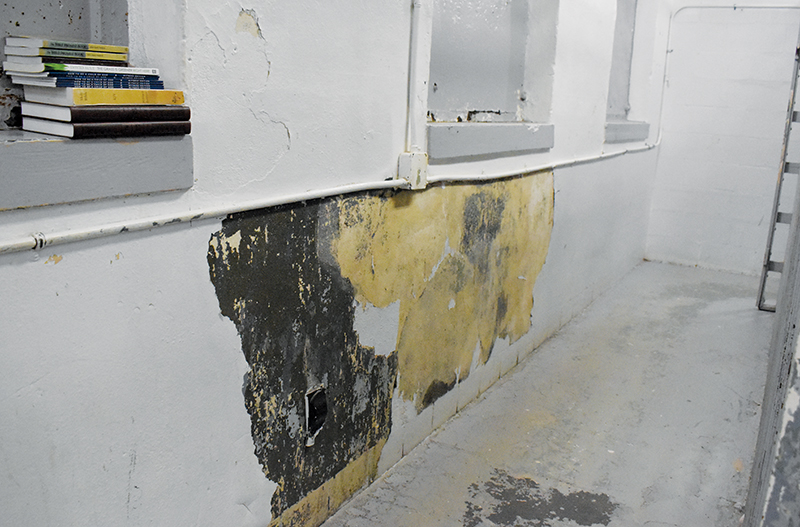
Past grand jury inspections have concluded with a high recommendation for a new jail, but the Graham County Sheriff’s Office made a plea to commissioners in January when lead-based paint was discovered inside the center. It was not the first time a positive sample had been found and the idea of painting over it is only what sheriff Brad Hoxit called “a Band-Aid.”
Currently, the jail has eight beds – but the Graham County Detention Center can have 30-40 inmates in custody at any given time. Outsourcing to larger facilities in other counties has became a normal procedure.
Between July 1, 2018 – June 30, 2023, the county spent $727,908.15 to house inmates elsewhere. Through a public records request, The Graham Star learned that $296,880 was spent in 2023 alone for the procedure – with those in custody being shipped to Buncombe ($3,795); Cherokee ($191,690); Clay ($10,440); Henderson ($19,195); Madison ($56,375); Polk ($8,485); and Transylvania ($6,900) counties.
Sellers made an astute observation about the practice.
“With the cost to house an inmate in another county $55 per day and then the officers needed for transporting the inmates back and forth to Graham County for court plus the fuel costs and maintenance costs of vehicles, the County is expending a large amount of funds that could be staying within the confines of Graham County if the County built a new jail facility,” wrote Sellers.
The issue then comes full circle when a court session is on tap and inmates have to be brought back to Graham the day before. With only eight beds available, sleeping arrangements prove to be a challenge.
“It has come to my attention that due to the current situation of housing so many inmates outside of Graham County, that the night before court dates numerous inmates are forced to sleep on the floor of the jail,” Sellers said. “I am appalled by this practice and find it to be a completely unacceptable practice that must be addressed immediately.”
Sellers also noted the risk involved with the current configuration of the detention center being located directly below the courtroom itself.
“With the jail having access to the courtroom without secure doors, if a disruption occurred in the jail, nothing would keep an inmate (from) coming up the stairs into court causing a potentially dangerous situation,” said Sellers. “This would constitute a significant security risk for courthouse staff and the general public. This is unacceptable.”
Current status
In 2018, Garland told The Star that the process of selecting a site for – and the construction of – a new justice center was something the county was going to take in “baby steps.”
Six years later, the commissioners are still holding firm to that outlook. At the county’s Aug. 20 meeting, Dr. Katy Lynch asked several questions regarding the status of the plans, which have hovered around 20 percent complete on county project manager Jason Marino’s monthly report for quite some time.
Commission chairman Jacob Nelms has stated numerous times in the past that the county is not going to rush the planning process. Sites have been evaluated on West Fort Hill, Old Tallulah, P & J and Snowbird roads – the latter three – entering the public mix as options earlier this year – as well as a complete overhaul to the existing structure, which Nelms admitted Aug. 20 was at the “bottom of the list” for options. The current courthouse would be not be torn down, however: instead, it would be remodeled to move more county offices into the structure, many of which are currently sharing space inside the Graham County Community Building on Knight Street.
The only artist renderings ever made public were for a site on county-owned property off West Fort Hill, which detailed an expansive structure with ample parking, the clerk of court’s office and the sheriff’s office combining space downstairs with the new jail.
No public indication has been made yet regarding where and when the county will break ground, but public hearings and input is still being gauged by commissioners.
Sellers’ letter wraps up by asking the county to set the wheels in motion, stating that the commissioners have 60 days from the date of the letter (Oct. 20) to present a plan to the judicial district and is signed by Sellers, Chief District Court Judge Roy Wijewickrama and District Court judges Donna Forge, Justin Greene, Monica Leslie and Kaleb Wingate.
“It is no secret (that) this issue has been brought to the attention of the Board of Commissioners on more than one occasion and the issue has remained unsolved even after receiving some funding through a referendum and funds earmarked in the State’s budget for Graham County courthouse facilities,” Sellers said. “…This letter is written out of genuine concern and in a spirit of cooperation.