
Silt from 2017 project destroyed local trout farm
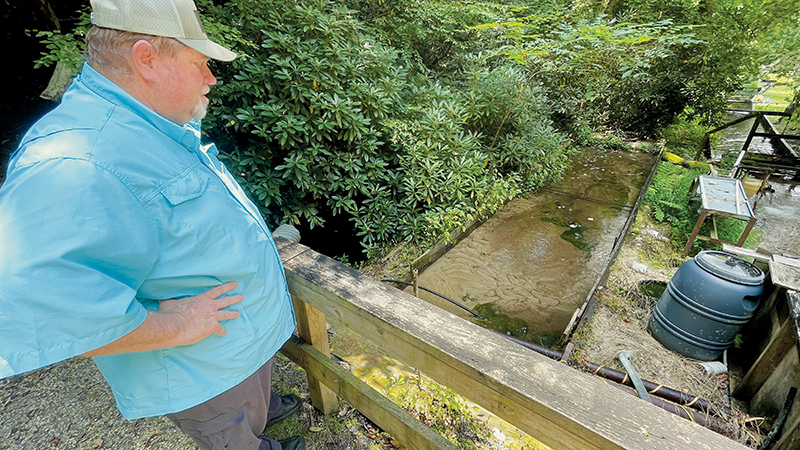
Snowbird – For more than 30 years, Duane and Linda Wilkey operated a trout farm in western Graham County on Hunting Boy Branch, a stream that feeds into Little Snowbird Creek.
In June 2017, they noticed the creek was unusually muddy following a light rain.
The problem grew worse. There was so much silt, their fish raceways filled with silt, fingerling trout started dying off and just three months after they first noticed the problem, they were out of business.
The Wilkeys traced the problem a ¼-mile farther up the Hunting Boy Branch watershed, where the Eastern Band of Cherokee Indians was having a substance abuse treatment facility built off Cornsilk Branch Road.
Since that time, the Wilkeys been engaged in an ongoing – but fruitless – effort to get compensated for their loss.
‘Pristine’ waters
Hunting Boy Trout Farm has been at the location since it was started by Don and Ray Moody in 1983.
Newly-hatched trout and fingerlings need pristine, clean water and Hunting Boy Branch made the operation possible.
The Moody brothers vaccinated the fish and once they reached
about 1 ounce in weight, they were shipped to other farms to be raised to maturity.
In 1991, their great nephew Duane Wilkey – fresh from finishing college in Texas – got involved in the business. He bought into the business in 1992 and bought it outright in 1994.
By 2017, the Wilkeys had been raising 300,000 fingerlings per year, they said. It wasn’t an extremely profitable business, but it was their living. The constant attention it required meant that Duane and Linda Wilkey never vacationed together.
Since they shut down operations, Duane’s health has declined and without income from their farming operation, the couple rely on Linda’s income as a hairdresser in Robbinsville.
They have complained to the Eastern Band of Cherokee Indians tribal authorities – as well as state and federal regulating agencies – to no avail.
The U.S. Environmental Protection Agency has regulatory jurisdiction over the Qualla Boundary, territory held as a land trust by the U.S. government for the federally-recognized Eastern Band of Cherokee Indians. The Wilkeys’ case was being handled out of the EPA’s Atlanta office, but officials there said the matter is closed and plan to take no action.
Richard Sneed, principal chief of the Eastern Band of Cherokee Indians, said the tribe has no comment about the dispute at this time.
Sequence of events
Here is a summary of the events, from the Wilkey’s perspective.
In mid-June 2017, the Wilkeys noticed unusually-muddy water after a small rain that they suspected had something to do with a tree that had fallen farther upstream. The mud increased, compelling them to look into it further until they visited the construction site of the EBCI project on Cornsilk Branch Road and found what they believe was the true cause.
They said an engineer on the project assured them that the matter would be resolved quickly.
Instead, the mud flow worsened, and started killing both fingerlings and larger fish.
They called the project engineer, who visited their nursery and told them to get it cleaned up and bring him the bill – a fruitless gesture since the problem was coming from upstream and was continuing.
After a visit, tribal authorities told the Wilkeys to fine-tune their numbers so that they could be presented to the tribal council to decide what if any compensation would be paid.
In fall 2017, the Wilkeys were informed that a representative from the EBCI Attorney General’s Office and an insurance adjuster would visit the farm and – by the Wilkey’s recollection – admitted that the Cornsilk Branch Road project was causing the silt.
The Wilkeys were asked to calculate their lost revenue and submit it to the tribe. In spring 2018, they were interviewed by an insurance investigator.
By August 2018, the insurance company told the Wilkeys to substantiate their claims. By that time, the insurance company didn’t think the source of the silt was from the tribal construction project, its adjuster saw live trout in the trout farm’s raceway and the company considered the Wilkeys’ claim dubious.
The tribal council deferred to the tribe’s Attorney General Office, which deferred to the insurance company, which denied the claim.
Meanwhile, the Wilkeys’ trout farm went out of business. The last group of viable fingerlings the Wilkeys were able to raise and sell was in September 2017.
“The entire site on Cornsilk is sloped on the Hunting Boy side,” Duane Wilkey wrote in a summary of events. “Hunting Boy Branch is too small to overcome the effects of temperature gain and pollution coming from the site. Sedimentation will never be stopped entirely due to the severe slope excavated. All of this renders Hunting Boy Branch useless in the production of food sized trout and especially fingerlings.
“Turbidity not only causes problems when at worst, but residue left in raceways is stirred up at each feeding causing the fish to stop eating. This brings feeding capacity to ½ or less. Sedimentation in raceways also hinders ability to grade, sort and capture fingerlings due to irregular bottoms.”
Debra Sloan, a Franklin-based agribusiness and aquaculture consultant for the N.C. Department of Agriculture and Consumer Services, sent a letter to the tribe in December 2017 reminding them of the problem.
“We looked at the continually increasing silt coming into the farm and it is evident the farm will never be a productive trout farm again,” she said. “Additionally, Duane and I visited the construction site of Robins & Morton on the reservation; it is apparent why Hunting Boy Creek has been environmentally compromised.”
(Robins & Morton is a Birmingham, Ala.-based construction company with offices throughout the Southern United States.)
In a report by environmental consultant Headwater Environmental, “a former ridgeline was leveled, and a significant amount of soil was used to fill the southern portion of the facility property, creating an artificial slope composed of fill soil. No vegetation has been established in the soil and no erosion control measures are visible in the photograph. Multiple rills are visible in the fill slope above Hunting Boy Branch.”
Rills are shallow channels cut into soil by the erosive action of flowing water.
Two years later – in December 2019 – the Wilkeys were represented by a lawyer who sent tribal and federal authorities a letter threatening a lawsuit.
“In the course of the construction, all of the storm water from the rehab facility was diverted into Hunting Boy Branch, including water previously discharged into another watershed,” their lawyer, William Clarke of Asheville-based law firm of Roberts & Stevens, P.A., said in the letter. “Excavation for the construction left a steep unprotected bank which continues to deposit sediment into Hunting Boy Branch.”
The suit was a citizens complaint to the EPA that was eventually dropped after the Wilkeys decided that they would find no help from the EPA.
“It became clear that the EPA was not going to be of any help against the tribe,” Mr. Wilkey said. “The result of such a court action could only result in them forcing the tribe to take care of the erosion problem. The only response we ever got form the EPA was that remedial action had been taken and they considered that sufficient.”
That belief was echoed in a request for information from The Graham Star to the EPA.
“The EPA is responsible for implementation and oversight of the National Pollutant Discharge Elimination System (NPDES) program of the Clean Water Act for activities occurring in Indian country, including those within the Qualla Boundary of the Eastern Band of Cherokee Indians,” EPA spokesman Melba Table said. “Under the NPDES program, construction activities greater than one acre in size generally require NPDES permit coverage while construction activities are ongoing to control the potential discharge of pollutants to waters of the United States. Based on information currently available to the EPA, the construction at the EBCI’s facility ceased in or around 2017, and no ongoing construction activities are occurring that would necessitate permit coverage at this time.”
Duane Wilkey said the EPA never visited the site, and his lawyer said no storm water construction permit or permit of any sort was issued by EPA for the construction of the rehabilitation facility or for the diversion of storm water and sediment into Hunting Boy Branch.
Ineffective measures
According to the EPA’s Stormwater Phase II Final Rule Construction Site Runoff Control Minimum Control Measure, dated December 2005, “Sediment runoff rates from construction sites are typically 10 to 20 times greater than those of agricultural lands, and 1,000 to 2,000 times greater than those of forest lands. During a short period of time, construction sites can contribute more sediment to streams than can be deposited naturally during several decades. The resulting siltation, and the contribution of other pollutants from construction sites, can cause physical, chemical, and biological harm to our nation’s waters. For example, excess sediment can quickly fill rivers and lakes, requiring dredging and destroying aquatic habitats.”
Although water in Hunting Boy Branch was observed to be clear at times, the raceways for the trout farm were inundated with sediment.
Observations of the Treatment Center during Headwater’s reconnaissance in April 2021 indicate that although multiple erosion control measures were in place, areas of exposed soil were observed on steep slopes and rills were observed in the slopes, said Adam M Tripp, senior geologist with Headwater Environmental.
Gutter downspouts and connected to the building roofs and other impervious surfaces appear to drain to the Hunting Boy Branch watershed, which likely results in much elevated flow volume during stormwater events, he said.
The rows of silt fencing protecting the Hunting Boy Branch watershed from stormwater runoff from the Treatment Center were inundated with sediment and had been compromised. Evidence of overland flow was observed below the silt fencing indicating that sediment from the Treatment Center is likely migrating into the watershed.
Although limited sediment was observed in Hunting Boy Branch, sediment traps appeared to be saturated, including one small pool where approximately 2 feet of sediment was observed.
Willing to settle
The Wilkeys initially asked the tribal council for $1,726,032.51 for the purchase of their property and compensation for their losses.
In an email from attorney Dale Curriden of the Asheville-based Van Winkle Law Firm to the Wilkeys’ lawyer in April of this year, Curriden said, “Tribal Council rejected the idea of a meeting but indicated a willingness to consider purchasing the property at market/appraised value. If the Wilkeys are willing to negotiate in that range, they should propose a price we can take back to Council (and obviously, the more support they can provide for their suggested price—such as an appraisal—the better). The prior demand in excess of $1M was a non-starter for Tribal Council.”
Duane Wilkey told The Graham Star in late-August that he and his wife would be willing to settle the matter for $500,000, which would include purchase of their acreage and business.