
Robbinsville – Whether it was long days of online classes, in-person masks and social distancing, or the prospect of adding another summer or even another school year to catch up, many high school students who have fallen behind in the age of COVID-19 are considering their options.
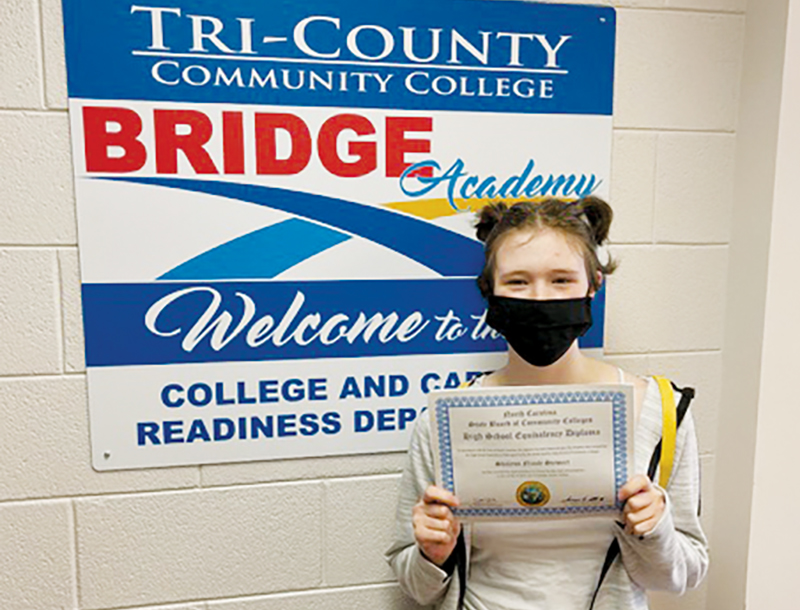
Shay Stewart, an 18-year-old Robbinsville resident, dropped out of high school her freshman year and once she turned 16, decided to pursue a high school equivalency certificate.
“I was not doing well with online schooling,” Stewart said.
Stewart applied through Tri-County Community College, a two-year college that serves Graham, Clay and Cherokee counties. Due to decreased volume in Robbinsville, her courses were taught in Murphy and were offered online.
Stewart said it took her just shy of three months to complete the 60 hours of study she need to take the tests.
Coincidentally, those courses were online – just like the environment that led her away from finishing high school. But for her, there was a big difference.
Through this program she participated in, Stewart was offered individualized support at her pace and fitting her schedule. She was paid as she achieved.
And once she earned her diploma, she was enrolled in a three-month paid internship – all part of the same program.
When she enrolled in the Tri-County College high school diploma, she was referred to HIGHTS, a Workforce Innovation and Opportunity Act (WIOA) program that provides young people everything they need to successfully complete the program. HIGHTS (an acronym: Helping Inspire Gifts of Hope, Trust, and Service — hights.org) is an independent non-profit based in Sylva that serves Graham County.
“We meet the students where they are,” said Sheree Blais, the workforce development case manager for Workforce Innovation and Opportunity Act, through HIGHTS. “We make them feel comfortable, so they can be successful.”
Helping Inspire Gifts of Hope, Trust, and Service paid for Stewart’s courses and tests ($80 for each of the four tests – language arts, science, social studies, and math), plus enrolled her in an internship program, paid her wages during that program, paid for any transportation costs, and paid for any supplies or equipment that she needed in the internship.
“In Graham County, gas reimbursement is really helpful,” Blais said.
The program even provided financial incentives — $100 for each time she went up a grade level and $200 for obtaining her high school equivalency (or, had she chose, her general educational development (GED).
Stewart was able to work at her own pace and received individualized tutoring and job counseling while she participated in the program.
“It’s way better than high school,” Stewart said.
Stewart participated in the program starting in December 2020 and was awarded her High School Equivalency Diploma on April 1.
Stewart interned for three months at Wehrloom Honey in Robbinsville and now works as a barista at Starbucks in Cherokee.
“The world lives off of coffee,” she said.
“She did great,” Blais added.
The program helps young people go on to college or obtain full-time work, Blais said.
Other participants have worked as rehabilitation technicians, pre-law, helped out at the Sheriff’s Department, and so on.
Stewart began working at Wehrloom on April 20 and completed the experience on July 20.
While there, she learned how to decant honey for retail and wholesale use, prepare online orders for packaging, provide customer service to the public, and work with the bees.
“She received glowing reviews from not only her supervisor but all her co-workers,” Blais said. “(She) gained valuable skills during this work experience and will no doubt contribute to the workforce in the area.”
Workforce Innovation and Opportunity Act programs are available to help young people who receive the training that they need in order to enter the workforce or to gain additional skills needed by the region’s employers.
The Workforce Innovation and Opportunity Act became federal law in 2014. It brings together federal investments in skill development, including adult, dislocated worker, and youth programs (Title 1); adult education and literacy (Title 2); the services available under the Wagner-Peyser Act (Title 3); and vocational rehabilitation (Title 4).
The act requires states to adopt several changes to their workforce systems, including the following:
* Places a greater emphasis on local and regional collaboration among workforce, education, and industry partners;
* Improves services offered to employers, including work-based training programs;
* Increases both the amount of funding devoted to helping out-of-school youth and the maximum age at which youth can receive services;
* Reinforces connections with registered apprenticeship programs;
* Promotes strong Workforce Development Boards;
* Calls for the use of career pathways to ensure job seekers are receiving credentials for in-demand jobs;
* Ensures that accountability measures are data driven.
NCWorks is the partnership between North Carolina’s workforce and education agencies.
The Helping Inspire Gifts of Hope, Trust, and Service program is available for ages 16-24. Applicants need a birth certificate and Social Security card.