
Eyebrows were recently raised at the state level regarding the pivot on how sanitation centers are operated in Graham County.
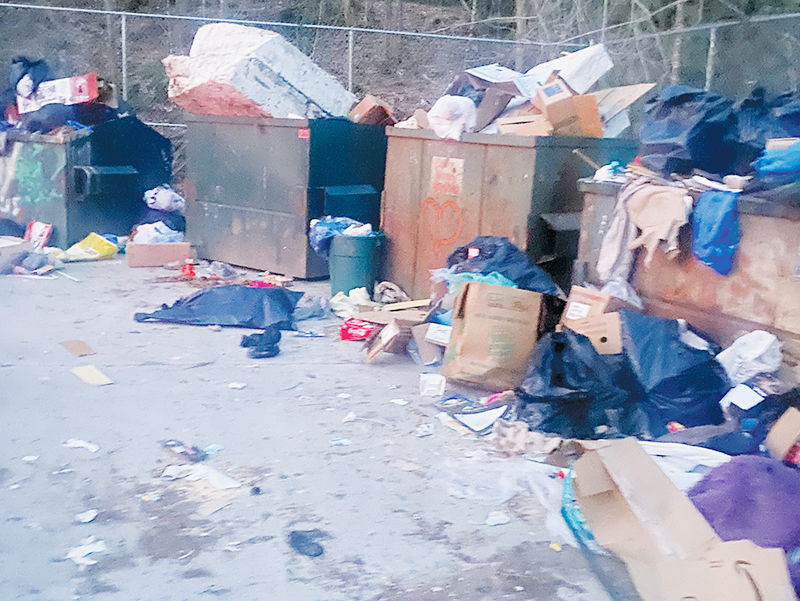
While paying a visit March 7, Lee Hill – the North Carolina Department of Environmental Quality’s Environmental Senior Specialist, Division of Waste Management – was alarmed by the conditions at several of the county’s unmanned sanitation sites.
The board of commissioners’ decision to close all but three of the county’s sanitation centers Jan. 1 proved controversial – as did the 180 the commissioners did on the matter just three weeks later, when public input led to an impromptu 4-1 vote, which re-opened the sites during the board’s Jan. 23 meeting.
Since then, the county has been scrambling to either draft new agreements or upgrade the sites it had just closed. The Jan. 1 closures did not come without a plan to leave three sites opened – and manned, which the county saw as a way to combat a long line of gross misuse and vandalism at the unmanned centers.
All the changes happened so quickly, that even Hill was not privy to the changes.
“It was my understanding that the unstaffed sites were closed, and that the county was moving to a staffed site model for residential disposal; however, when I came through the county yesterday, I learned that the unstaffed sites had been opened back up,” Hill told Graham County Clerk/Interim Manager Kim Crisp in a March 8 email.
Initially, local residents discussed acting as good stewards and keeping many the unmanned sites clean. But it seems the sites are already back to following the same pattern of abuse as before: large, hazards items that are to be taken to the county’s main center just outside the Robbinsville town limits – which comes with a weighted fee – have started showing up again at the convenience locations. In many cases, a combination of the large items and suspected trash being brought over from neighboring counties have led to dumpsters overflowing with trash.
The end conclusion? Trash is left on the ground.
Hill was alarmed.
“The state does not have specific regulations regarding whether the convenience sites should be staffed or unstaffed,” Hill’s email continued. “However, there are rules regarding the types of waste and how it is to be managed at convenience sites.”
Hill then cites portions of the state’s department of environmental quality’s administrative codes.
Under Code 15A is a list of guidelines that are to be followed. Of note, one portion reads:
“The following items shall not be accepted at collection centers for the purposes of disposal: construction, demolition, or industrial wastes from commercial or industrial sources; burning or smoldering waste; asbestos-containing materials, unless it is generated by an individual property owner and is packaged and handled to prevent the material from being friable; radioactive waste; hazardous waste; regulated medical waste; animal carcasses; liquid waste, unless it is in containers similar in size to containers found in household waste; and items banned from landfill disposal pursuant to G.S. 130A-309.10.”
“Convenience sites are for residential household garbage only and are not allowed to receive waste that is from non-residential activities or by commercial waste collection services. The rule explicitly states that convenience sites are for residential use and not for commercial use,” Hill continued. “How you prevent business waste from being disposed of at the convenience sites is up to the county, whether that is using signage, staffing sites, the choice is up to you. If the county wants to collect business waste at these sites, the county will have to apply for a transfer station permit and operate under the .400 rules, which is not feasible.”
Hill all but concluded his email with a sentence bolded to catch the reader’s eye: “Garbage piled out front of the dumpsters is unacceptable.”
The state can enforce sanctions against the county for failing to properly manage waste at the sites, Hill also noted.
In response to the email, Crisp told The Graham Star last week that plans were being discussed to man the Bear Creek sanitation center, which would limit its accessibility to normal operating hours and significantly reduce the amount of misuse at one of the county’s most abused locations. In addition to paying an employee to work the site, fencing around the perimeter will also have to be replaced by Asheville Fencing, at a cost of $11,000.
On a lighter note, the East Buffalo, Snowbird Main and Stecoah sites that are currently manned are reporting daily, immaculate appearances. The cleanliness is attributed to having someone on-site to help sort garbage and assure items are being disposed of properly.