
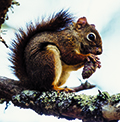
The red squirrel, or mountain “boomer,” is also known as the pine squirrel, as it mostly inhabits coniferous forests. Photo courtesy of Blue Ridge Discovery Center
While the false feud between young millennials and aging boomers continues, western North Carolina has another boomer debate: why do we call the tiny American red squirrels of the mountain “boomers?”
And do they really bite bits off of gray squirrels?
The Blue Ridge Discovery Center attributes the red squirrel’s nickname to its loud, “booming” voice, describing the boomer’s “barking vocalizations” as ranging from chirps to rattles, screeches to growls and even a buzz.
Hunters such as Nolan Stamper of Albemarle sometimes offer another theory.
“Maybe it’s because the last thing they see is me and my shotgun, so the last thing they hear is boom!,” Stamper argued.
But naturalists tend to agree with Kim Hainge of Graham County.
“I have heard that they are called boomers because they make an outrageously loud sound that echoes through the forest when they are alarmed,” said Hainge. “I have heard this call and it makes perfect sense to me.”
The boomer is not only one of noisiest critters in the woods, it might also be one of the quickest. Expert gardener and naturalist Lynn Hunt recounted the legend of the red squirrel’s speed.
“They can snag a pine cone from a tree branch and be waiting on the ground by the time it falls,” Hunt stated.
The boomer is loud, fast and according to mountain lore, furious. Known to be extremely territorial, the eight-ounce creature will defend its home from trespassers of any size, from gray squirrel to human. The tiny “scatter-hoarders” store their food in multiple spots, so boomers have reason to defend a large territory for such a small creature. Writing for Nature Journal, George Ellison even called the eight ounce rodents “tree warriors.”
One of the most common victims of the boomers’ wrath is the gray squirrel. The two species are often seen tussling over territory, with the red usually coming out on top.
More than one long-time resident of Graham County has relayed the tale of the red squirrel biting off certain parts of a gray squirrels’ anatomy, in an attempt to keep the grays from breeding and overrunning the boomer’s territory. Hunters swear that they have killed male grays that appear to have no reproductive organs.
However, Amy Renfranz is one of many biologists who refute these claims.
After mating season in fall, the reproductive organs of the male gray squirrels shrink in size until nearly undetectable, leading hunters to think that their prey has been surgically altered by the overly-territorial and aggressive pint-sized red-haired cousins.
So blame the boomers for the noise, but do not accuse them of mutilating their squirrel neighbors.