
Second in a series
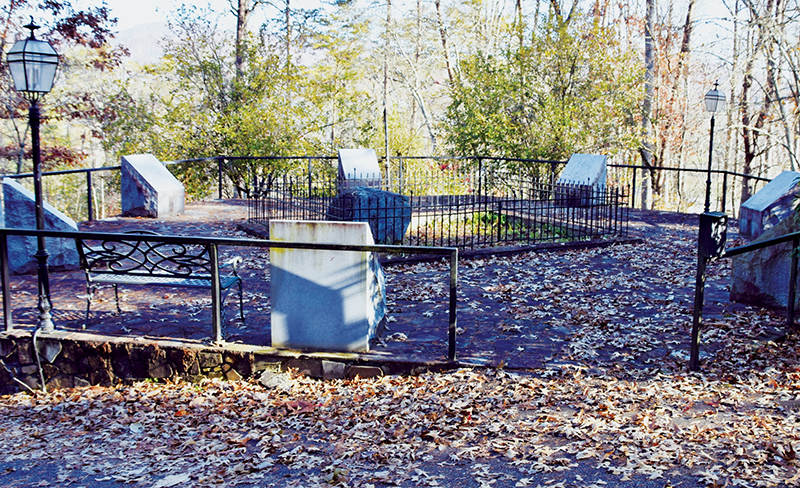
At the top of a hill in Robbinsville perches one of Graham County’s best-known landmarks: the grave of Junaluska, the Cheoah Valley’s most famous citizen.
The Cherokee warrior, farmer and leader lies alongside his third wife, Nicie, on the grounds of the Junaluska Memorial, Museum and Traditional Medicine Trail.
But this is one of the few aspects of the Junaluska’s life that is not subject to debate.
Historians cannot even agree on where the man was born. Though his birthplace was near the headwaters of the Little Tennessee River, it may have been in present-day Macon County or Rabun County, Ga. The year is also a matter of dispute, possibly because the man himself claimed no specific year of birth, only saying he was around 70 years old in the mid-19th century.
His name is complicated, as well. As a child, his parents, whose names are unknown, had a difficult time naming the child, eventually calling him Gul-ka-la-ski or “one falling from a standing position” after his cradle-board fell after being propped against a tree.
Hardly anything is known of the man’s adult life until 1811, when he declined the Shawnee chief Tecumseh’s offer to join in war against the advancing white settlers. Though he never held the title of chief, the man who would be known as Junaluska was considered a respected leader and spoke on behalf of the Cherokee during Chief Tecumseh’s visit.
By 1813, he was gathering Cherokee warriors to join braves from Georgia, Tennessee, and Alabama to fight alongside Andrew Jackson against the Creeks. In 1814, he vowed to kill every Creek in battle.
Though he fought the Creeks to an overwhelming victory, he did not reach his ultimate goal of extermination, so he re-named himself Tsu-na-la-hun-ski, or “one who tries, but fails.” That name gradually became corrupted by English-speakers, until he was popularly known as Junaluska.
The tales of Junaluska’s heroics at the Battle of Horseshoe Bend vary, though both Cherokee warriors and U.S. soldiers consider him to be instrumental in victory against the Creek. Junaluska was credited with saving Andrew Jackson from being killed at the hands of a Creek warrior, a decision he would regret once Jackson signed the 1830 Indian Removal Act.
Junaluska appears to have spent decades between Horseshoe Bend and the removal as a farmer in on his native soil. In 1838, U.S troops forced Junaluska and his family onto the Trail of Tears, along with thousands of other Cherokee. Junaluska led around 50 other deportees in an escape from the forced march, but were recaptured.
His second wife and two sons died along the route to present-day Oklahoma. Junaluska eventually walked the entire 1,000-mile trail back to the Cheoah Valley.
Junaluska spent the rest of his life at Cheoah with his third wife and their three children: Jimmy, Nalih, Secqueyuh.
Traditional accounts claim that Junaluska died on his way to the healing springs at Citico, Tenn. Various sources list his age as anywhere from 79 to more than 100 years.
Though the Junaluska Memorial and Traditional Medicine Trail are accessible year-round, the Junaluska Museum closed years ago after being destroyed by a falling tree. The grounds are owned by the Eastern Band of Cherokee Indians and maintained by the Friends of Junaluska.
The Junaluska Memorial and Traditional Medicine Trail is located at 1 Junaluska Drive in Robbinsville.