
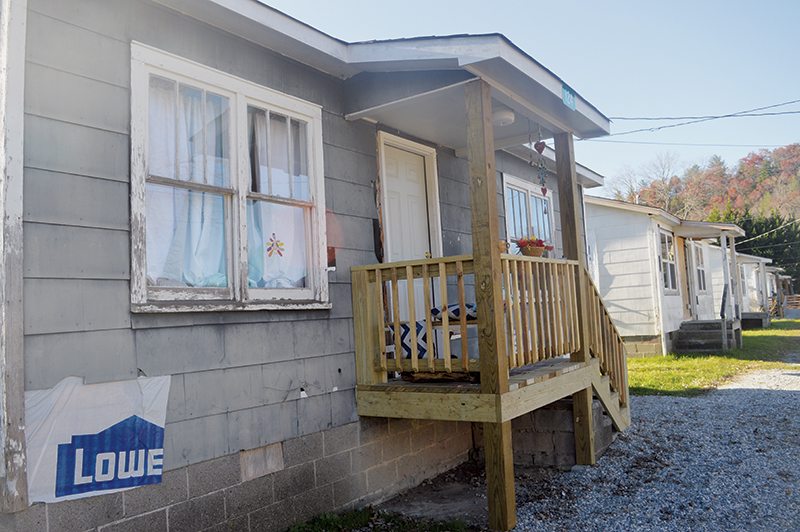
Robbinsville – A local woman and daughter are being threatened with eviction, as sparks fly between a local contractor and local U.S. Department of Housing and Urban Development (HUD) administrator Four Square Community Action.
David Hall, a contractor and maintenance worker with J&T Wood Properties, LLC, said Four Square Community Action Executive Director Kara Jones would not sign off on a Snider Circle home for the tenant, due to issues with the types of electrical outlets installed.
However, HUD regulations provided by Hall appear to allow the three-pronged outlets installed in the home.The main concern from HUD is the outlets not being grounded due to the older electrical system in the home, which was built in the 1940s.
“If you take a tester and plug it into (the outlet), it’ll show you an open ground because there’s no ground wire in this,” Hall said.
HUD regulations allow the ungrounded outlets in homes built prior to 1975, where three-pronged, ungrounded outlets have been installed to allow easier access to modern appliances built with a three-pronged plug, even without grounding being in place.
Prior to 1975, most homes were built with two-pronged outlets.
“However, in some cases, owners may replace two-printed, ungrounded outlets with the three-pronged, grounded type outlets without the necessary rewiring that adds a ground wire to the newly installed, grounded type outlets,” read a passage from the regulations.
Hall said the house would likely be fitted with the updated, grounded outlets at some point, but that it would require extensive rewiring of the entire home.
“The only way you can show a closed ground is with today’s wiring that has a ground wire in it,” Hall said. “Right now, we’re not tearing down all the sheetrock inside the house.
“In a lot of them, they are. This just happens to be the one that’s not.”
He said the owner was not required to install the three-pronged outlets in the home, but chose to do so to make life easier for the tenant.
“Me, the owners, the electrician, the inspector, we don’t understand what part of this they’re not getting,” Hall said.
Other issues HUD brought up with the dwelling including siding replacement, rails on porches and painting are being reconciled. Hall said he had worked on several HUD homes and had never had a problem.
However, he said with Jones’ arrival, the outlets had been an issue on more than one occasion.
“This is the first time that it’s ever been an issue,” Hall said. “We’ve done the same thing before.”
Hall said he was upset due to the relative simplicity of the issue and the risk of homelessness it placed on the tenant.
“Their paperwork says they’re not able to fail it,” Hall said. “They’re the one that said the owner can do this without making the necessary changes. We don’t understand, and they’re going to make the girl and her little child homeless if they fail it, because she doesn’t have anywhere else to go. She was living in a camper trailer with her child.”
The tenant has been in the home for approximately a month, with the inspection occurring on Oct. 28.
Hall also said he believed that the ungrounded, three-pronged outlets were safer than the two-pronged outlets Jones would require to be reinstalled, pointing to the relatively weak three-prong adapters that would be required for most appliances and other devices.
“That could cause it to overheat,” Hall said.
He also said that as the home was currently wired, he believed the circuit breaker would be thrown if anything serious went wrong in the house’s electrical system.
“It’s nothing personal to me,” Hall said. “I just can’t understand if they’re supposed to be helping the people in the county why you want to fail something when the paperwork says it should pass.”
However, Four Square Community Action CARES Act Coordinator Danielle Tipton – who staffs the agency’s Robbinsville office – said the issue could be resolved by the installation of a ground-fault circuit interrupter (GFCI) somewhere in the circuit.
She also said the Robbinsville office was familiar with the issue, with Hall coming by to voice his concerns on more than one occasion.
“Yes he did install the three-pronged, grounded outlets without grounding them,” Tipton said. “He did not, however, put in the GFCI protectors.
“With HUD, you have to have the protected GFCI in the house basically for safety reasons.”
Tipton said the office had tried to explain the issue to Hall, but that he seemed not to understand. She also said Four Square had addressed the issue with the state HUD office.
She said while she believed the GFCI to be the best option, the house could be returned to two-pronged outlets.
“What we’ve explained to this gentleman several times is that it’s not necessary for him to go in and replace every single outlet with a GFCI,” Tipton said. “If you put a GFCI on one wall, then it will protect that whole wall, but he’s not quite understanding that.”
An additional option would be a GFCI breaker installed in the breaker box, which would protect everything on the circuit.
“We get that it could be costly to rewire a house, but we’re not asking him to rewire the whole house,” Tipton said. “The way I see it, there are about three options.You can go back to the two-prong, you can put in the GFCI or you can rewire the whole house.”
She also spoke to a second contractor dealing with similar issues, as Hall had referenced.
“We had another handyman come in here and ask the same questions,” Tipton said. “We pulled out the same policy and said, ‘this is what it says,’ and thy seemed to understand. They went in and changed it.”