
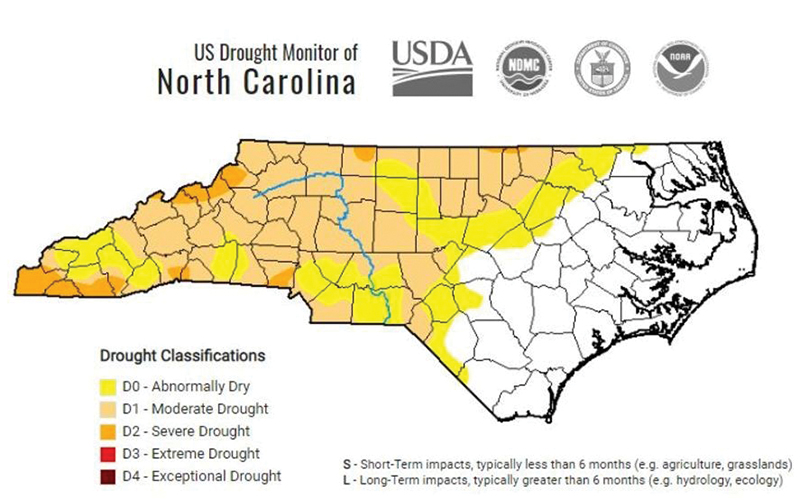
As every farmer and gardener is well aware, western North Carolina has been in drought or near-drought conditions for some time.
Severe heat coupled with a lack of rain has thrown much of the region into dangerously dry conditions, the likes of which have not been seen in two years.
“September was ranked as one of the top five hottest on record for much of our state,” said Rebecca Cumbie-Ward, state climatologist with the N.C. State Climatology Office.
While the U.S. Drought Monitor of N.C. currently lists most of Graham County as only abnormally dry, areas of the county are officially in a state of moderate to severe drought, with bordering counties of Clay, Macon and Cherokee experiencing drought conditions as well.
Of our state’s 100 counties, 48 are in drought, with 12 more considered abnormally dry. There are 6.73 million North Carolinians are living in drought conditions, with 1.396 million in abnormally dry conditions.
This means that 71 percent of North Carolina’s residents are experiencing a dangerously dry environment.
These drought and abnormally dry conditions have primed our area for a potentially dangerous wildfire season, which typically runs from mid-October until mid-December.
“We will not forget the 2016 fall wildfire season that burned more than 59,511 acres across North Carolina,” said Agriculture Commissioner Steve Troxler. “As we head into this fall fire season facing similarly dry weather conditions, let’s remember that each of us can do our part to avoid and prevent wildfires.”
According to the N.C. Forest Service, the leading cause of wildfires in North Carolina is burning debris. The service “encourages residents to contact their local county forest ranger before burning debris. The ranger can offer technical advice and explain the best options to help ensure the safety of people, property and the forest.”
Safety tips
The service asks residents to consider alternatives to burning. For example, leaves, grass and stubble make excellent mulch. For those who do choose to burn, check local burning laws, which vary from community to community, then obtain a valid permit from any forest service office or authorized permitting agent.
The NCFS also offers the following tips:
* Keep an eye on the weather and avoid burning on hot, dry days.
* When burning debris, avoid pilling vegetation on the ground. Place it in a cleared area and contain it in a receptacle far from overhead wires and branches.
* Household trash must be disposed of at trash stations or recycling stations. The law forbids burning of household trash.
* Prepare before you burn. Be sure to have a hose, bucket, steel rake, shovel, and phone nearby.
* Never use accelerants such as kerosene, gasoline, diesel fuel, or any other flammable liquid.
* Stay with the fire until it has been completely extinguished.
* When burning agricultural residue and forestland litter, plow a fire line around the area to be burned and separate large fields into smaller plots to be burned individually. Before burning in a wooded area, contact your county ranger for guidance.
Campfires are another danger during fire season, and the N.C. Forest Service also has guidelines for safely extinguishing campfires:
* Ideally, allow the wood to burn completely to ash.
* Pour lots of water on the fire and drown all embers, not just the ones still glowing.
* Pour until the hissing stops.
* Stir ashes and embers with a shovel.
* Stir and make sure everything is wet and embers are cold to the touch.
* If water is unavailable, use dirt or sand, mixing it with the embers.
* Continue adding and stirring until all material is cool.
* Do not bury a fire, as it may smolder and catch underground roots on fire, which can eventually start a wildfire.
Designing a safe zone around a home is also a wise tactic during fire season. The National Fire Protection Association offers the following guidelines:
* clean gutters.
* move leaves and flammable debris at least five feet from home’s perimeter.
* trim grass shorter than four inches.
* move firewood, fuel, and portable propane tanks at least 30 feet away from home.
* thin understory of trees and shrubs and prune larger trees to a minimum 30-foot perimeter around home; a 100-foot perimeter is ideal.
With conditions likely to get worse before they get better, all residents are advised to take appropriate precautions until dry and drought conditions have abated.
For details, call Graham County Fire Ranger Frank Cline at 479-6341 or visit ncforestservice.gov/contacts.
For information on obtaining burn permits, visit ncforestservice.gov/burnpermit.