
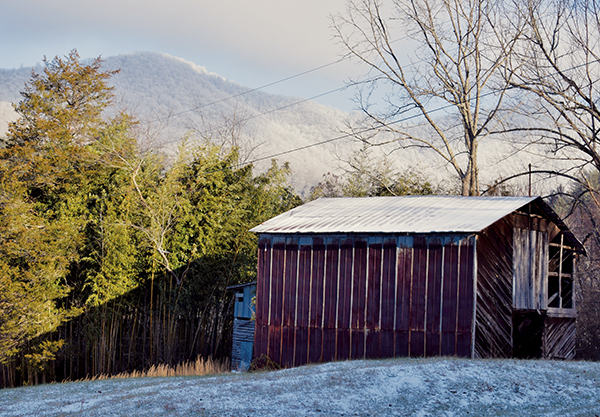
Half a million tobacco barns once sat in North Carolina fields.
In recent decades, many states have actively discouraged tobacco production, while industrialized farming methods rendered tobacco barns largely irrelevant to the modern farm. The combined forces of government and modernization have left only 50,000 tobacco barns standing on North Carolina soil.
Our State’s Susan Stafford Kelly described the remaining tobacco barns as “deteriorating reminders of the leaves’ influence on our culture.” Though the architecture of tobacco barns has regional variations, the commonalities include gabled roofs, frame construction and some type of ventilation.
Prior to World War II, most barns were built of materials harvested on-site, but as crop yields increased, bigger barns were constructed of more modern materials. While earlier barns typically stood 20x20 and were built of hewn logs and mortar, later incarnations boasted sawn timber possibly reinforced with tin or asphalt shingles.
“Whatever the dollar would buy to get the job done,” said Bill Monk, an 86-year-old retired from his family’s Farmville, N.C., tobacco business. “Here in North Carolina, most tobacco barns were far and away for flue-cured tobacco.”
This process involved a pine-fed furnace located outside the barn, with a system of ductwork and shutters conducting indirect heat throughout the structure.
“Curing is a science and an art,” said Monk. “A good tobacco farmer would learn all the tricks to produce the finest tobacco.”
Curing was a three-step process, with temperatures rising over the course of six days. Curing took place during the hottest part of the summer, so fire was an imminent danger. This explains why tobacco barns tend to stand alone, far from other farm buildings.
Eldred E. Prince, Jr. of the South Carolina Encyclopedia explained how the move to mechanized farming in the 1960s replaced the traditional tobacco barns with all-metal bulk barns. By the 1990s, nearly the entire tobacco crop would be bulk-cured in such modern structures. Many farms had multiple old-style tobacco barns, so rather than take the buildings down, they were either used for storage or left to rot, or, in many cases, both. As Monk said, the traditional barns were “essentially flimsy structures, with little insulation,” so there was little incentive to repurpose the buildings.
Rather than leaving them to the elements, some owners choose to salvage and sell the lumber. The practice has become common enough that entire businesses have sprung up to salvage and re-purpose old barn wood.
In Graham County, some surviving tobacco barns have become a part of the tourism industry that is slated to take agriculture’s place. A decade ago, the Barn Quilts of Graham County project – funded by Graham County Travel and Tourism and managed by Eve Rogers of the N.C. Cooperative Extension – hung painted wooden quilt patterns on the barns of participating owners, making the county part of the Appalachian Barn Quilt Trail.
In 2010, Rogers told The Graham Star that “the idea behind the quilt blocks is to promote tourism within the county. The longer we keep people in the county, the more likely they will be to shop, eat and spend the night.”
Robbed of their original purpose, perhaps the old tobacco barns can serve one final function: luring tourists to once-thriving agricultural sites.