
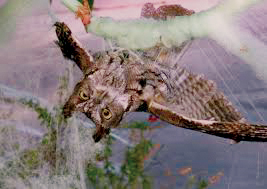
Even creatures as large as owls can become entangled in Halloween spiderwebs. This trapped screech owl was rescued by a Humane Society officer.
With both Halloween decor season and fall migration upon us, unlucky birds are becoming hopelessly entangled in Halloween spiderweb decorations.
Several wildlife and conservation organizations have issued warnings to consumers: fans of seasonal decor are advised to keep the decorative spiderwebs indoors.
This is the time of year that rehabilitators receive numerous animals caught in these decorations, from songbirds to chipmunks and everything in between,” said Kathryn Dudeck of the Chattahoochee Nature Center in Georgia. “This is obviously not a new issue, but one that I rarely see addressed.”
Rescuers have found birds as small as hummingbirds and as large as hawks and owls trapped in the plastic webs. The problem is not just regional or even nationwide, but spans the continent from Canada to Mexico.
All along the seasonal migration route, fake spiderwebs tangle with migrating birds.
“It’s hard for birds to see something as fine as that spider web,” said Chantal Therijn of Hobbitstee Wildlife Refuge in Ontario, Canada.
The fake webs are “made of acrylic,” according to animal rescuer Alison Hermance
of Wildcare in Marin County, California. “It’s strong and it’s very easy for animals to get tangled in that.”
Fake spiderwebs work much in the same way as real webs; the more an animal struggles, the more trapped it becomes. Without human intervention, the trapped animal may die of starvation, dehydration, or suffocation.
Of course, a trapped creature is also a sitting target for predatory animals. Though birds are particularly vulnerable to the webs, beneficial insects such as bees can also get caught in the stretchy, spooky decor. Snakes, bats, squirrels, and lizards have been rescued from the webs, but any relatively small animal that flies or crawls could potentially become trapped in the material.
The solution is simple: enjoy Halloween spiderweb decorations, just relegate them to the indoors and properly store or dispose of the plastic webbing at season’s end.