
The holiday treat that inspires the most passionate reaction may just be the much-maligned fruitcake.
Even though many consider the fruitcake to be a remnant of holidays past – with thousands of bakeries still producing the cakes each year and millions of home bakers creating their own – the contentious confection continues to foment discord at holiday feasts.
Most younger people tend to agree with Delish Magazine’s recommendation for serving fruitcake.
“Throw it in the trash,” wrote food writer Rheanna O’Neil Bellamo. “You get all the sugar, fat, and calories of cake but none of the ‘that was so worth it!’ amazing taste.”
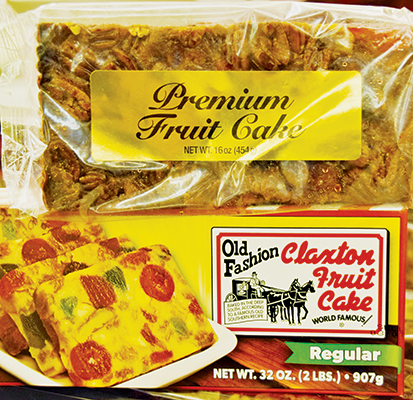
With an estimated 1/3 of the commercial version never even taken out of the box, both lovers and haters of fruitcake seem to agree that the mass-produced version is the lowest form of the confection.
“Mass-produced fruitcakes, the kind that most people are exposed to during the holidays, are nothing like what a fruitcake should be,” said Virginia Glass, pastry chef and amateur fruitcake historian.
Cookbook author Susan G. Purdy agreed.
“Fruitcake can be just as wonderful as its ingredients,” Purdy said.
Following a fruitcake recipe at home is both a laborious, time-consuming and expensive process deserving of respect, but the cheap, store-bought version has earned the ire of comedians for decades.
“Fruitcake is just a taste that fell out of habit and became really a dessert associated with the old and out of touch,” said NYU Professor of Food Studies Amy Bentley. “As a result, fruitcake ended up a punchline for jokes around Christmas time.”
Perhaps the most famous fruitcake-hater was Johnny Carson, who began ragging on the dessert in the 1960s.
“The worst Christmas gift is a fruitcake,” Carson said on The Tonight Show. “There is only one fruitcake in the entire world and people keep sending it to each other, year after year.”
Year after year, Carson continued to skewer the fruitcake during his holiday broadcasts, cementing the confection in the common consciousness as an anachronism only useful as a comedy foil.
Nearly 60 years later, comedian Jim Gaffigan continued the tradition.
“I think the most disappointing cake would have to be the fruitcake,” Gaffigan said. “You’d think they’d be better. Fruit: good. Cake: great. Fruitcake: nasty.”
While “nasty” might be a common reaction to the taste of fruitcake, incidents of actual rancidity are much more rare. The high moisture content – usually alcohol-based – prevents rot up to a point, but mold could still populate the surface of a fruitcake and the sugars in the ingredients could cause the cake to ferment.
N.C. State Food Safety Researcher Ben Chapman explained that “fruitcakes are extremely shelf-stable, so they would be safe to eat for a long time; a really long time. But it might taste pretty bad.”
While the longevity of fruitcake might not appeal to modern audiences, the original recipes were the equivalent of ancient MREs (meals ready to eat). Created as rations for soldiers and travelers, the fruitcakes of ancient Rome were wrapped in alcohol-soaked fabric to keep them fresh as they rode for weeks or months in a saddle-bag or trunk.
Explorers have also packed fruitcake for hundreds of years, with Antarctic explorers having been particularly fond of the brick-like treats.
According to the Antarctic Heritage Trust’s Lizzie Meek, “Living and working in Antarctica tends to lead to a craving for high-fat, high-sugar food, and fruitcake fits the bill nicely.”
In fact, just two years ago, researchers discovered a 100-year-old fruitcake in an explorer’s hut. Described as “in excellent condition,” the antique cake “smells and looks almost edible.” To date, no one has actually tested that theory.
By the time that Antarctic fruitcake left its baking tin in the early 1900s, the popularity of fruitcake had long ago spread throughout Europe, with versions developing in Poland, Bulgaria, and Portugal, and cultures across the globe concocting their own fruitcakes, from black cake in the Caribbean to banh bo mut in Vietnam.
As fruitcake took over the globe, it moved from the soldier’s ration kit to the center of the wedding feast. Hard as it may be for modern tastes to accept, Victorians considered a towering fruitcake to be the most-coveted wedding cake.
The Victorians also developed the tradition of saving the top layer of the wedding cake for an entire year, presumably to eat in celebration of the birth of the couple’s first child. Of course, considering that the layer in question was fruitcake, the memento might well have lasted not only until the first child’s birth, but perhaps for the duration of the marriage.