
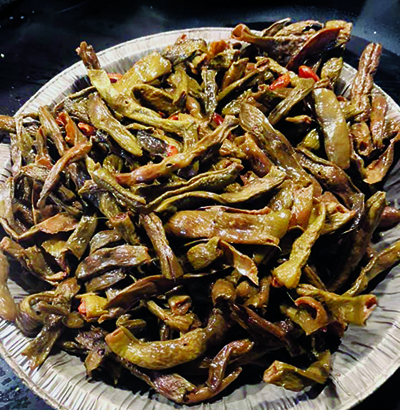
What in the world are leather britches, you ask?
“Leather britches? That’s a mountain cuisine,” said Renee Teesatuskie of Cherokee. “I just remember eating them at elders’ homes. The process of curing them is being lost. Everyone I know would love to have a mess of them.”
Rick Davis of Graham County remembers “stringing the green beans with a needle and thread and hanging them on the porch to dry. I never developed a taste for them, but my momma liked them.”
For the uninitiated, leather britches are neither leather – nor britches – but dried, late-summer green beans, often the very last beans on the vine. Leather britches are made from the heirloom variety of string beans known as greasy beans for the appearance of their smooth, shiny pods.
Reconstituted and cooked with bacon, fatback, or ham hocks, the beans are described by some as having a deep, meaty flavor and by others as basically tasting of dried-out green beans.
Food writer Jenny Everett praises the dish as “the ultimate way to preserve a late-summer string bean haul.”
Drying was the first known method of preserving food and folklore attributes the origins of dried green beans to the Native tribes of the southeast. When the food became known as “leather britches” is unknown, but the tan hue and tough, albeit smooth texture of the dried pods could – with some imagination – be compared to cowhide pants.
“It’s an incredible piece of history from a time when people thought, ‘How do we make it through the winter with what we’ve got?,’” pointed out food historian Katie Button.
“They were considered a poor man’s meal at the time,” said Dean Williams of Andrews, whose wife, Ann Williams, remembers her grandmother stringing up the beans to dry. “We both loved that they were welcomed into the $75 New Year’s Eve meal.”
The meal in question belonged to Fontana Village Resort’s buffet, where the “poor man’s meal” was found amongst the Oysters Rockefeller, lobster ravioli and trout caviar, perhaps indicating a comeback for the traditional dish that otherwise seems near extinction.