
A first-hand account on how to make moccasins
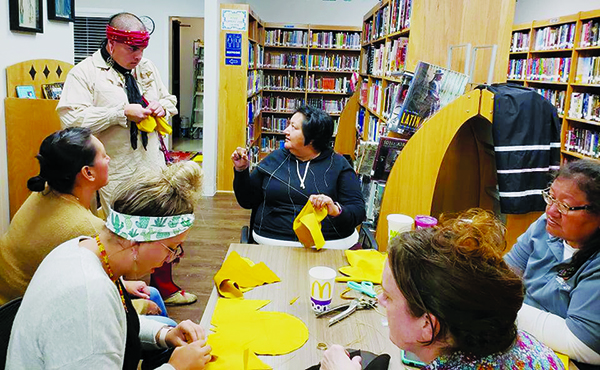
Snowbird – When someone dropped out of the recent moccasin class at Snowbird Community Library, I pounced on the spot, in spite of the fact that I cannot sew, do not craft and have no patience with the tedium that comes with making pretty things by hand.
I wanted to make moccasins because I knew I would be horrible at moccasin-making.
I wanted to make moccasins because the failure would keep me humble.
And I wanted my very own pair of handmade moccasins, no matter how bad I proved to be at sewing shoes – which I assumed would be pretty bad – especially since the eye that nearly went blind months ago is still mostly useless at close-range.
So, a white lady with no sewing skills and only one good eye was going up to Snowbird to learn to make moccasins.
This was going to be great.
The instructor for the first class was Michael Crowe, who arrived a bit late. This made perfect sense, considering that he looked like he stepped out of a time machine. He was head-to-toe in traditional clothing, including leggings and of course, a very fine pair of handmade moccasins.
For the rest of the evening, we made patterns, cut leather and sewed by hand.
The needle was thick. The leather was thick. I managed to stab myself with nearly every stitch.
“Don’t worry,” said one of my neighbors. “We got you. None of us know what we’re doing, but we’ll get it done together.”
I already suspected that if I had to rely on myself to make my own footwear, I would spend the rest of my life barefoot.
At some point while stitching my first moccasin, I quit wiping away the blood. It was that orange-red capillary blood that looks too bright to be real. Luckily, I was wearing red pants. When the blood started making my fingers slippery, I wiped my hand on my britches and kept sewing.
“Aren’t you the one at the paper who found out you have Cherokee blood?” asked one of the women at the table.
I managed to stop myself from listing all the Native ancestors in my pedigree: Cherokee, Monacan, Cheraw, Pamunkey and Chickamauga Cherokee.
“A little bit,” I said. “Way back.”
“Well, don’t feel bad,” she said. “You know, not all Cherokee women sewed. They worked in the garden, built their own houses. How much Cherokee you got in you? A 16th? A 32nd?”
“I’m not sure,” I said. “I never was good at math.”
“Did you get a DNA test?”
“Can’t afford one,” I said.
“Ha! That sounds pretty Native to me. Well, however much Native blood you got in you, I think you just bled it out all over the table.”
Someone found Band-Aids. I taped up and kept sewing. By the third hour, everyone’s volume went up as we got more tired and more frustrated.
I think my moccasins are mostly held together by blood. If I ever decide to get married, these mocs will be my wedding shoes. Too much time and blood went into them to be mere footwear.
The instructor for the next two classes, Evan Mathias, brought out sewing machines, which not a one of us knew how to use.
At least twice over the course of three classes, out of a combination of frustration and theatricality, I slammed my moccasins into the garbage can.
Each time, before I could fish them out, somebody else grabbed them and began helping me. Without being asked. For that matter, without permission. It took me a while to realize – and to accept – that the people around me simply wound not allow me to fail.
Once we got to the sewing-machine part, my incompetence was fueled by electricity.
I could make more mistakes, faster.
I sewed my shoes closed.
I sewed my shoes together.
I sewed the flaps to the shoes themselves.
I goofed in every way possible, short of sewing my fingers together or stabbing myself in my good eye.
Each time I thought I had made a catastrophic mistake – that all was lost – hands appeared. My moccasins were taken away from me, and I watched as other people worked together to fix my mistakes. There was no discussion. It just happened. Every time.
“You heard of gadugi?”
I shook my head.
“It means working together. Helping each other. Getting something done as a community.”
I live alone. My family died a long time ago. Necessity has taught me to be more independent than anyone would ever want to be. I am not good at asking for help. I am worse at accepting it. But I am learning.
So far, it has taken seven of us at least 16 hours to build my moccasins. The shoes are still not finished. There is one more class to go.
We will return. We will get it done.
Together.