
With the first snow of the season now in the rear-view mirror, the question of the coming winter’s severity has crossed the minds of many a mountain-dweller.
Fortunately, there is no shortage of forecasts, ranging from those based on science to those focused on tradition and folklore.
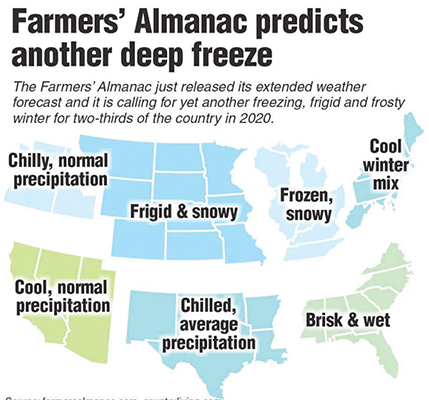
The Farmers’ Almanac’s extended forecast paints a snowy picture.
“Freezing, frigid, frosty,” said the Almanac, which predicts a wet winter followed by a late spring.
Readers of last year’s almanac considered the predictions for 2018-19 to be accurate and a study of past decades’ predictions found the forecasts to be 80 percent correct.
This year’s prediction warns of “another wild ride” with “hefty snowfalls” during a “particularly brutal season” of colder than normal temperatures and above-normal precipitation. A “wintry-mix” of rain, sleet and snow should be common, with January ranking as the coldest month.
With the Almanac known as a fairly reliable source, folklore also gives the powers of prognostication to a number of natural phenomena, including the design of persimmon seeds. The shape of the pattern inside the seed predicts the coming winter’s severity, with a spoon shape indicating mild weather, a fork shape predicting an abundance of snow and a knife shape warning of a bitingly cold season. This year’s persimmon crop calls for a mild start to winter, before the cold swoops down quick and hard.
Those who keep livestock can also study their animals’ coats to estimate the coming cold, with thick hair on the nape of a cow’s neck and the long winter coat of a horse predicting fiercely cold temperatures.
If mice are chewing their way into the house while spiders creep indoors in large numbers, folk wisdom dictates that the creatures are trying to escape the coming brutal cold.
For those who study the colored bands on wooly worms, the prediction includes four weeks of severe winter weather and nine of fair skies, while hornet experts claim that the insects built their nests particularly high this year to keep their homes clear of rising snowdrifts.
Meanwhile, scientists at the National Oceanic and Atmospheric Administration predict a milder-than-average winter for the southeast, but with possible large swings in temperature and precipitation.
With severe swings in weather being the only common factor among these many forecasts, whether you listen to the meteorologists or study animal behavior, get ready for a wild winter ride.