
Third in a series
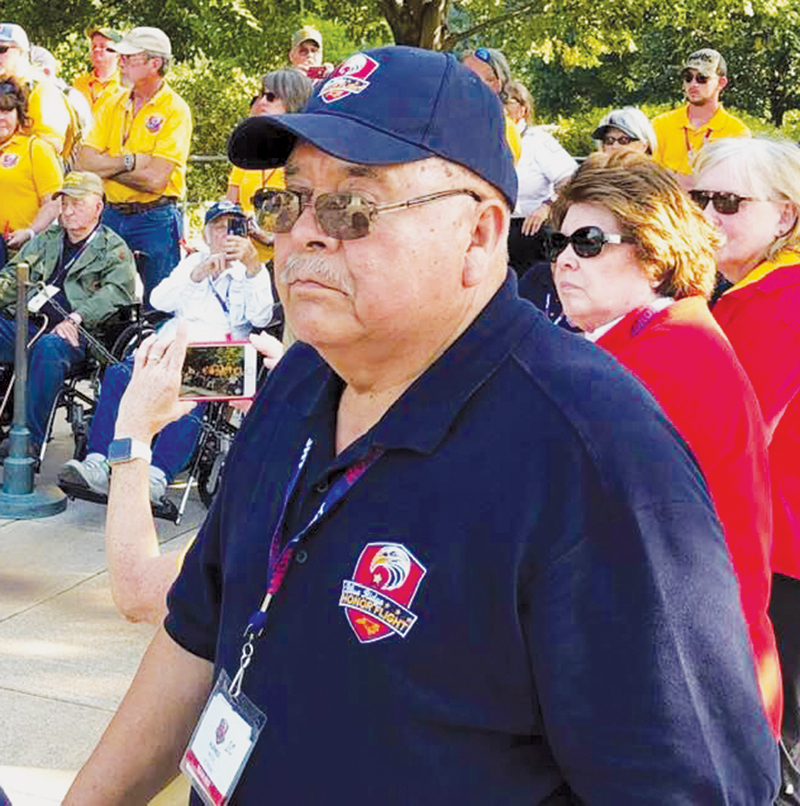
Army Veteran Alfred Welch paid tribute to fellow veterans at Arlington National Cemetery during a special September ceremony. Photo courtesy of Richard Sneed
Native Americans volunteer for service in the U.S. Armed Forces at a rate three times higher than non-Natives.
While Native Americans have fought for the United States in every major conflict – including the Revolutionary War – all five branches of the military saw a post-9/11 surge in enlistment among Native Americans, with nearly 20 percent Native American adults now having served in the U.S. Armed Forces.
The legendary Navajo code talkers of WWII are an example of how Native American service has been both lionized and minimized. While the 29 Navajo code talkers are well-known, fewer recognize that Cherokee and Choctaw service members pioneered the practice in World War I, with code-talkers representing a total of 14 tribes.
The Native American tradition of service spans all 573 federally recognized tribes, including the Eastern Band of Cherokee Indians. Among the band’s veterans are Principal Chief Richard Sneed and his wife Trina – who both served in the Marine Corps – and Tribal Council Chairman Adam Wachacha, who served 13 years in the Army.
Of course, every person who chooses to enlist does so for his or her own reasons, including a steady paycheck, access to training and education and an opportunity to travel.
But many Native American service members cite another reason: the warrior tradition. The warrior tradition is not just about fighting, but protecting home, family, and a way of life.
Native American communities also tend to share an elevated respect for military service – especially combat service – that is sometimes lacking in the non-Native population. That respect can also fuel a higher rate of enlistment.
As World War II Navajo veteran Peter MacDonald said, “A lot of people ask, ‘Why did you join the white man’s war? They weren’t nice to you. Well, that may be so. Still, this is our land.’”
While the federal government is known for breaking treaties with Native Americans, the treaties of the 1800s required an oath of allegiance to the U.S., including a promise to fight for the country. Especially among older tribal members, military service can be viewed as living up to the promises sworn in such treaties.
Long after the last treaties were signed, World War I brought new life to the warrior tradition, with 90 percent of Native American soldiers volunteering rather than being drafted. These warriors volunteered to serve a country that had not even deigned to give them U.S. citizenship. Citizenship finally came in 1924 – five years after the end of the war – but many Native Americans did not have full voting rights until the Voting Rights Act of 1965.
In spite of being denied basic rights of citizenship, Native Americans volunteered for service for every conflict of the 20th century at rates at least four percent higher than the general population.
In September, tribal members joined government officials and staff from the Smithsonian’s National Museum of the American Indian to break ground on the National Native American Veterans Memorial. The “Warriors Circle of Honor” – designed by Cheyenne and Arapaho artist Harvey Pratt – will be unveiled in November, 2020.
Museum Director Kevin Gover, a member of the Pawnee tribe of Oklahoma, said of Native American service members and veterans: “They are perfectly aware that they are serving a country that had not kept its commitments to Indians, and yet they chose – and are still choosing – to serve. This reflects a very deep kind of patriotism.
“I can think of no finer example of service to the United States and the promise it holds.”