
This Christmas Eve, children will leave one billion cookies for Santa.
Assuming that he restrains himself to the point of taking just one bite from each offering, Santa will still have to eat the equivalent of at least 300 million cookies as he travels the globe delivering presents. While the tradition of leaving cookies for Santa dates back to the Great Depression, the Christmas cookie itself has a history dating back to the first Europeans, who settled what would become America.
The cookie itself has humble origins. Before ovens had thermostats, bakers would pop a few dollops of cake batter into the oven to test for correct baking temperature. The migration pattern of the ancient cookie follows that of the fruitcake, with cookies making their way from Egypt to ancient Rome and on to Western Europe.
By the time Queen Elizabeth reigned over England, cookies were common fare, but she elevated the gingerbread cookie by inventing the gingerbread man. The sovereign instructed her palace bakers to create gingerbread cookies to resemble visitors to her court. Her courtiers appreciated seeing their likenesses rendered in sweet dough and the tradition of cookie customization began.
The tradition of the American Christmas cookie dates back to the early 1600s, when Dutch immigrants shared the holiday treats. Becky Krystal of The Washington Post described the early version of Christmas cookies as “leaner, crisper, smaller, and less sweet that what we think of today.”
In American Cookery, published in 1796 and widely considered the first American cookbook, Amelia Simmons included a recipe for Another Christmas Cookey. The rather Spartan recipe called for flour, fine powdered coriander seed, butter, sugar, and pearl ash.
“Tho’ hard and dry at first...they will be finer, softer and better when six months old,” Simmons warned.
Though not appealing to our modern tastes, Simmons’ “cookey” recipe hinted at one of the main appeals of the genre: cookies keep.
As Martha Stewart pointed out, “You can’t keep a pie on hand in case visitors drop by, and cakes tend to dry out, but cookies are built to last.”
Easily customizable, portable and durable, by the 1800s, Christmas cookies were a staple of the holiday season, with the production of cookie cutters in 1869 causing a surge in popularity.
The most popular cookies today include Spritz cookies from Scandinavia, which are basic butter cookies but made with a cookie press; plain sugar cookies inherited from the German Protestant settlers of Pennsylvania; Linzer cookies of almond dough and sweet jelly filling from Austria; and the humble shortbread cookie from Scotland.
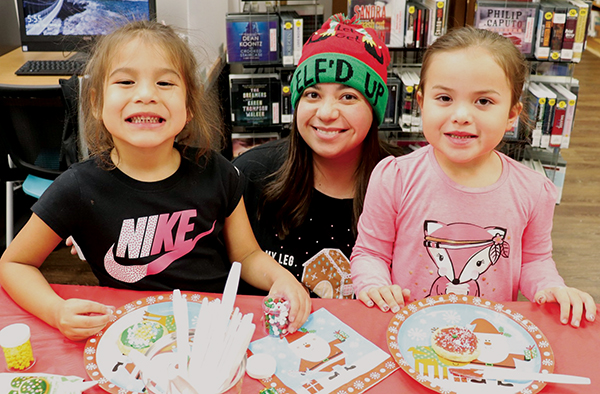
Cookies even have their own holiday now, with National Cookie Exchange Day on Dec. 4 happening in plenty of time for the holidays. Just this year Robbinsville had its inaugural Cookie Crawl Dec. 7, and the Snowbird Community Library threw a Cookie and Ornament Decorating Party Dec 10, which saw sugar cookie enthusiasts of all ages customizing their Christmas treats.
“We had such a fun time tonight watching the little ones decorate cookies, especially when the grown ups took over and started making their own as well,” said library manager Zena Rattler.
While the Christmas traditions of Apple Stack Cake might be on the wane and the much-maligned fruitcake is always a topic of debate, the Christmas cookie seems to only grow more popular, with cookie exchange parties becoming more common and cookie production – both at home and at commercial bakeries – counting into the tens of billions each season.
“They are inexpensive, easy to make, fun to decorate, and there are so many varieties, every taste is satisfied,” said Krystal. “With cookies in the oven, you know it’s Christmas.”