
Over 3.5 million Americans are infected with Hepatitis C.
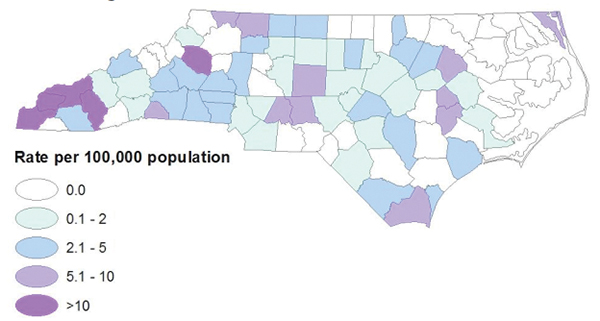
Of those affected, more than half of those are unaware of their infection. From 2011 to 2016, Graham County’s Hepatitis C infection rate tripled.
In the following two years, the incidence rate in increased from 117-per-100,000 in 2016 to 468-per-100,000 in 2017.
Last year, the Center for Disease Control declared an epidemic outbreak of Hepatitis C.
The virus
Hepatitis C is a blood-borne virus that infects the liver and is most commonly spread by the sharing of IV drug needles and other injection equipment. Though some may fight off the infection, 70-85 percent of those infected develop long-term, chronic infections.
The virus can be deadly. Hepatitis C often results in sclerosis of the liver and is the most common reason for liver transplant, an operation with an average cost of $577,000. Though Hepatitis C can be cured by anti-viral treatments if diagnosed early, the medications are notoriously expensive, with costs of up to $1,000 per dose.
With no vaccine available for Hepatitis C, the most effective way to avoid the disease is to avoid what is by far the most common transmission route: IV drug use.
With 1-in-5 Graham County adults surveyed admitting to IV drug use within the past year, the cause of transmission is clear. However, the reasons behind the epidemic are much more complex.
The N.C. Division of Public Health’s 2016 report on Hepatitis C in Western North Carolina identified the root causes of IV drug use. Poverty was a major predictor of IV drug use, with the lack of educational opportunities, affordable housing and living wage job opportunities that accompany poverty all factoring into the equation.
Over-prescribing of opioids – as well as residual childhood trauma – can trigger drug use, and the public perception of drug addiction and Hepatitis C infection tend to inhibit testing and treatment.
Graham County does have many assets – including a local health department and a free clinic – but other resources, such as methadone clinics and needle exchanges, are non-existent.
While both methadone/suboxone and needle-exchange programs are criticized as enabling addition, both are CDC-endorsed methods of treatment and harm reduction. Methadone and suboxone clinics offer prescription doses of drugs, which replace street-level opiates.
Curbing the issue
While needle-exchange programs have been legal in North Carolina since 2016, there are none convenient to Graham County. Many people recoil from the idea of giving addicts clean needles, but as one anonymous local IV drug user said, “Nobody ever decided to start shooting up because somebody gave them a clean needle, and nobody’s gonna quit shooting up because all they have is a dirty one.” Needle exchange programs also safely dispose of dirty, possibly infected needles, which might otherwise pose a public health threat. In the three years since needle-exchange programs became legal in North Carolina, the number of clean needles distributed has risen from 1.15 million to 3.3 million and the number of participants has doubled. Needle-exchange programs also offer users information about recovery as well as the importance of getting screened for diseases such as Hepatitis C.
If the CDC has one message for the public regarding Hepatitis C, it is “get tested.”
“Hepatitis C is a deadly, common, and often invisible result of America’s opioid crisis,” said Dr, Jonathan Mermin of the CDC. “By testing people who inject drugs for hepatitis C infection, treating those who test positive, and preventing new transmission, we can mitigate some of the effects of the nation’s devastating opioid crisis and save lives.
Dr. John Ward, director of CDC’s Division of Viral Hepatitis, is optimistic, even as the rates of infection spiral upward.
“We have the incredible opportunity to stop new infections and prevent people from dying of hepatitis C. With the right treatment and prevention efforts, we can eliminate hepatitis C as a public health threat within our lifetime – but to do so we must stop new infections at the source.”