
As winter began to show its teeth over the last few weeks, mountain-dwellers may have felt tempted to crawl in a hole in the ground and not come out until spring.
The instinct to hibernate can be strong this time of year.
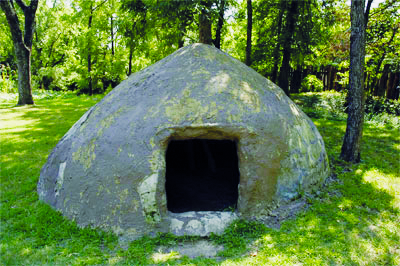
While this is not really an option for modern residents of Appalachia, hundreds of years ago – and for thousands of years before that – some of the area’s original Cherokee people living at higher elevations chose to over-winter in an asi, or winter-house, described by the Museum of the Cherokee Indian as a “house made of woven saplings, plastered with mud and roofed with poplar bark.”
As a settled, agrarian society, the Cherokee lived in established towns, since there was no need to migrate in search of game. While some Cherokee lived in the same houses year-round, others rotated between winter and summer houses, the latter of which were square or rectangular in shape and much larger and better-ventilated than asi.
At least nine Cherokee towns stood in what is now Graham County, including Cheoah – the site of present-day Robbinsville – as well as Talula, Connicheloe, Gat-astu, Tsudayehi, Stecoah, Tuskegee, Buffalo Town and Ustanali.
Of the 200 Cherokee towns present in Appalachia when Europeans arrived, most stood near rivers or bold streams and consisted of 30-60 houses, arranged around a council house. While many Cherokee lived in the same houses year-round, those at higher elevations often chose to move between summer and winter houses.
The seasonal houses were situated directly across from one another – with the larger and more well-ventilated summer houses being of square or rectangular construction – while the smaller winter houses were sunken partially into the ground. These low, round, domed structures were easy to heat, with thick wattle-and-daub walls retaining the warmth. The domed shape deflected the worst winter weather, as the dome is an ideal architectural design for enduring hurricane-force winds, blizzards and even earthquakes.
Winter houses also featured raised beds built into the walls and only a small portal serving as a door with no other ventilation. This kept the interior as warm as possible.
The Cherokee people of the time were known to pride themselves on being able to endure cold and wet, with relatively-little clothing.
However, no level of endurance could compete with the mountain winters of past centuries.
As any long-time resident of the Appalachian mountains is likely to tell you, winters used to be colder. Hundreds of years of meteorological data backs up this folk wisdom.
For example, 1816 was known as the “year without a summer,” as volcanic dust clogged the atmosphere, allowing winter to dominate the entire year. According to the National Oceanic and Atmospheric Administration, colder winters spanned the “little ice age” which lasted from the 15th century until 1850.
While contemporaries credited the winter houses with being “as strong and warm as log cabins,” winter houses did have the advantage of being relatively fireproof, as the walls were plastered inside and out with a thick coating of dried mud.
Although winter houses fell out of favor in the 19th century, when the wind whips down the mountain and the cold, wet “wintry mix” of rain, snow and sleet refuses to let up, crawling into a warm, dry oven might sound like a pretty good strategy for surviving an Appalachian winter.