
Long-discussed improvement project has made significant progress
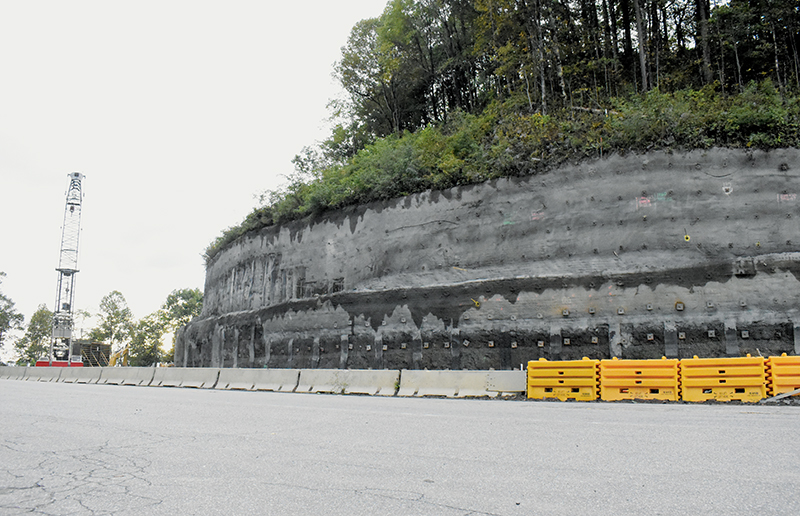
Today marks two years since dignitaries from the North Carolina Department of Transportation converged onto a press conference outside Robbinsville High School, to usher in the launch of a road improvement project first conceived by the Appalachian Development Highway System in 1965.
Three separate crews got right to work shortly after the ceremonial groundbreaking for one of the final unfinished portions of the “Corridor K” project, a 128-mile improvement plan that spanned from the I-40 interchange near Clyde to the I-75 connection in Cleveland, Tenn. Much of the project was a distant memory by the time the 1990s rolled around, but the effort stalled after 8.8 miles of a 4-lane highway from U.S. 19/74 West in the Almond community to Red Barn Hollow General Store & Cafe in Graham County. The pause came due to a variety of factors – mainly, officials were unsure which route to take. Before finally breaking ground Oct. 3, 2022, Corridor K was almost a part of local legend: a story that was often heard about, but without the fruits of any labor to show for it.
Residents, elected officials and DOT personnel alike sparred over how to best navigate through the Snowbird Mountains of Graham County, as well as the point where the famed Appalachian Trail crosses over North Carolina Highway 28 at Stecoah Gap. Everything from building a 4-lane road across the mountain to erecting a tunnel below was discussed for the latter; in the case of the final connective tissue to U.S. 19/74 in Andrews, was it best to go over Tatham Gap Road, or perhaps another point – like Bear Creek? Innumerable public hearings were held, while the pathway seemed less and less likely with each passing year. But department officials finally reached the point of wanting to get the Johnson Administration-era project off the books – so it was decided in 2019 that a final set of hearings would be the last. The project turned into an improvement of shoulders, drainage and navigation along the existing roads of N.C. 28 and N.C. 143. A touch of U.S. 129 has also received some long-overdue care.
Despite one final plea from many local residents, Corridor K shoved off in Graham County on Oct. 3, 2022. A project 57 years in the making was finally underway.
By now, travelers have learned to schedule their trips through the project with a lengthy buffer for traffic stops. The only way to avoid the construction altogether – and successfully travel between Robbinsville and Stecoah – is to take U.S. 19/74 through the Nantahala Gorge. Crews have worked seemingly daily – including plenty of weekend shifts – to make the progress most see today.
A lot of Earth have been moved, but the main question lingering on everyone’s mind is: how much longer will the project take?
The Graham Star reached out to the North Carolina Department of Transportation in mid-September, to answer that very question.
Almost halfway home
N.C. Department of Transportation Resident Engineer Adam Dockery broke down the progress made thus far by Watson Contracting (“Section CA,” a 5.9-mile section between Five Points Road in Robbinsville and Beech Creek Road off N.C. 143 East); Charles Blalock & Sons (“Section CB,” which covers 3.9 miles from Beech Creek to just past Stecoah Gap); and local company Adams Contracting (“Section CC,” a span of 2.6 miles between the gap and Stecoah Road, off N.C. 28 South).
* Section CA is 48 percent complete, according to Dockery. Franklin-based Watson is working on a $48,750,475.24 contract to improve the segment, with Dockery reporting that grading is complete and the road is waiting for a final layer of surface. The work ahead includes what Dockery calls “minor drainage structures;” a wall at the Pinhook Road/N.C. 143 West intersection; and a culvert at the eastbound terminus of Beech Creek Road.
* Section CB is 40 percent complete. Based in Sevierville, Tenn., Blalock & Sons have completed “most” of the mass grading and all wall construction is underway. The contract for this portion was by far the highest – $116,407,729.70 – because of one major caveat: a land bridge.
* Section CC is reportedly 42 percent complete. Adams received the $67,387,346.29 job, which still has some leg work to do. Subsurface drainage installation is underway, as is wall construction. Grading is almost complete, with what Dockery termed “a few remaining fills and cuts to be constructed after the walls are complete.”
Dockery also revealed more about the work that’s been done, touting:
* Drainage devices to convey water through the project, as well as handle roadway runoff. Pipes that measure up to 66 inches (5’ 6”) in diameter – as well as both concrete and metal culverts – have been put in place;
* Over a mile of curb-and-gutter has been crafted, spanning 5,813 feet;
* There have been 2,500 cubic yards of sidewalk created, as well as 47 ADA (Americans with Disabilities Act)-compliant ramps placed;
* Around 22,000 linear feet of pipe has been placed in the ground;
* Asphalt has also been bountiful – to the tune of 39,000 tons already spread.
Section CD
Originally, plans called for sections to simply be titled “A,” “B,” and “C.”
Funding dictated a change to the concept.
Thanks largely in part to the COVID pandemic, the cost of materials caused the forecasted $130,606,888 price tag to fly out the window. To date, Watson, Blalock and Adams’ firms have been awarded $231,295,075.99 in contracts to do the work commuters see each day.
Congressional Rep. Chuck Edwards (R-Hendersonville) announced May 28 that $20 million had been secured for the final, untouched portion: a 2.807-mile stretch from Stecoah Road to Red Barn Hollow. The funding was awarded to the N.C. Department of Transportation through the U.S. DOT Nationally Significant Federal Lands and Tribal Projects Program.
Unfortunately, that seems to be all the funding secured to date. Dockery had no insight on any monies coming in across the foreseeable future.

Hurry up and wait
Roadwork has forced travelers to adjust their schedules by 15-30 minutes, in order to navigate through the entirety of the construction.
On any given day, drivers can expect between 1-4 remote-controlled traffic signals to dictate arrival times in-between Stecoah and Robbinsville. The Graham Star personally researched the matter in August, clocking the time it took to navigate from one end to the other; a chart detailing the results accompanies this report.
Dockery struck down the notion that the crews are restricted on how long they can halt traffic at each checkpoint.
“There are no stipulated wait times in the contract for commuters,” said Dockery.
However, he did shed some light on potential conflicts that could arise with the weekday travel for students, to and from Robbinsville’s three main schools.
“On N.C. 143 from U.S. 129 to Tatham Rd, the contractor shall not close or narrow a lane of traffic between the hours of 7:00am - 9:00am and 2:00pm – 4:00pm while school is in session,” Dockery cited from the agreement in place for Section CA, adding that $500 per hour is due in the event that Watson violates those terms.
Land bridge
The first of its kind in the state, Dockery said the much-hyped land bridge will begin construction in spring 2025.
The $5 million connector will be cultivated to allow hikers and wildlife alike to safely pass over N.C. 28 at Stecoah Gap without fear of being hit by passing vehicles. Before construction began, a crosswalk was the only barrier those walking the Appalachian Trail could use to stop the flow of vehicles. Plans are to construct tunnels for drivers to pass under the bridge, which will be planted and eventually grow into a natural crossover with foliage and grass for those crossing above the road.
The bridge serves two masters: advocates for the Appalachian Trail that had long opposed disruption to the natural state of the path; as well as significantly diminishing the chance of a tragic accident occurring when the road is widened to four lanes as it passes through the tunnels.
On the descent and approach, the road will shift into an alternating 3-lane pattern.
The road ahead
Edwards has strongly advocated for the outright elimination of proverbial roadblocks in place that prohibit development along the Appalachian Development Highway System.
In September 2023, he introduced H.R. 5835 to the Committee on Transportation and Infrastructure Where the final connective tissue on the Corridor K route would land has long been a point of contention, but when Edwards introduced H.R. 5835 in September to the Committee on Transportation and Infrastructure, the answer was clear: improvements would be made along U.S. Highway 129 (Tallulah Road) to Topton.
From there, upgrades would be made to the four-lane highway connector in Andrews. To ensure funding would be available for the new concept - which tacked 15 miles onto the existing verbiage - H.R. 5835 simply strikes “three thousand and ninety miles” from the allotment of federal monies for the Appalachian Development Highway System; and replaces the distance with “3,105 miles.”