
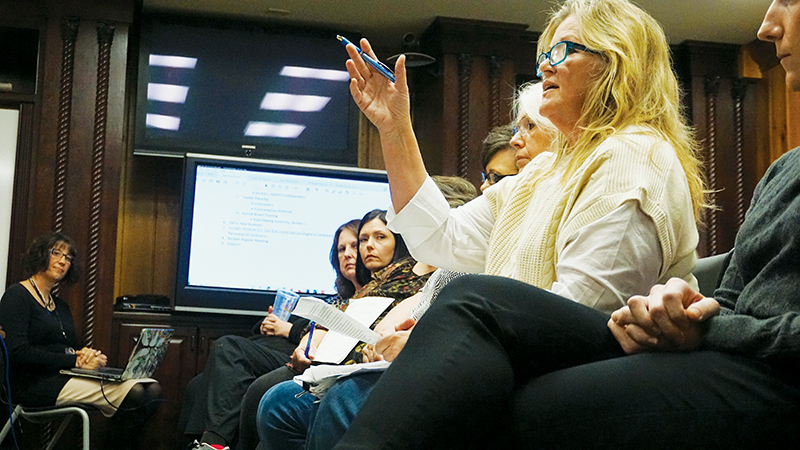
Tallulah – Graham County commissioners faced an issue that pitted their responsibilities as stewards of county government against their religious beliefs, with the hot-button topic of abortion on the agenda — the day before Election Day.
The commissioners meet monthly as members of the Graham County Board of Health. Monday’s meeting had a packed agenda, but what drew the most attention was the subject of family planning.
The meeting, which has been held at the Graham County Community Building in town, was held in the meeting room at the Health Department facility off of P and J Road.
The controversy centers on emergency contraceptive pills, which must be administered within five days of insemination to be effective.
Graham County Public Health has the drug available, but has never prescribed it.
Healthcare professionals regard the pills as a last-chance way to avoid an unwanted pregnancy by preventing sperm and egg from coming in contact and preventing conception.
They say they are required to make emergency contraception services available in order to qualify for state and federal funding and worry that ending the service would jeopardize an array of family planning services available to people with low income and little or no insurance.
Opponents argue that the medicine could prevent a fertilized egg from implanting on the uterine wall and regard it as essentially abortion.
They say that there are other options available for pregnancy prevention and don’t think Graham County should be in the business of preventing or – as they regard it – ending pregnancies.
They say that many surrounding counties don’t offer the medication, but as health officials circled back, many of those counties started adding the service or plan to add the service in order to stay in compliance with state and federal rules.
There was a separate issue during that discussion, two personnel matters with the issue of abortion at their core. As a rule, personnel matters are held in closed session; it is unclear why county attorney Jay Coward – who was in attendance – allowed the public discussion of personnel matters to continue.
With about 20 people in the audience – mainly staff for Graham County Health, members of the health advisory board, and other medical professionals – just two people spoke against the drug in Graham County.
One was Brandi Adams, a former health worker who was terminated after a counseling session with a client during which she reportedly offered a faith-based family planning alternative that violated policies and procedures, according to a variety of sources. The other was Claudine Gibson, a Robbinsville business woman and former county commissioner.
Adams alleged that science is unreliable and pointed to the Theory of Evolution – describing it as humans evolving from monkeys – as an example of that unreliability.
“We talk about women’s rights,” she said. “What about a baby’s rights?”
Gibson said the drug could destroy an egg, or prevent a fertilized egg from attaching.
“It’s abortion,” she said, adding that abortion is a sin.
“It is wrong. It is wrong,” she said.
Ongoing debate
Several others spoke, mainly health care professionals who argued that family planning is an essential service that prevents abortions.
“You can’t terminate what you’ve prevented,” said Lorita Eller, nursing supervisor for Graham County Public Health.
Eller spoke at the meeting in defense of emergency contraceptive pills, and also wrote a memo on Oct. 31 in which she said opponents are spreading “misinformation.”
“Public Health’s main goal is prevention, not just related to unplanned pregnancies,” she wrote. “Prevention is preventing illness, communicable disease, vaccine preventable disease, child abuse, sexual abuse, elder abuse, maltreatment, addiction, just to name a few.
“Providing contraceptive options, including emergency contraception, allows clients to have an active role in their own reproductive life planning. Decreasing unplanned pregnancies decreases abortions, period. A planned pregnancy has a greater chance of a healthier birth outcome,” she wrote. “Placing barriers to clients having access to contraceptives, including emergency contraception, can lead to an increase in teenage pregnancies, an increase in children placed in foster care, and an increase in abortions.”
She said providing the service is not optional. The state requires county public health departments to make the service available or, absent that, pay for the service if it is provided elsewhere. If a client is forced to go to an emergency room for a service the county should have provided, the county has to pay that ER bill, she said.
She said emergency contraception pills are not abortion pills and have no effect on an existing pregnancy.
Graham County Public Health is prohibited from providing abortions, she said.
After several sometimes lengthy comments, the board went into closed session to discuss a personnel matter.
Following the closed session, the board reconvened in open session, at which point Commissioner Keith Eller said new information was available and any decision would not be made until the next regular meeting of the Board of Commissioners on Nov. 15 – the week after the November General Elections.
The county attorney will be sorting through information presented Monday and advise the board how to proceed next week.
It was unclear when the board discussed the issue other than during closed session, a possible violation of open-meeting laws. The Graham Star has formally asked county government to clarify when the board’s discussion about the drug took place.