
Emergency contraceptive has caused division amongst residents
Robbinsville – For Bible Belt county commissioners, few issues weigh more heavily than birth control.
In a nation as polarized as the United States, battles rage over birth control in its many forms – abstinence, rhythm method, prophylactics, prescribed birth-control medications, emergency contraceptives and ultimately, chemical and surgical abortion.
State and federal legislation – along with the tax dollars that come with it – mandate that county public health departments provide such things as emergency contraceptives and pregnancy counseling.
But those state and federal dollars do more than that. They pay for an array of women’s health and family-planning services, aimed at a low-income clients who may not even have insurance.
Fiddle with anything that is required and the county risks losing more than just funding for birth-control treatments. Shuttering such services would leave many women without any local pregnancy-care services at all.
But here’s the kicker: even if Graham County refuses to provide such services, the law requires that it still ensure that the service is provided elsewhere – and pay the bill, as well.
The Graham County Public Health Department is a department of Graham County Government and receives local, state and federal funding, along with fees for service, payments from insurance companies and grants.
In addition to a deep bench of medical professionals, it is advised by a board of medical professionals, but executive decisions are overseen by the Graham County Board of Commissioners, which also serves as the Graham County Board of Health.
Upon taking office, each county commissioner is required to take an oath in which he or she “does swear (or affirm) that I will well and truly execute the duties of the office of county commissioner according to the best of my skill and ability, according to law; so help me, God.”
Every member of the Graham County Board of Commissioners – chairman Connie Orr, vice chairman Keith Eller, and commissioners Dale Wiggins, Lynn Cody and Jacob Nelms – says they are a church-going, Pro-Life Christian. Still, they swore to God to execute their duties according to law. The assumption is that the word “law” refers to civil law and not religious law.
Some of that contradicts what local pastors tell congregations about the hot-button topics of conception and pregnancy, including who has senior rights – the mother or the unborn child – and the Sixth Commandment forbidding murder.
Slow simmer
Over the summer, Brandi Adams, a peer counselor employed at Tallulah Health Clinic, learned the clinic would be making Ella, an emergency contraceptive, available in cases that required it.
Those cases generally occur when a woman has unwanted or unintended sex that she is worried will result in an unplanned pregnancy. Its main function is to keep egg from meeting sperm, but it can also stop an impregnated egg from implanting on the uterine wall. For heavier women, it is the only effective emergency contraceptive.
To learn more about Ella, Adams reached out to the Graham County Public Health Clinic, as she had in the past when researching issues important to her clients.
During that meeting, Adams discovered that the Graham County Public Health Department also has Ella available (although it has never been prescribed by the department). A conversation about Christian-based family planning followed before Adams left.
Beth Booth, public health director, was briefed about the encounter shortly after Adams left and called the CEO of Appalachian Mountain Community Health Centers, the parent company of Tallulah Health Center.
Within the hour, Adams was fired.
Personnel matters are notoriously-tricky things when it comes to obtaining information. Sometimes, personnel will share information, but their former employers are restricted by privacy laws and the threat of lawsuits, so generally have little to share about personnel matters.
That’s been the case with Brandi Adams.
It is unclear what motivated Booth to call about Brandi Adams, but what is clear is that Adams has clout.
In addition to her own intellect and training, her husband is Coy Adams – pastor at Dry Creek Baptist Church – and her mother is Claudine Gibson, a former county commissioner and local businesswomen.
Between support from powerful friends and relatives – and the simmering discussions that took place in the weeks that followed Adams being fired from Tallulah Health Center – Graham County commissioners found themselves at the center of one of their worst possible nightmares, politically.
It came to a head on Monday, Nov. 7, at a Health Board of Directors meeting. Adams and Gibson both spoke about their convictions and their opposition to the Ella drug.
Saying that Ella is not an abortion drug, nurses, nurse practitioners and physicians argued that good family planning – which includes reducing unwanted pregnancies – prevents abortions. They also argued that the services they provide help young and middle age women deal with extremely difficult decisions with consequences that will follow them their whole lives.
These aren’t simply cases where a young couple wasn’t careful; in many cases, the Public Health Department deals with involve rape, incest, and underage sex.
Connie Orr dialed in to the Nov. 7 meeting, so Keith Eller served as chairman. Following the comment period and a closed session in which personnel matters were discussed, Eller said more research was needed and it would come up again the following week at the Board of Commissioners’ regular monthly meeting. He then adjourned the meeting.
He was wrong. Because he adjourned the meeting, another Health Board meeting would need to be scheduled.
But he also dodged a bullet. Nov. 8, the next day, was Election Day and two county commissioners – Nelms and Cody – were standing for re-election. How they voted on the Ella drug could have had consequences in the election the next day.
But the Health Board did make a decision on Nov. 7 affecting the Ella drug. The board authorized Booth to submit an agreement with the N.C. Department of Health and Human Services for the 2022-23 fiscal year – an agreement that included emergency contraceptives.
Decision time
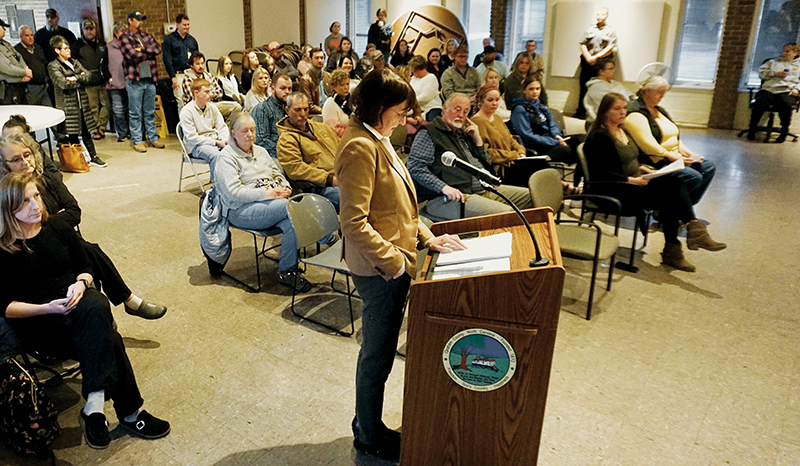
When the Health Board convened again on Nov. 21, it was very much a replay of the Nov. 7 meeting – the same people presenting the same arguments, but what went unsaid was perhaps the bigger issue – the slippery slope.
Both sides use the slippery-slope argument. Yes, Ella is an emergency contraceptive, but it’s only a matter of time before the Public Health Department begins performing abortions, one side argues. Yes, Ella is just one treatment available, but it’s only a matter of time before all contraceptive methods are banned, the other side argues.
This time, the heat was on the county commissioners.
All five talked about the need to protect unborn babies and several said they are Pro Life.
Commissioner Jacob Nelms, the first to speak, said he is 100 percent Pro Life and completely against abortion, but added the “division and dissension” over Ella during the past few months have upset him.
He said the law requires the Public Health Department to provide specific services – or ensure that the services be provided (even if it is at greater expense) if the county is unable or unwilling to provide the services itself.
Commissioner Lynn Cody said the goal should be to ensure that everybody in the county receives the proper care that they deserve.
“We have to protect our own – come together and work together,” he said.
Commissioner Keith Eller said he did his own research and listened to all sides before deciding how to proceed.
Wiggins, whose seat as a county commissioner expires in December, cautioned against relying on the internet for research about things like Ella. He said the use of emergency contraceptives should be a private discussion between a woman and her healthcare provider, adding that for women with low income and little or no insurance, the Public Health Department is their only option.
He said removing Ella as an option in Graham County would only be symbolic, since the Public Health Department would still be required to ensure that the medication be available from other sources.
The only segment impacted by such a ban would be women without the resources to see a private doctor, he said.
Chairman Orr said she represents the county as a whole and is committed to that role.
Ultimately, it was Wiggins’ motion, with Nelms seconding it, that preserved Ella as a treatment option for unwanted early pregnancies, with Orr provided the tie-breaking vote.
Eller and Cody – both of whom are volunteer fire chiefs, committed to saving lives – voted against it.
The meeting, which lasted just over an hour, was streamed on Facebook Live and had more than 2,400 views, a reach of 3,412 people, 286 reactions (all “likes” and “loves”) and 87 comments – the lion’s share from people arguing on behalf of the emergency contraceptive.