
Four graduate from Cherokee Language Program
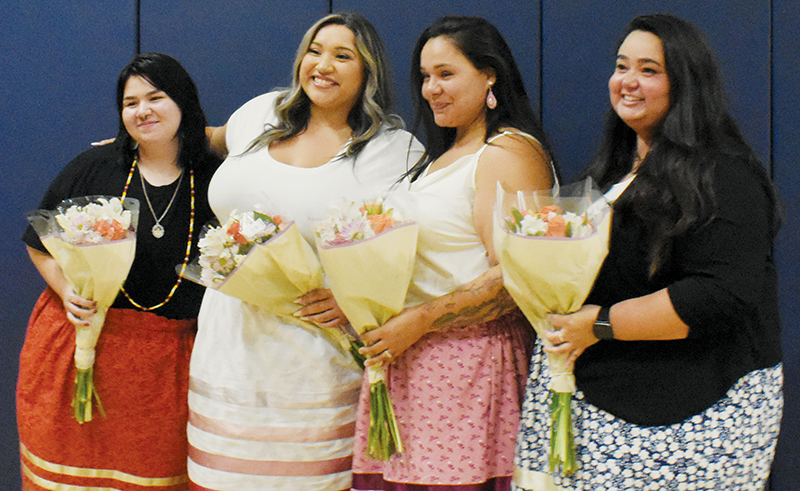
Snowbird – The first graduating class of the Dadiwonisi Adult Language Program embodied the meaning of the program’s name – “We are all going to speak” – as they spoke in Cherokee, thanking their community and accepted their certificates in a moving ceremony Tuesday.
Dadiwonisi is a 2-year language program in the Snowbird/Cherokee County division of the Eastern Band of Cherokee Indians. The goal of the program is to create, grow and develop adult second Cherokee language learners.
The four graduates were Cailon “Uwodsdi” Garland, Jazlyn “Wadulisi” McEntire, Kirstie “Tsayga” Frady and Gina “Amage” Myers.
Garland, McEntire and Frady are from the Snowbird community; Myers is from Cherokee County. Each was referred to by their Cherokee name during the ceremony.
Roger Smoker began the ceremony with a prayer in Cherokee. D.J. Robinson lead the opening remarks, followed by principal chief Richard G. Sneed, vice chief Alan B. Ensley, councilman Adam Wachacha and councilman Bucky Brown.
Each graduate later gave a speech in Cherokee, which was translated into English.
It was an emotional experience for each graduate, as they held back tears while speaking.
“Cherokee is hard work, but it’s important, so I am going to speak,” said Frady.
“Snowbird community, I am thankful to you all,” Myers said. “You all believed in us.”
“I am grateful for my grandmother for teaching Cherokee, for teaching me,” said McEntire. “I miss her everyday. I wish she was here to see what I have learned.”
“I starting learning Cherokee when I was 11 years old. I stopped speaking Cherokee when I was 17. I wasn’t speaking Cherokee for eight years,” Garland noted, adding that she was given a flyer for Dadiwonsi two years ago at Lynn’s Place, where she worked.
Preserving Cherokee
Today in the Eastern Band, there are only about 200 native speakers –and most are over age 55.
According to visitcherokeenc.com, as these speakers pass, the language is in danger of doing the same. Starting around 1970, most Cherokee families stopped speaking the Cherokee language in their home. The result is very few – if any – Cherokee children learned the language.
Cherokee, Robbinsville, Snowbird and surrounding areas stress the importance of programs like Dadiwonisi, the New Kituwah Academy – an immersive experience for children ages 2-13 – Cherokee language programs at Cherokee Central Schools, and the language summer camp in Robbinsville.
Creation of syllabry
According to History Channel, the Cherokee were the first group of Native Americans to have a written form, created by native Sequoyah.
Born between 1770-78 in the town of Tuskagee, near present-day Vonore, Tenn., Sequoyah was a blacksmith and silversmith, and served the U.S. Army from 1813-14, where he observed how Americans used writing to learn and share information. Sequoyah wanted the Cherokee people to have the same opportunity.
Sequoyah only spoke Cherokee and did not know how to read or write in any other languages.
Sequoyah married after the war and settled in Alabama, where he continued to work on his writing system. Sequoyah neglected his other duties at home and in the fields to focus on creating the syllabary.
His neighbors thought he was practicing witchcraft and his wife was so frustrated that she burned some of Sequoyah’s papers. He finally finished in 1821 and the first person he taught was his six-year old daughter Ahyokah.
Sequoyah’s Cherokee – or Tsalagi – syllabary is based on the sounds of the Cherokee language and not on an existing alphabet, since Sequoyah didn’t know any other written forms. The syllabary now has 85 characters (originally 86) and – similar to the English alphabet – each symbol represents a sound.
According to linguist Peter Unseth, the syllabary contains characters composed of English, Greek and Hebrew letters.
Once a Cherokee speaker learned the 86 syllabics, they could read and write immediately because the syllabics were just like the spoken words, according to Ellen Cushman, professor at Northeastern University and Cherokee nation member.
Cushman said that within 3-5 years of the written form’s introduction, a tribe could read and write. About 90 percent of Cherokee were literate by the 1830s, a much-higher literacy rate than white settlers in America.
Sequoyah and Ahyokah demonstrated the syllabary to Cherokee leaders in Arkansa and North Carolina. In 1825, the Cherokee National Council adopted the syllabary as the official writing system.
A Cherokee Newspaper called the Cherokee Phoenix started printing in 1828. It was the first bilingual newspaper, printed in Cherokee syllabary and English. The Phoenix provided news on Cherokee tibial activities and the U.S government’s actions.