
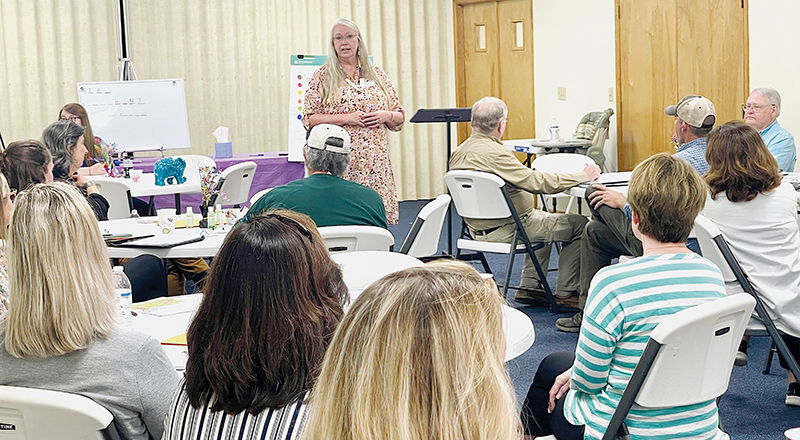
Robbinsville – When Michelle Shiplet became executive director of Graham Revitalization Economic Action Team (GREAT) in 2019, she found a shelf filled with community improvement plans for Graham County and Robbinsville that – at best – were only partially accomplished.
In an effort to kickstart progress and bridge gaps in communications and cooperation in the county following two years of COVID-19 stagnation, Shiplet hosted a meeting of community leaders, local and state and government agencies, and businesses.
She called the meeting – held May 19 at Robbinsville United Methodist Church – “Demo the Silos.”
“Think about how you can tie what you’re working on with what others are working on and help them along,” Shiplet said.
About 30 people were at the three-hour meeting, which included an icebreaker activity and brainstorming.
Participants came from banking, social services, education, community development, health care and religious groups – about 30 people total.
The Graham County Cooperative Extension was represented, as was Duke Energy, the N.C. Department of Transportation, Stecoah Valley Cultural Arts Center, and the Eastern Band of Cherokee Indians. Retired forest service employees and educators – as well as county commissioners Connie Orr and Dale Wiggins – were also there.
The meeting provided a rare opportunity for in-depth conversation, Shiplet said. The goal of the meeting was to have a solid idea about what needs to be done, who is going to do it, and determining the next step in the process.
Shiplet distributed copies of the plans she found in her office, a different plan to each table in the room, and asked participants to identify which parts of the plans had been implemented, which parts still needed implementation, and which parts were no longer relevant.
The plans ranged from economic development and tourism to the state of health and livability in Graham County.
“There’s a big, huge gap between the plans and the implementation,” she said.
An estimated 400,000 people pass through Graham County during tourist season each year, with an average stay of just two days. The goal is to provide each visitor with 120 minutes of activities while they are in Robbinsville. The town has a limited selection of restaurants and shopping – as well as a supermarket – that in all, may fill up half of that 120 minutes, so there is opportunity for growth, such as outdoor adventure outfitters and guides, walking trails, river rafting and bicycling.
There is a plan to improve Robbinsville’s streets, sidewalks and storefronts, with some of that already accomplished, such as the Ronnie Milsap and Cherokee women murals, streetside planters and directional signs.
But there needs to be more.
The group went through the plans and narrowed them to specific themes including health, tourism and economic development – but nothing about education, and education was unanimously identified by the group as an important priority in Graham County.
That’s when Angie Knight, Graham County Schools superintendent, chimed in.
There is nowhere for teenagers to hang out and stay out of trouble in Graham County. As a stopgap, Graham County Schools has been letting teenagers gather after hours until 10 p.m. at a campus parking lot, just to hang out.
“Do you want teenagers to not make bad choices?” Knight asked. “Then give them a good choice.”
Knight said a survey of Robbinsville High School students revealed that the top concern for them is substance abuse, with having nothing to do coming in second. There were 417 responses to the survey, so the results are considered statistically reliable.
She provided a sketch of her vision of an activity park that includes a gym, batting cages, racketball, ping pong, pool tables, concessions, restrooms, a playground, splash pad, covered and uncovered picnic tables, and a tubing put-in area along Tallulah Creek.
Graham County has no parks or museums and Knight said an activity park would provide activities for Graham County’s children, as well as be useful for visitors.
The group agreed that activities for young people – whether it be Knight’s proposal or something else – would be worth pursuing. Lisa Leatherman of Duke Energy suggested her company can pay for construction materials to build corn hole boards. Leatherman suggested other corporations with presence in Graham County could be approached for other donations.
Other big issues crying for attention include substance abuse and a lack of affordable housing.
Not invited to the meeting was the U.S. Forest Service, which controls ⅔ of Graham County territory. Shiplet said the omission was deliberate, because forest service involvement would have resulted in its own complications that could have dominated the conversation.