
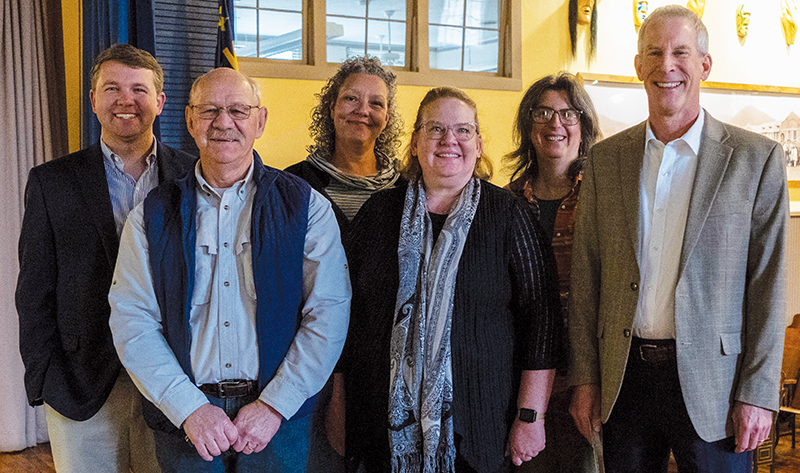
Stecoah – On April 5, Secretary of the North Carolina Department of Natural and Cultural Resources Reid Wilson visited the Stecoah Valley Cultural Arts Center, where he talked about the resilience of the arts center, the importance of public spaces in our lives and resources to support public spaces.
Wilson was accompanied by Legislative Affairs Director Deans Eatman.
Representing the Stecoah Valley Cultural Arts Center were Executive Director Jennifer West, Program Director Amber Benton, Gallery Manager Melinda DeHart and Board Chair Rick Davis.
As the group wove through the halls and rooms of the center, the center representatives described the center’s origins, its response to the COVID pandemic and its future plans.
Wilson’s mission is to help the state’s parks, museums and venues learn about resources that can help them engage with people.
“What you are doing is amazing. It keeps arts and culture going,” Wilson said to the staff.
Wilson asked the group if the grants that Stecoah Valley Cultural Arts Center received have been sufficient to carry it through the pandemic and how big a hit the center had sustained due to closures.
West acknowledged that the center received grant money that temporarily sustained it.
“We are coming to the end of that money,” West said. “I am a little fearful about what the next six to twelve months will look like, because we now have staff in place.”
Help on horizon
Millions of dollars in additional funding is allocated in the state budget for various parts of Wilson’s department, including the N.C. Parks and Recreation Trust Fund, North Carolina Arts Council and the State Library.
“Some of that will find its way to this part of the state,” Wilson said. “But, having said that, one of the challenges in rural areas is that not all local governments have the capacity to apply for grants. Maybe they don’t have enough staff, and there’s also a match element.
“If you ask for $200,000 you need to show that you have already raised $200,000. A lot of small communities can’t do that,” he said.
What may be easy for Wake County, for example, could be more challenging for smaller, rural counties.
“We’re trying to think through ways of helping local communities build the capacity to apply for these grants. It’s going to take a little while,” Wilson said.
Wilson added that the Outdoor Economy Conference that he had attended in Cherokee the same week hosted people from about 24 states.
Wilson also noted that most of those states lack the expanded funding for parks and outdoor recreation that North Carolina enjoys.
“I think the fact that the legislature and the governor agreed on all these budgetary expansions for our department just demonstrates that they understand the value that people place on arts, history, culture and nature – which is great to see,” Wilson said.