
Graham still more expensive than Cherokee County
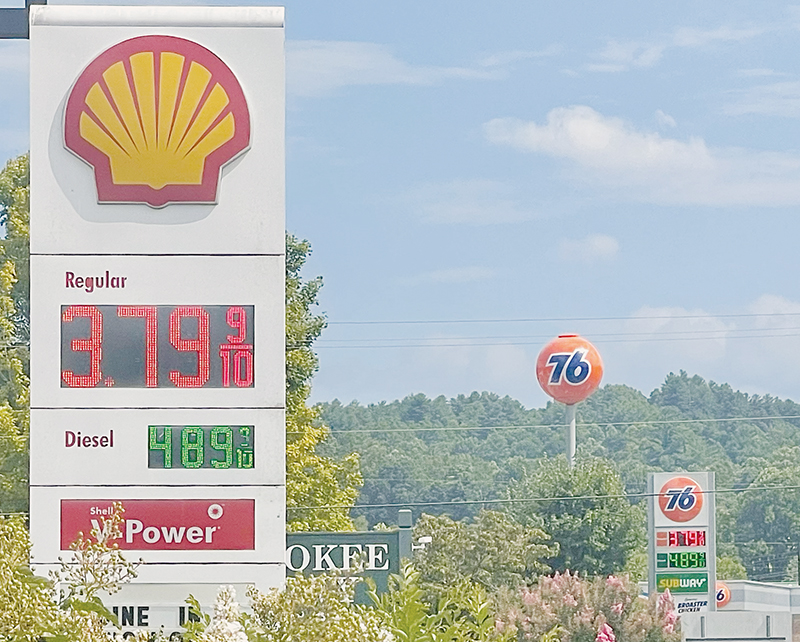
If you drive, gas prices have probably been on your mind recently, especially if you live in Robbinsville or are motoring your way through Graham County.
The price for a gallon of regular gas has been creeping down after peaking over $4 a gallon here during the summer, but gas prices in Robbinsville continue to be higher than in neighboring Cherokee County.
According to the GasBuddy app, user-reported gas prices at four Robbinsville gas stations ranged from $3.69 at TNJ Convenience on Sweetwater Road and $3.73 at Aztex on Tallulah Road, to $3.79 at Crown, Shell and BP stations on Rodney Orr Bypass. A visit to the Sunoco station off Tapoco Road showed its price for a gallon of regular gas was also $3.79 per gallon.
In Andrews, gas was going for 10-20 cents a gallon cheaper and in Murphy, gas was going for 30 cents a gallon cheaper than in Robbinsville.
On the other hand, gas prices in Bryson City as of Monday were fairly comparable to Robbinsville prices.
There are a number of factors that weigh in when it comes to gas pricing, not the least of which is the wholesale price that a gas station pays to its supplier.
According to AAA, Monday’s national average of $3.95 was 62 cents less than a month ago, but 77 cents more than a year ago, and 22 cents a gallon higher than most Robbinsville stations.
Statewide, AAA said North Carolina ranked 36th in gas prices at $3.66 per gallon as of Monday (with 1st being the highest — California, at $5.366 per gallon). That puts Robbinsville’s gas prices at about 13 cents higher than the state average.
Demand for oil bounced back from the depths of the pandemic faster than oil production, according to Vox. A second major driver of rising prices is the costs of refining crude oil. These costs are also going up: refineries have shut down in the past few years, outpacing the new refineries being built.
Then, as motorists changed their habits, it eased demands on supply, resulting in a gradual decline taking place now, according to AAA.
But what happens at the local level?
As wholesale prices rise, local stations have already paid for the gas they have in their tanks and have to gear up for the oncoming and escalating cost of their next shipment. Wholesale prices tend to escalate rapidly under situations such as hurricanes or international conflict, so the local stations increase their prices in lockstep, day by day, in anticipation.
Then, as wholesale prices decrease, it becomes a local decision based on local markets.
While not exactly collusion or price gouging (the state has a law prohibiting price gouging during emergency situations), local gas sellers don’t want to decrease their prices any faster than they have to or much differently than their competitors.
“We try to stay competitive,” said Dirk Cody, whose family owns a 76 gas station off Rodney Orr Bypass in Robbinsville.
It’s nothing more sinister or complicated than a station owner walking to the curb and looking down the street to see what the competitor is charging.
“I’ve seen it when we sell below cost because of competition,” Cody said.