
Robbinsville – A decision whether the Graham County Public Health Department should distribute a specific type of emergency contraceptive remains in the hands of Graham County commissioners until Monday at the earliest.
The commissioners, serving as the board of directors for the Public Health Department, had postponed a decision last week, with acting chairman Keith Eller saying that the issue would be discussed at the board’s regular meeting this week.
But because Eller adjourned last week’s health board instead of recessing it, the board will have to reconvene as the health board. That meeting will be at 5 p.m. Monday at the Graham County Community Center.
Board Attorney Jay Coward has been researching the issue and is expected to bring his findings to the board at its meeting on Monday.
Tuesday’s Board of Commissioners meeting still provided an opportunity for people on the two sides of the issue to argue over whether Ella – an emergency contraceptive – should be distributed by the Public Health Department.
Much the same as what happened the previous week’s Board of Public Health meeting, medical professionals argued that the Ella pill prevents pregnancies, either by preventing fertilization or by preventing a fertilized egg from implanting and developing in the uterus. On the other side, Christians say that a fertilized egg is conception and preventing it from developing is abortion.
The issue forces Graham County commissioners to pit their responsibilities as stewards of county government against religious and moral beliefs that compel them to oppose abortion.
The pills, which must be administered within five days of insemination to be effective. Healthcare professionals regard it as the most effective emergency contraceptive, especially for women over 165 pounds in weight.
Healthcare professionals regard the pills as a last-chance way to avoid an unwanted pregnancy by preventing sperm and egg from coming in contact and preventing conception.
They say they are required to make emergency contraception services available in order to qualify for state and federal funding, and worry that ending the service would jeopardize an array of family planning services available to people with low income and little or no insurance.
Graham County Public Health has the drug available, but has never prescribed it. A less-effective emergency contraceptive called Plan B is also available and has been prescribed.
Jill Raymer, a nurse practitioner, said the scientific and medical consensus is that life begins at implantation and not fertilization, adding that county commissioners should not be involved in this issue, anyway.
“I don’t think it’s appropriate for a county board to be making these medical decisions,” she said.
One citizen who did not provide his name stood during the meeting and accused Raymer and other healthcare officials who were at Tuesday’s meeting of not being from Graham County, and being insensitive to local people’s religious and moral convictions.
Opponents to the drug argue that the medicine could prevent a fertilized egg from implanting on the uterine wall and regard it as essentially abortion.
They say that there are other options available for pregnancy prevention and don’t think Graham County should be in the business of preventing or, as they regard it, ending pregnancies.
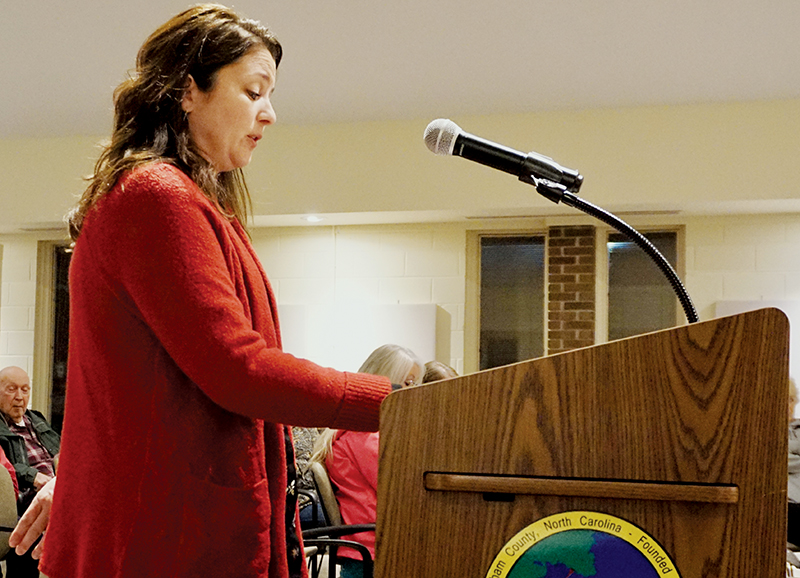
Like last week’s meeting, the same two people took the podium to speak against the drug at the meeting Tuesday.
Brandi Adams is a former peer support specialist who worked for Tallulah Community Health Center before she was terminated after she met with Graham County Public Health staff in early August to talk about emergency contraceptives.
She said Beth Booth, director of public health in Graham County, called Adams’ company’s CEO about the visit. Adams was fired a short time later that day.
Adams said she was wrongfully terminated as retribution for her asking the Public Health Department questions about the drug, violating her religious rights and violating her responsibilities as a peer advocate to research treatment options for her clients.
The other who spoke against the drug was Claudine Gibson, a Robbinsville business woman and former county commissioner – who is Adams’ mother. The two say that Ella is a watered-down version of RU486, an abortion drug that Graham County Public Health does not provide. Adams said Ella “hides under the emergency contraceptive label” and said using it is equivalent to murder.
Booth and other county officials have not spoken about Adams’ employment situation, but Booth and other public health officials have spoken out forcefully against banning Ella, saying it is a slippery slope that could lead to prohibitions against any kind of birth control.