
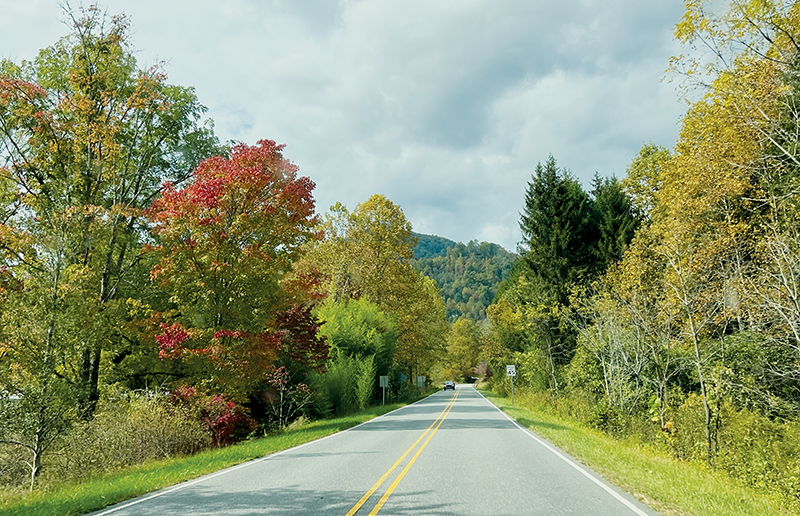
Stecoah – As three separate crews progress through the massive undertaking that is the “Corridor K” expansion, the last unfunded section of the current project has received new life.
In a May 28 press release, Congressional Rep. Chuck Edwards (R-Hendersonville) announced that $20 million had been secured for what is currently the only untouched piece of the puzzle: a 2.807-mile stretch of North Carolina Highway 28 between Stecoah Road and Red Barn Hollow General Store in Wolf Creek, which is where the original renovations ended in the 1990s.
The funding was awarded to the N.C. Department of Transportation through the U.S. DOT Nationally Significant Federal Lands and Tribal Projects Program. The state department of transportation has been scheduled to “let” (award contracts based on bids) the final section several times, but has had to delay the process due to a lack of funding; brought on by increased construction costs that came in as a result of the pandemic, which has already caused the project to exceed its original budgeted amount by over $100 million.
“The $20 million funding for Graham County’s construction of Corridor K is great news for WNC,” Edwards said in the release. “The Appalachian Mountains make up the vast majority of our beautiful district, and I’m grateful that the U.S. DOT agreed with me about the merit in funding to build this highway and give the region the necessary resources to boost economic development in an underserved area of the district.”
The final portion was renamed “Section CD,” after being separated from the original plan when the money dried up. “Section A” spans Graham County from the Five Point Road intersection in Robbinsville to Beech Creek Road in the Sweetwater community; “Section B” continues from Beech Creek to Stecoah Gap; and the rechristened “Section CC” keeps the progress flowing to the current end of roadwork at Stecoah Road.
Edwards has also strongly advocated for the outright elimination of proverbial roadblocks in place that prohibit development along the Appalachian Development Highway System. In September 2023, he introduced H.R. 5835 to the Committee on Transportation and Infrastructure
Where the final connective tissue on the Corridor K route would land has long been a point of contention, but when Edwards introduced H.R. 5835 in September to the Committee on Transportation and Infrastructure, the answer was clear: improvements would be made along U.S. Highway 129 (Tallulah Road) to Topton. From there, upgrades would be made to the four-lane highway connector in Andrews. To ensure funding would be available for the new concept – which tacked 15 miles onto the existing verbiage – H.R. 5835 simply strikes “three thousand and ninety miles” from the allotment of federal monies for the Appalachian Development Highway System; and replaces the distance with “3,105 miles.”
History
First conceived by the Appalachian Development Highway System in 1965, “Corridor K” is all that remains of a planned 128-mile improvement between I-40 near Canton and I-75 in Cleveland, Tenn. Most of the work was completed by the early 1990s, but officials were stymied by local advocates who wanted to protect the integrity of the Appalachian Trail and the purported area where the infamous Trail of Tears began in 1838. The Appalachian Trail crosses through Graham County; the Trail of Tears is believed to have began in the Long Creek community and followed a similar path as present-day Tatham Gap Road.
The popular belief was that Corridor K would see crews clear a pathway through Graham County’s mountainous terrain, disrupting both routes. A compromise was reached to build the first land bridge in North Carolina at Stecoah Gap, which would allow hikers and wildlife alike from the Appalachian Trail to cross over N.C. 28 without fear of being struck by traffic.
Likewise, the workaround for diverting traffic from the planned route through the Snowbird Mountains at Tatham Gap Road – which would have connected the corridor to U.S. 74/129 in Andrews – was rumored for quite some time.
The N.C. Department of Transportation held an official groundbreaking for the project Oct. 3, 2022 – just 57 years after the concept was first pitched.