
County health director recognized with state award
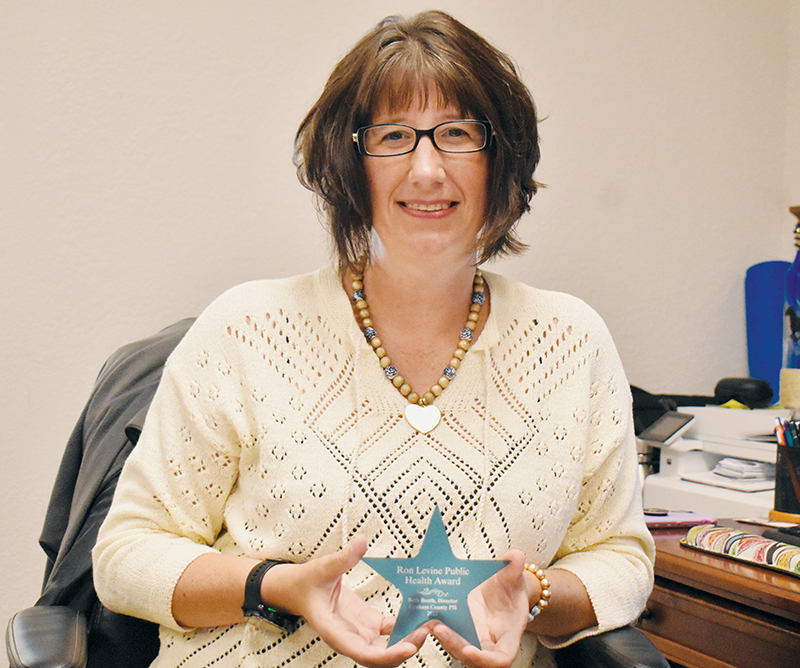
Tallulah – It is a very distinguished award, but this year’s winners might be the most deserving yet.
Helping wade through the murky waters of the COVID-19 pandemic, local health directors – 85 to be exact – across North Carolina were recently presented with the Ron Levine Public Health Award. Levine was a former N.C. state health director.
On the list was Graham County Department of Public Health Director Beth Booth.
“The award is centered around innovation and forward-thinking work,” Booth said. “Of all the states in the nation, we ranked No. 2 – behind Vermont – for COVID response. The state was also nationally recognized for its equity work – regardless of your skin color, gender or anything – you were vaccinated.
“It was a huge, huge undertaking by all the local health directors and departments.”
COVID in Graham
The latest data shows that Graham County has had 31 deaths related to COVID-19 and 2,726 reported positive cases.
“Graham County fared very well in its response, compared to other counties in the region,” Booth said. “We succeeded more than some people probably expected us to, especially with all the conspiracy theories around the vaccine and the huge division the vaccine caused. We actually ended up with about 50 percent (of the count) vaccinated.
“I attribute a lot of that to my staff, because they are homegrown. Everybody knows and trusts them. When somebody calls you locally, it means a lot more than if someone gives you that information on the vaccine on WLOS or Facebook.”
Booth also noted the success of addressing the spread of the virus within Graham County Schools, expressing gratitude for the great working relationship the district has with the Graham County Health Department.
“We have an awesome working relationship with the school system here,” said Booth. “Rather than having to build the plane as we flew it – like a lot of other communities had to do – that was not the case for us. We were able to work with community partners to get things done.”
Booth also collaborated with the Asheville-based Mountain Area Health Education Center to set up a mass-vaccination clinic for Graham County, which was held Nov. 13 at Robbinsville High School. More than 200 vaccinations alone were documented during the event.
The reality is that the virus will never completely go away, but it has weakened significantly.
“It has kind of followed the same pattern as other pandemics in the past, like the Spanish Flu (February 1918 through April 1920); it’s still there, but it wanes over time,” Booth explained. “When it first hit – and you have no natural immunity to it – everybody caught it, but you didn’t even have the immune system to react to it, so it was bad.
“(The) Delta (variant) was worse, but by the time (the) Omicron (variant) gets here, most of the population had either been vaccinated or contracted it naturally, so you have a little bit of immunity. So with each new variant, you build up so much immunity that you (eventually) end up with a headache and a runny nose.
“Will it ever go away? No. It’s like the flu or any other respiratory, contagious disease. It’s going to keep cycling through.”
Dream fulfilled
Booth took over as Graham County’s health director on Nov. 2, 2017. Originally from Smyrna and Otway – both located in Carteret County – Booth and her husband, Jack, had already enjoyed vacationing in the western mountains of the state.
She graduated from East Carolina University, but traveled to Western Carolina University in Cullowhee for an internship to become a registered dietitian. Booth also holds a master’s degree in public health. Expressing a desire to be a health director, Booth interviewed for the position in Graham County and once offered the role, felt more comfortable relocating across the state.
“It feels like – especially given the time of my arrival – God put me here for what was to come two years later,” Booth said. “That gave me enough time to build relationships.
“A lot of health departments lost a large majority of their staff (during the height of the pandemic), but I didn’t really lose anybody. I have the same nurses and office staff I had when COVID started. It is a very tight-knit group, and I attribute a lot of our success to them. They make me a great leader.”