
* Part 1 of a 2-part report
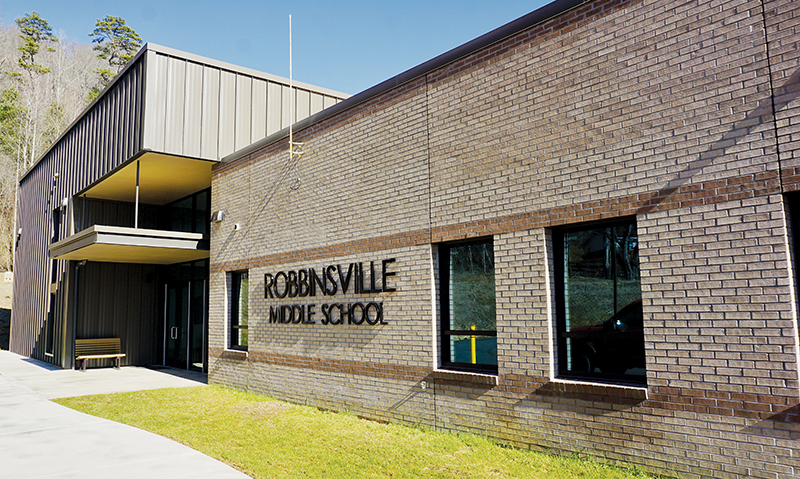
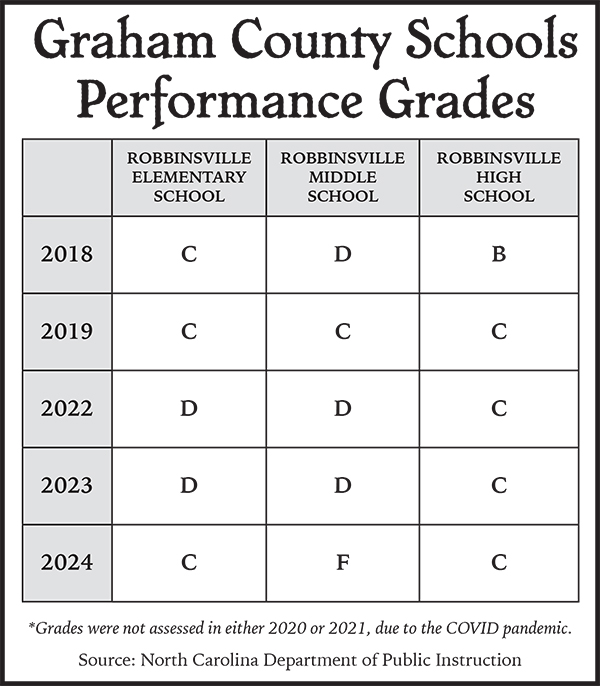
Robbinsville – The N.C. Department of Public Instruction has issued its annual school performance grades for each district across the state. Both Robbinsville elementary and high schools received a “C,” while Robbinsville Middle School was scored as an “F.”
The Graham Star sat down with administrators at each institution and asked for details on key areas that the facilities will focus on to improve each mark. All three schools in the district welcomed both new principals and assistant principals for the 2024-25 calendar – a byproduct of newly appointed Superintendent Robert Moody’s strategy of moving staff around to increase productivity.
Coupled with presentations from each school at the Oct. 2 Graham County Board of Education meeting, the system has worked with consultants and local advisory panels alike to develop individual plans of action.
The state did not issue grades in 2020 nor 2021 thanks to the impact COVID had on public education. Remote learning became the primary method after the pandemic was declared official in March 2020, but students were slowly allowed to resume in-school instruction months later – with an option to remain at home.
It wasn’t until fall 2021 that schools nationwide resumed normal schedules, though quarantine rules were still in effect. The disconnect of public-school students expected to perform at a high level – while not sitting in a classroom environment – was evident, as parents suddenly had to become tutors on curriculums that varied significantly from what they might have learned while in school themselves.
Grades are determined based on achievement (end-of-grade or ACT) scores (80%); and growth (20%).
Middle school
Prior to COVID, Robbinsville Middle received a “C” in 2019. The school dropped to a “D” in 2022 – when grades resumed – and 2023.
For the 2024 mark, Robbinsville Middle did not meet growth, dropping to a 64 after reaching 83.3 last year. The performance score was 36 (down from a 47 in 2023).
Students at the school undergo end-of-course standardized testing. Scores were a 27 for English/language arts (down from 47 last year) and 17 for math (32 in 2023).

Stuart Nelms was promoted to principal in July, replacing the retired Tonia Walsh. Brent Icenhower has been named assistant principal.
* “Rigor in the classroom” was what Nelms called the biggest area of focus. “The word ‘rigor’ gets tossed around, but that’s as far as it goes,” Nelms said. “We’re trying to focus on teaching core content.”
* Interventions. “If a student is in eighth grade and struggling by reading on a sixth-grade level, they can get eighth-grade core (instruction) in class and, during that intervention time, they will get the sixth-grade material that helps to fill the gap and get them where they need to be.”
The interventions themselves will be handled by another pair of new hires for Robbinsville Middle: Shae Mullinax, who moved up from the elementary school to become a transition coordinator; and Reece Adams.
Nelms also discussed the drop in test scores.
“There were a couple of years where the tests didn’t matter,” he said. “In 2020, they didn’t have them; in 2021, the state didn’t hold the students accountable to them. They were passed on to the next grade without that accountability factor, but we’re slowly getting the students back to realizing that the tests do matter. Things seem to be going in that direction.”
Attendance and morale amongst the student body was two areas of focus Nelms revealed that the school was focused on repairing.
“We’re focused on teaching from bell to bell and trying to get away from downtime,” he added.
Nelms also revealed the presence of Professional Learning Communities, or when teachers hold strategy sessions on methods of improving classroom instruction. It’s a method proposed to Nelms by independent coaches, and it already seems to be paying dividends.
“They’re going to dissect data, they’re going to look at testing reports and dig deep,” Nelms said. “That’s going to hopefully improve instruction in the classroom.”
One of those coaches is Dr. Jeana Conley. Along with retired Clay County Schools instructor Jim Saltz and Amy Hobbs – another retired teacher from Graham County Schools – Conley is working with the Bridges to Learning Tutoring Center, a Murphy-based organization that helps students and school systems with specialized curriculums.
A graduate of Andrews High School, Conley served Cherokee County as an educator for 32 years, spending the last eight as the system’s superintendent until retiring in 2022. She holds a bachelor’s degree in English education from Western Carolina University as well as a doctorate in educational leadership from Liberty University.
She has logged a lot of time in Robbinsville Middle’s classrooms – alternating between three full days or six half-days each month, depending on the needs of instructors – and offered an honest assessment of how well things are going regarding the improvement plan.
“This is an opportunity to look at these grades as a blank canvas,” Conley said. “There are so many teachers that have came to the profession from a non-traditional educational background. I’ve been very pleased to have encountered those who are willing to hone their strategies and to do their presentations in a way that they can be delivered, so the students can retain information in a way that it needs to be.”
The nationwide teacher shortage has forced districts to get creative in its hiring practices, leading to some instructors taking over a classroom with little to no experience. There are positives and negatives to the concept.
“Part of it is helping the faculty learn how to play the state’s game and how to score on that test,” Conley said. “But I do think it’s a mistake for anybody to judge a district based on the grade.”
She added that the formula used to calculate a school’s letter grade – 80/20, performance vs. growth – needs a second look.
“If I had any influence on policy, I’d flip that,” Conley said. “Every school in Graham County grew, which is what they expected the kids to do. That’s a lot to be proud of.
“One of the big things that we emphasize is that children are more than numbers. While I’ve been working in Graham County Schools, I’ve been so impressed with the level of care and dedication for all the students that these teachers work with.”
Elementary school
A “C” institution before the pandemic, Robbinsville Elementary dipped to a “D” during both the 2022 and 2023 grading period.
So the return to form for the most recent cycle was encouraging. Though the growth score was slightly lower (77 for 2024 and 80.2 for 2023), the school’s performance grade grew from 50 to a 55.
Methods of testing vary, as younger students are not expected to complete a standardized test (those begin when a child enters third grade; grades K-2 undergo “assessment screenings” by teachers).
Scores were a 73 in English/language arts (down from 79.8) and 77 in math (a slight decrease, from 77.2).
Kevin White stepped into the role as principal at Robbinsville Elementary for this session. Brandy Carpenter received a promotion to assistant principal.
“We’re both brand-new at this, so we’ve both had to look at a lot of data to try and determine where we can improve,” White said. “We’re excited that we’ve exited the state’s school-improvement area, but there’s still room to grow.”
He said a statewide survey – titled “Teacher Working Conditions” – issued to teachers helped build a lot of the elementary school’s improvement plan, as White and Carpenter both culled through the responses and noted that the staff were asking for “a lot of good stuff,” in terms of areas that need addressing.
“A lot of where this plan came from is exactly from the survey,” White said. “We wanted to do what we thought was going to best serve our kids.”
Elementary-level instruction serves as a conduit for helping a child grow into a personality they will carry for the rest of their lives. As such, the improvement plan focuses on critical areas that synchronize perfectly with those ages 5-10 may absorb, such as:
* Classroom management. The plan reveals that a behavior intervention support staff member has been employed by the school to help with this. “We’ve implemented a Responsibility-Centered Discipline,” said White, adding that training for the curriculum first began in October 2023. “The big ask is to help with student behaviors and getting them to take responsibility for the way they act.” The plan notes that incentives are offered based on how well a student behaves.
* Grade-based instruction. Robbinsville Elementary has also implemented a heavy emphasis on PLCs, with teachers participating weekly in the communities. The hypothesis is that core instruction will improve, in direct correlation with the creation of “pacing guides” for both language arts and math. The long-term goal is making sure all classrooms in a specific grade are teaching the same content at the same time.
* Tiered curriculums. Drawn from the state department of instruction’s Multi-Tiered System of Support, the school has given teachers the freedom to deliver evidence-based instruction that matches individual needs. Referral forms for exception children have also been created, as has a local tier team.
* Principal in the classroom. White makes his rounds to classrooms and as the plan succinctly puts it, “provides timely, clear, constructive feedback to teachers.” An observation schedule is in place, as are data meetings with instructors. “We want teachers and students alike to be comfortable with administration,” White said. “We’re trying to get in and out of classrooms on a consistent basis, to where teachers are comfortable coming to us and letting us know how we can help them. But, of course, all education comes back to building relationships with kids.”
* Improved communication with parents. Robbinsville Elementary is on a mission to make sure no stone is left unturned when it comes to parent/teacher communication. New to the school year are the introduction of ClassDojo and Remind 101 (both online platforms for communication), plus a renewed focus on updating the school’s Facebook page, sending home mid-term reports to parents and twice-yearly parent/teacher conferences. “It may be a several-year process, but we’re trying to get to a point of consistency where parents aren’t trying to figure out something new every year,” White said.
Carpenter added that any lingering effects from remote learning have almost been eliminated, as students who were in kindergarten when COVID began are now in fifth grade and will be moving to middle school for the 2025-26 year.
“Issues do still filter in from home life,” Carpenter said. “Initially, the elementary took the biggest hit on a report card – because the kids in middle and high school knew how to write, how to read and how to do basic math. They had study skills and knew how to work a computer, but elementary students required a parent or someone to sit with them and help them as they go.”
“We’ve got this plan submitted to the DPI, but if we find things during the year that need to be adjusted, that’s what we’re going to do,” White added.
* Next week: The high school’s plan; the district issues a statement.