
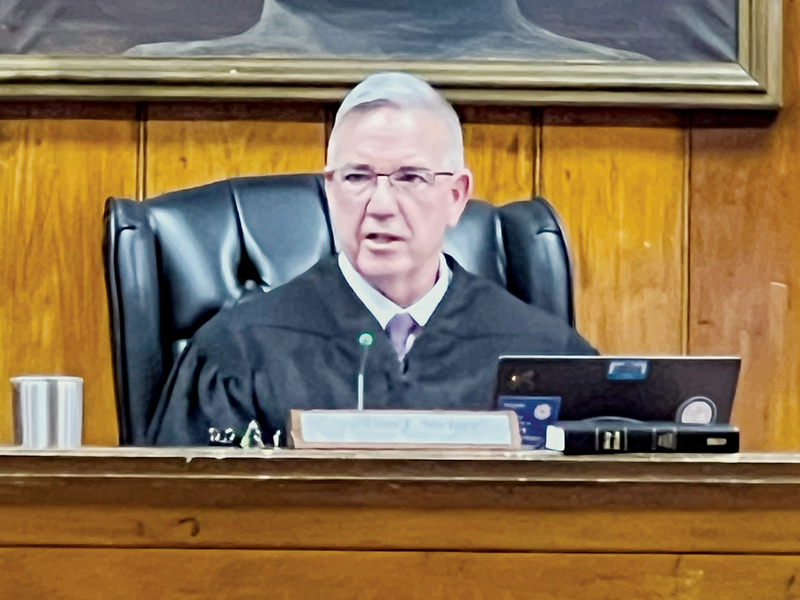
After deliberating for just over a week, Special Superior Court Judge William T. Stetzer ordered Monday that Brad Hoxit be removed from the office of Graham County Sheriff.
Currently serving an eight-year term as a Superior Court Judge in North Carolina's Fifth Judicial District, Stetzer took on the case – State of North Carolina v. Harold Bradford Hoxit – after District 43A Senior Resident Superior Court Judge Tessa Sellers recused herself from presiding over the proceedings. Sellers signed off on the 53-page verified petition for Hoxit's removal filed by District Attorney Ashley Welch on Jan. 29, which alleged that Hoxit committed repeated acts of willful misconduct or maladministration in office, in violation of N.C. G.S. 128-16(2); as well as engaged in corruption of office and extortion, pursuant to N.C. G.S. 128-16(4).

The state's case revolved around an investigation Hoxit had the Graham County Sheriff's Office launch against Graham County Commissioner Jacob Nelms last year, regarding alleged violations of Nelms' duties in his role as the county's building inspector. Hoxit is now married to Nelms' ex-wife – though testimony provided during last month's hearing indicates the couple has separated.
Eventually, the investigation expanded to include the N.C. Department of Insurance and the District Attorney's Office.
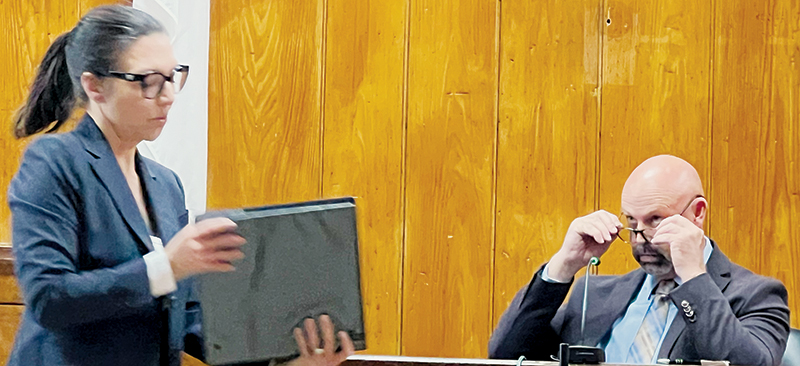
A motion hearing regarding the civil filing was held Feb. 20, while the hearing itself took place in Graham County Superior Court between March 24-27. Twelve witnesses testified – including Hoxit himself taking the stand as the final witness.
Before adjourning, Stetzer reflected upon the significance of the process. Simply put, Monday's order sets a precedent in North Carolina.
"The statute requires these type of hearings occur rapidly, but that doesn't mean I'm in a position to issue an order today," Stetzer said. "I think it may appear at times that the court system is not very efficient – and I would agree: the court system is not designed to be efficient. It is designed to get things right, instead."
Conclusions
Stetzer's 12-page order concluded with the judge focusing on 23 different points that led to his verdict, which included:
* After citing the general statute used to justify the Jan. 29 petition for removal, Stetzer's order points out that case law is non-existent for sheriff's in North Carolina regarding willful misconduct. He instead notes the case law for judges on the matter, "willful misconduct in office is improper and wrong conduct of a judge acting in his official capacity done intentionally, knowingly and, generally, in bad faith."
* Stetzer goes on to state, "Here, Hoxit's conduct during the Nelms investigation involved multiple acts of dishonesty," citing examples such as informing N.C. Department of Insurance Criminal Investigations Western Commander Leonard Stump that Welch had given the approval to continue the Nelms case, just two weeks after Welch told him differently; telling N.C. Department of Insurance Special Investigator Jasmine Hanline that Welch would prosecute Nelms, after Welch had said the opposite; Hoxit's failure to disclose his marriage with Nelms' ex-wife to Welch during an August meeting regarding the Nelms investigation, despite the nuptials only being exchanged six days prior; and that applications for tracking orders and search warrants would not have been signed off on by North Carolina Fifth Superior Court District Judge Alan Z. Thornburg without Hoxit's "deceptions."
* Stetzer goes to state his belief that Hoxit should warrant a Giglio letter and a notification to the Criminal Justice Standards Division, per N.C. G.S. 17C-16.
* Hoxit's "willful misconduct" is backed up by Stetzer noting Hoxit both initiating the Nelms investigation, as well as consistently remaining involved with the case. "An investigation brought not to uncover criminal activity but to harass or stalk Hoxit's intimate partner's husband, and later his wife's ex-husband, cannot fail to bring the Office of Sheriff into disrepute," Stetzer wrote, later pointing out that "Hoxit's insistence on secrecy throughout the investigation demonstrates that Hoxit's misconduct was committed knowingly and in bad faith."
* Stetzer agreed with the maladministration allegation by citing the interaction with former Graham County Detention Officer Vanessa Carpenter, during which Hoxit directed Carpenter to create a fictitious email in order to send public records requests to Graham County. "While there is ample case law allowing law enforcement officers to engage in subterfuge during an investigation, Ms. Carpenter was not a law enforcement officer and was not (in her mind) conducting an investigation," wrote Stetzer.
"Hoxit's conduct, as disclosed during these proceedings, failed to maintain the dignity and honor his office required of him," Stetzer later said. "The Court concludes that Hoxit's misconduct resulted in the misuse of public resources of Graham County, the NC DOI, the NC Office of the Attorney General, and two superior court judges.
"The Court concludes that the use of official resources to conduct a personal investigation constitutes conduct of ill repute that undermines public confidence in law enforcement and demeans the dignity and integrity of the office of sheriff."
The Graham County Board of Commissioners appointed Russell Moody to serve as temporary sheriff Feb. 23.
A permanent sheriff will be elected during the Nov. 3 general election.
To read The Star’s extensive coverage on this case, call 828-479-3383, or visit grahamstar.com to subscribe and gain access to our online reports.