
Infestation can kill hemlocks in 3 years
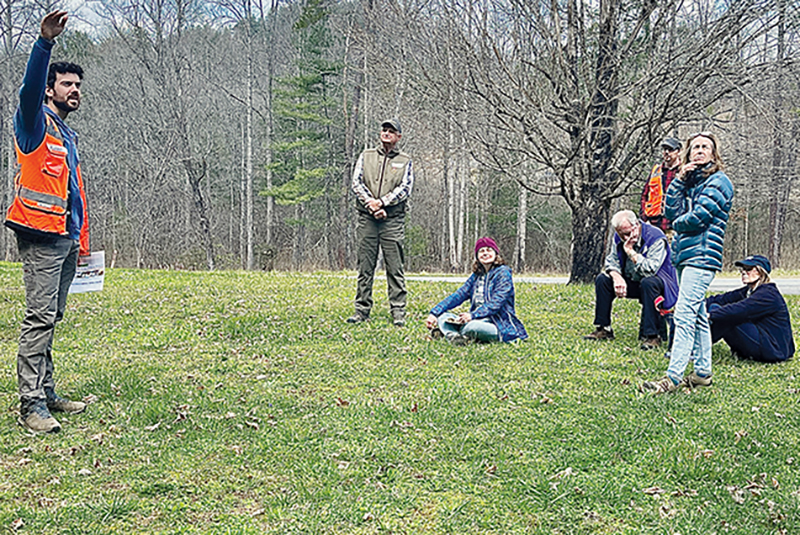

Snowbird – A small group of people from several surrounding counties gathered around Aaron Whittemore as he described the eastern hemlock tree close by.
This tree is struggling to live, he explained. It is borderline whether it could be saved – and whether it was worth the expense and effort to even try.
Off to the other side is a hemlock doing much better; although stricken, it is worth the effort. And off in the distance, beside a stream, is a robust hemlock, a perfect example of a tree worth protecting – except its nearness to the creek complicates things.
Whittemore works with the Hemlock Restoration Initiative, a group that identifies hemlock woolly adelgid infestation and provides treatment for hemlocks that can benefit from tree-saving measures. They work throughout western North Carolina, including Graham County.
Members of the group combine treatment visits with educational demonstrations for landowners, land managers and tree care professionals. During the March 29 session – this time off Massey Branch Road, across from the U.S. Forest Service Cheoah Ranger District complex – there were landowners from as far as Franklin eager to learn how to protect their hemlocks.
Hemlock trees in western North Carolina are an important and irreplaceable component of forests, according to Hemlock Restoration Initiative literature. They once accounted for half of all living plant life along mountain streams in the region.
The loss of eastern hemlocks is the tip of the iceberg, according to researchers. The decline of eastern hemlocks has resulted in increased erosion, sediment and stream flow. This causes less soil, degraded soil and declining water quality. This affects other plant life, as well as animals that feed on those plants.
The tiny insect attaches at the base of the needles of eastern hemlocks and suck out the carbohydrates before they lay their eggs. The egg capsules resemble fuzzy, cottony balls at the base of each needle – that’s where the “woolly” part of the insect’s name comes from.
The hemlocks, carbohydrates sucked from needles, can’t protect their buds in the winter or grow new needles in the spring. Thus starved, an untreated hemlock will die in as little as three years.
The adelgid arrived on ships from Asia in 1924, but infested ornamental hemlocks imported from Asia in 1951 caused the wave that is impacting East Coast hemlocks. The wave reached North Carolina around 1995, but went mostly unnoticed until around 2002, and became a problem between 2006-08 amid a severe drought, said program director Margot Wallston.
In the past, chemical treatments have been expensive and usually done by professionals, but new methods are available that can be done inexpensively by landowners themselves.
People who participate in the demonstrations learn how to assess hemlock health to determine the best treatment options and chemical treatment methods.
They also learn about environmental considerations and whether they should hire a tree care professional.
There is a lot to consider when treating hemlocks, said Seth Mullinax, who also works with the Hemlock Restoration Initiative. The first consideration is whether a tree can be saved at all.
“If a tree is dead or close to it, we can’t bring it back,” he said.
The ground temperature must be above freezing. Treatments can be applied after a recent rain, but not too soon before an inch or more of predicted rain. Special care must be taken if a hemlock is too close to a body of water.
The treatment is harmless to vertebrates including humans and animals, but deadly to invertebrates including beneficial insects and invertebrates that live in water.
There are two main treatments available on the open market: a fast-acting formula that must be applied each year, and a slower-acting formula that can last 5-7 years between treatments.
The two treatments can be combined, however, Mullinax said. Both are applied to the soil surround the tree and are taken up through the root system.
A spray formula can be applied to the needles but provides no lasting relief for the tree, he said. Treatments cost about 5-17 cents per inch of trunk circumference, he said.
Regardless of the treatment, it will take a couple of seasons for dense foliage to return, Mullinax said.
For more information about treatments and upcoming demonstrations, go to savehelocksnc.org or email education@savehemlocksnc.org.