
Annual ceremony honors legacy of Cherokee chief
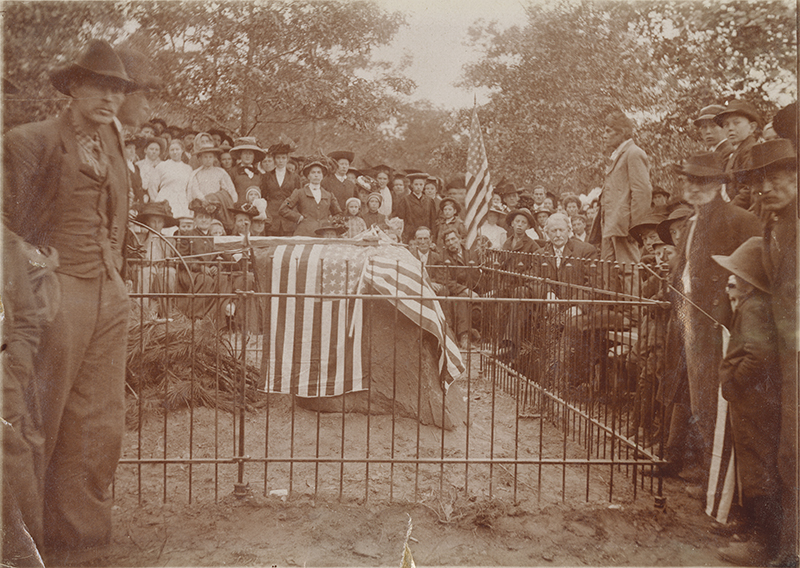
Robbinsville – It was on a Saturday – Nov. 5, 1910 – that the Daughters of the American Revolution dedicated a memorial for Chief Junaluska in Robbinsville.
Pastor Armstrong Cornsilk – a friend of the great chief – spoke kind words, hoping that “All could be happy together.” Friends and family gathered to honor and remember the Cherokee leader who helped to shape America.
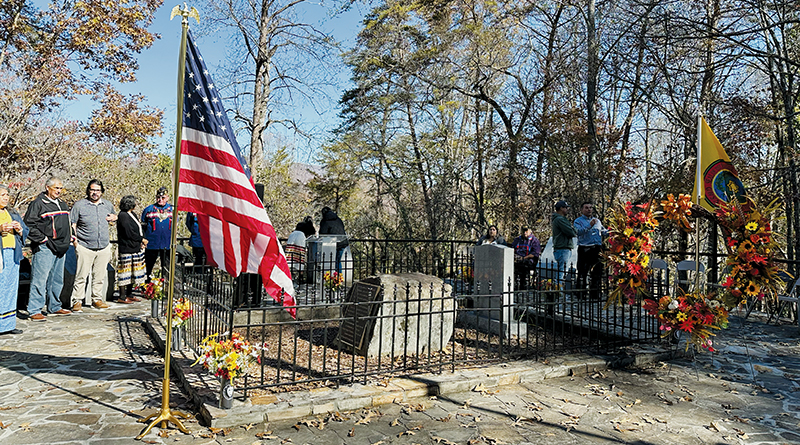
Wednesday, Nov. 5, 2025, friends, family, community leaders and students gathered at the same gravesite to continue the tradition of paying respect and honoring the legacy of Junaluska.
The 115th Annual Junaluska Wreath Laying began with “Taps” and a presentation of flags by the Steve Youngdeer Post 143 from Cherokee. Those in attendance rose for the presentation which was followed by a moment of silence.
During the pause, a gentle breeze stirred the leaves, creating a hush – a gentle reminder of the reason why Junaluska loved his mountain home.
Who was Junaluska?
Born in the year 1779, he was given the name “Gu-ka-la-sgi,” which means “one who falls from a leaning position.”
Junaluska spent most of his life in western North Carolina. He became a United States Veteran and fought in the War of 1812.
Even though he was a great warrior, he strived to live a life of peace. He refused to support Shawnee Chief Tecumseh – who organized a group of Native Americans to prevent the expansion of the United States – and he is known for helping future President Andrew Jackson defeat the Creeks at the Battle of Horseshoe Bend. Junaluska also saved the life of Jackson when he was captured by a Creek Warrior, who intended to kill him.
In an ironic twist of fate – as the Trail of Tears became evident, in 1835 – Junaluska hoped that by having served with President Jackson, he may be able to prevent the removal of the Cherokee. After traveling to Washington, D.C. to speak with Jackson, Junaluska was denied the opportunity to meet with the President.
Despite his loyalty to his country – and a previous treaty in 1819, granting him 640 acres – he was rounded up and forced onto the Trail of Tears in 1838. He was forced to leave his mountains and travel to Oklahoma with thousands of his brothers and sisters of the Cherokee Nation.
During the march, his beloved wife Tina died. He and about 50 others made an escape, but were later recaptured.
By 1841, Junaluska walked the entire 800 miles home – avoiding roads and hiding in forests – only to see his Valley Town reserve had been auctioned off to white settlers. In 1847, Junaluska was given 337 acres of land in the Cheoah Valley (currently Robbinsville), and $100 for his service in the War of 1812 and wrongful removal.
Even though he had lost so much, he never lost his desire to live a peaceful life in the mountains he loved and called home.
He died on his way to healing springs in the Citico, Tenn. area in 1858.
Relatives of Junaluska still live in the Robbinsville area. Some say his spirit endures in the mountains he called home. One hundred and fifteen years after its dedication – as community leaders and members of the Cherokee Nation celebrate his contributions – it is quite possible that Junaluska looks down and he remembers the events that led him to his final resting place.
To the Cherokee Nation, the memorial is not just a piece of property: it is a part of history and a culture.
It is what makes the Cherokee Nation what it has become today.
It is a place where the mountains are always calling you back home.