
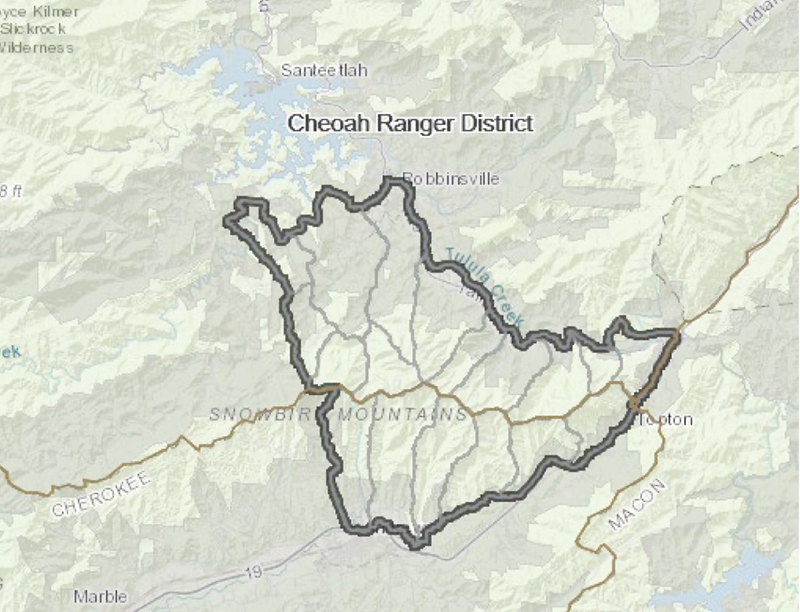
Tatham Gap – The U.S. Forest Service is developing plans to restore and protect portions of a 16,000-acre swath of land between Robbinsville and Andrews, which has many in Graham County worried.
The “Crossover Project” has several goals:
* Restore stream systems and watersheds to a healthy condition;
* Restore rare native communities; threatened and endangered species;
* Restore fire-dependent ecosystems;
* Restore diversity in low-diversity forest stands;
* Restore viable native plant communities by controlling non-native invasive species; and
* Restore wildlife habitat, particularly interior forest early successional age classes.
It may be difficult to realize that Graham County’s rugged, thickly-forested landscape and wild streams – filled with crystal-clear water – could be anything less than healthy, but clearcutting logging practices a century ago and forest management practices since that time have resulted in middle-aged woodlands that lack new growth and old growth, lack wildlife diversity and are vulnerable to non-native factors, including invasive plants.
Located on the Cheoah and Tusquitee Ranger districts of Nantahala National Forest – in Graham and Cherokee counties – the Crossover Project analysis area is 16,378 acres of National Forest System lands in the eastern Snowbird Mountains, between Andrews and Robbinsville.
“Only a small portion of the area will be directly impacted by this project, but the benefits will be widespread,” the forest service said in a report. “The project is focused on conserving forest resources and improving recreation, fish and wildlife habitat, and diversity in age and structure of the forest.”
But landowners, county officials and other residents are concerned that the project will prohibit active uses for the land, further isolate Graham County from economic development, and keep the county poor. Said Graham County Board of Commissioners Chairwoman Connie Orr about whether she supported the project, she answered simply: “No.”
The first public meeting for the project was in 2017, but was delayed due to COVID-19 and a fearsome fire season.
“After several months of study and collaboration with the public, non-government organizations, and county, state, and federal partners, we are now releasing a set of potential management actions for public consideration and comment as part of our scoping process,” the forest service said.
Public comments are being sought to help refine the set of proposed management treatments.
Assessments of the area revealed the need for increasing diversity of age class and structure of the forest to benefit wildlife by establishing interior forest early successional habitat. Silvicultural treatments may include tree harvesting by commercial timber sale, site preparation for forest regeneration and to promote oak survival, stand improvements, crown-touch release, and vine-control measures.
Wildlife-related treatments include rehabilitation and maintenance of existing wildlife openings which provide permanent areas that support nutritious forage, berries, grasses, and other herbaceous species. Watershed and fisheries improvements would restore passage.
Fire would be reintroduced to select areas of the landscape through prescribed burning. The forest service is also considering actions that would improve recreational opportunities in the area. Some reconstruction and maintenance of the existing network of system roads may be necessary and new temporary road segments are proposed to access several areas proposed for treatments.