
Fresh off his November victory over an incumbent, newly elected Robbinsville Mayor Shaun Adams knows what his top priority is.
“My main concern is getting jobs,” Mayor Adams said. “People are really suffering.”
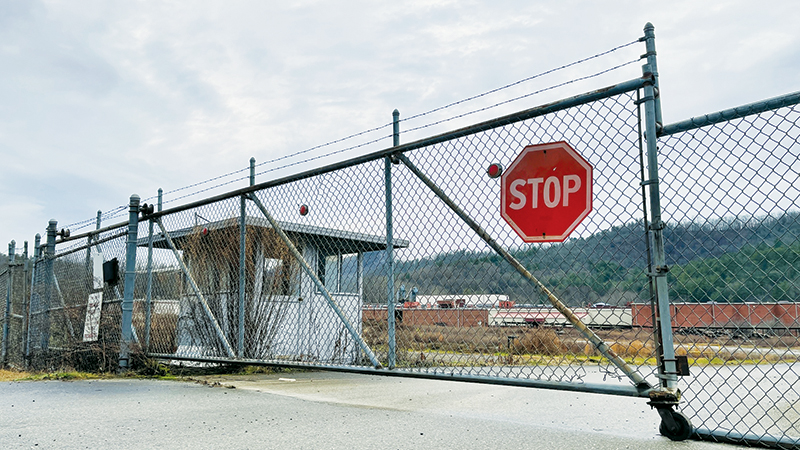
One idea – his only idea, at least expressed during a year-end interview with The Graham Star – is to find a new occupant for the massive, vacant Stanley Furniture Company factory on Snowbird Road.
Stanley Furniture closed in 2014, affecting about 400 jobs in a county that – at the time – had a population of just over 8,700. It is probably no coincidence that Graham County’s population has dropped to 8,030 as of the 2020 census.
Oak Valley Hardwood set up shop in the old Stanley Furniture plant in April 2015 – employing at most 35 people, but closed in May 2019.
The facility is listed for sale at $4.7 million. It encompasses a 37.47-acre parcel with just over 588,000 square feet of contiguous building space. It was built in 1958 for lumber and furniture and zoned for commercial/industrial.
The listing agent said the building is sound, with a good roof and multiple drive-in doors and docks, 23,660 square feet of lumber kiln space, 312,000 square feet of warehouse space, 16 loading docks, one freight elevator and a separate log grading building. A sprinkler system and dust removal system are in place, but need “modest” repair, according to a sales brochure.
Adams looks for inspiration in Blount County, Tenn., Graham County’s neighbor to the north. Blount County had a very good year in 2021, landing Smith & Wesson’s new headquarters – and with it, 750 new jobs – and an Amazon fulfillment center, creating 800 jobs.
There are significant differences between Blount County and Graham County, however, not the least of which is population: Blount County has just over 135,000 residents, compared to Graham County’s 8,030. Blount County also has an interstate highway, I-140, which connects to I-40. Interstate highways are the gold standard for manufacturers looking to build or relocate.
Graham County has some four-lane highways, but no expressways (freeways) and no four-lane highways that connect directly to Robbinsville. That’s a big drawback for manufacturers looking for lower trucking costs.
Big-rig trucks hauling raw materials and components to the Stanley plant and finished goods off to market have to negotiate two-lane surface streets that wind through downtown Robbinsville. Heading the other way, through the Cherohala Skyway and Tail of the Dragon, is probably out of the question for big rigs.
That doesn’t mean Robbinsville is without hope.
The N.C. Department of Transportation is planning improvements between U.S. 129 in Robbinsville and the existing four-lane section on N.C. 28 at Stecoah. The $130.6 million project, called “Corridor K,” would provide 3 to 4-lane highway access to Robbinsville to the rest of North Carolina. Construction is expected to start in August.
Robbinsville is not without other job creation options in the meantime, and one just became available: beer and wine sales.
A controversial subject in this mostly dry county, Robbinsville voters approved beer and wine sales in November, in one case by the narrowest possible margin (two votes).
Once procedures are set in place, beer and wine could be available at local grocery stores, convenience stores and restaurants. New businesses may spring up that specialize in beer and wine. That could have significant impacts on not only Robbinsville jobs, but how Robbinsville looks.
Beyond that, it’s hard to get around the transportation issues, so another route would be to look for industries that rely on other types of infrastructure, such as call centers. All a call center requires is good communication lines and square footage, or – as was proven during the COVID-19 pandemic – workers can even work from home.