
Despite board member’s opposition, school clinic paying dividends for district
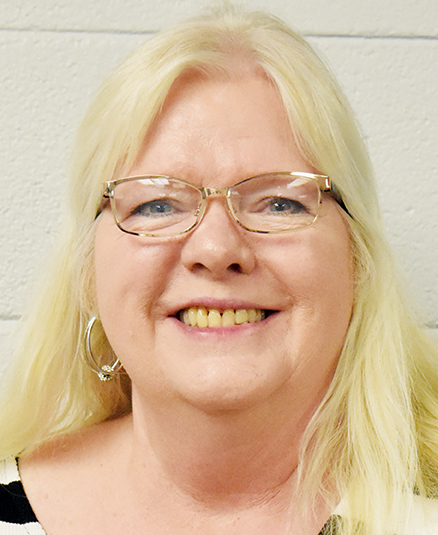
Debra "Hank" Dinschel
* Conclusion of a 2-part report
Robbinsville – Debra “Hank” Dinschel’s presentation at the March Graham County Board of Education meeting drew the ire of many people in the room, including those who work specifically to improve a child’s quality of life.
The newest member of the board, Dinschel was touring Robbinsville Elementary School with superintendent Angie Knight in January, when she walked past the Erlanger School-Based Clinic, which is housed inside the facility. A student was in seated in the corridor, waiting to be seen as a patient and was wearing a mask. (The clinic incorporates an overflow waiting area in the hallway; patients normally wait inside the clinic itself).
Long opposed to masks in schools, Dinschel was stirred enough to speak out against the clinic when the contract between Erlanger and Graham County Schools began to creep into discussions at board meetings. In March, Dinschel presented a quick summary of her issues with having a clinic located inside a school – deeming the premise “Unconstitutional” – and recounting the story of seeing the child in the hallway, wearing a mask.
All the while, seated in the audience was one district staff member who only stewed more as Dinschel continued.
‘Need it desperately’
Latesha Wiggins wears many hats for Graham County Schools. She oversees staff and student support, is the coordinator for both special populations and career development, and is the district liaison for the McKinney-Vento Act, which originated in 1987 as a way to ensure proper education for children who may be homeless. She also holds a master’s of arts degree in education.
At the April 4 meeting, the board was set to vote on renewing the clinical agreement with Erlanger. Wiggins came armed with data from both the school’s counseling programs and the health-based clinic.
Equipped with both a line and bar graph for illustration, Wiggins noted how beneficial the clinic has been for those same students, faculty members and their immediate families. Since March 2022, the graphs report a whopping 1,302 visits from the available demographic (an average of 108 ½ visits per month).
The only instance in which there were more non-sick visits came during the summer months (June and July). Otherwise, sick visits – more often than not – eclipsed non-sick check-ins.
In fact, there were 244 visits to the clinic in February alone – at a time when the flu was running rampant through the district. March saw a drop back to 168 visits.
Wiggins pointed out that recent data shows the median-family income for Graham County last year was $42,207. Children living in either poor or low-income homes across the county was a staggering 46 ½ percent, and there were 42 students in foster care in 2021.
“That has an impact on accessibility to health care,” Wiggins said, before shifting her attention to Dinschel. “You had made a remark at the last board meeting that you could not make a decision unless you were fully informed. I hope these numbers will help with that, because it’s important for our children.
“We are charged with making sure we educate children, and that we take care of them to the best of our abilities. We would be remiss if we believed children do not come to school sick every day, because they do.”
Wiggins later broke down more of the data, which showed that physicians, mental-health providers and dentists are three times harder to obtain access to in Graham County versus the rest of North Carolina.
“We need our school-based health center, and we need it desperately,” Wiggins concluded.
Others in the gallery chimed in to support the clinic, with positives ranging from improved attendance to sports physicals and health-care needs for exceptional children.
Spurning off Dinschel seeing a student sitting in the hallway with a mask on, board member Pam Knott asked about adding an extra layer of privacy to the registration process – in the form of an tri-fold curtain. There are two seats in the registration office of the clinic, but at times of high demand, those waiting to be seen might have to sit outside in the corridor for everyone to see.
“We are certainly willing to do that, as long as the school is OK with it,” said Richelle Phillips, Erlanger business operations coordinator and practice manager for the clinic.
Knight and the rest of the board quickly asserted their vocal approval of the idea.
“It’s been really wonderful to provide a wide spectrum of care, from children all the way through retired teachers,” said Tori Phillips, who began working as the clinic’s nurse practitioner in October. “As far as access and scheduling, unfortunately there is a lack of providers in the area, but anything we can do to help increase that access here and support the school system, we’re all for it.”
The contract was affirmed 4-1. Dinschel was the lone dissenting vote.
Laundering?
As a follow-up, The Star asked Dinschel to detail her opposition to the clinic. Citing portions of the contract, a statement emailed April 14 more than covers her stance.
“I have several well thought-out reasons for you to consider,” Dinschel’s email reads. “First, the contract between the parties was not what I expected. It works like this. In the contract, Graham County Schools are to supply, ‘space, maintenance of medical records, equipment, support and supplies.’ The school also supplies ‘maintenance on the space and repairs to keep the equipment in good working order.’ We are obligated to ‘furnish all usual and customary support to APP.’ To be included in the cost are these, ‘telephone, utilities and housekeeping.’
“Erlanger’s part is to pay for the ‘support staff and to give medical services.’ Erlanger will receive all of the ‘grant monies. All monies from billings for the services are and will remain the sole property of Erlanger.’ As you can see, the money is all Erlanger’s.
“My opinion on this – in short – is this: it looks like laundering money through schools.”
Dinschel then delved deeper into her belief that the clinic is not constitutional.
“This approach is probably my biggest obligation as a board member,” said Dinschel. “You see, when I put my hand on the Bible to swear an oath to the Constitution, I saw this action as I was touching God and telling Him I would follow the Constitution to the best of my ability. Combining two huge entities like medical and education is definitely something you would find in a socialist or communist country; making the medical/education combination not constitutional in nature. Separation of these powers is constitutional, and I will stand with that.”
She then expanded on her brief explanation from the March board meeting, concerning the rights of a parent being violated.
“Parents are not present to represent the child while they are being examined by an Erlanger staff member,” Dinschel noted. “I see this down the road becoming a big regret for parents! Why? Because parents’ rights are already being eroded. I see it up close now and am shocked to see how parents are being drug down the government’s path of ‘do it our way or else.’
Dinschel ended her statement to The Star by encouraging parental feedback to the email address hank.d@graham.k12.nc.us.
The Erlanger School-Based Clinic is open from 8 a.m. to 4:30 p.m. Monday through Friday (closed noon-1 p.m. for lunch). No appointment is necessary, but to schedule one, call (828) 735-8112, Ext. 1027.