
Cancer survivor’s latest challenge perseveres, despite ankle sprains, fractures
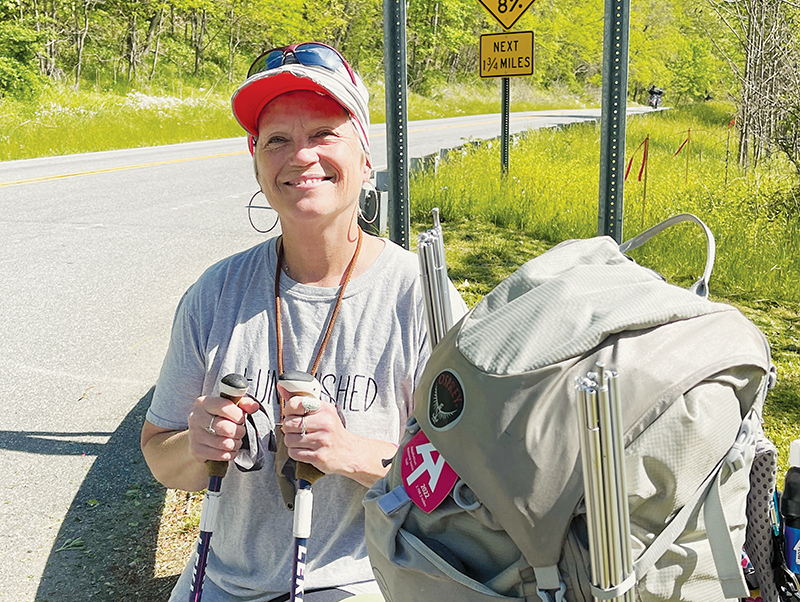
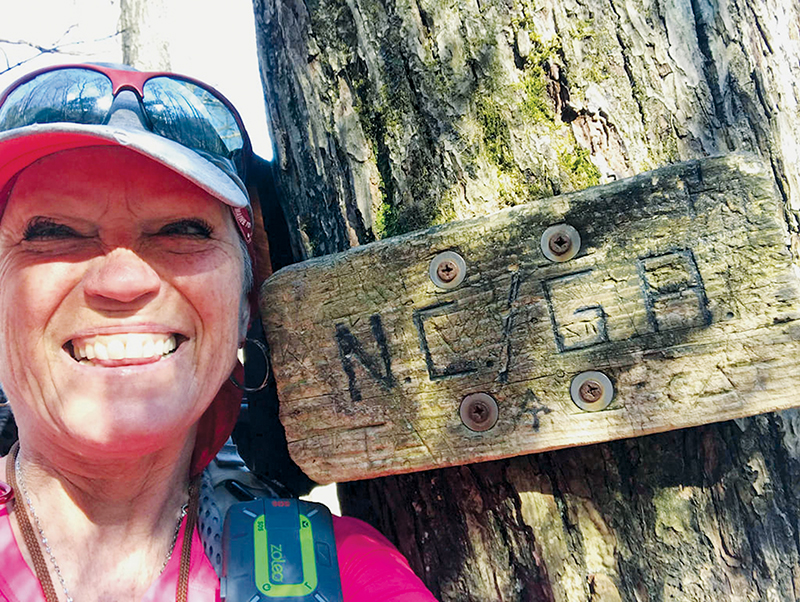
Stecoah – After logging 150 miles on the Appalachian Trail since mid-February, on May 5 – with a good night’s sleep in her own bed behind her – Graham County resident Kelly Karr got a ride to Stecoah Gap from her husband Raymond and resumed her 2,190-mile journey.
Karr lives less than two miles from Stecoah Gap, where the Appalachian Trail crosses N.C. Highway 143 in Graham County.
She has driven through the gap countless times while commuting to work in Swain County, but until summer of 2021, it never occurred to her that she would one day walk the scenic, sometimes grueling mountain trail between Georgia and Maine.
Yet with just book learning and no training, she went from couch to trail and is raising money for cancer research just two years after her own major cancer surgery.
“I’m tougher than I thought,” Karr said.
That may be an understatement.
Desire to hike
Last summer, Karr was working at Fontana Dam and met some Appalachian Trail hikers.
Within days, she became fixated on the idea of walking the trail herself – by herself.
Karr read every book she could get her hands on about the Appalachian Trail. She watched videos. She started making plans to walk the trail starting in March 2023, but couldn’t stand the wait and was concerned that the trail might again close because of COVID-19.
She registered to walk the trail in 2022 – registration number 299. On May 5, the day she resumed her walk after a good night’s sleep at home, there were more than 3,200 people walking the trail between Georgia and Maine.
Her plan was to start early and avoid the crowd. That increases her chances of finding space in shelters along the way. But by February, much of the trail is covered in fallen, wet leaves, and it is difficult to avoid uneven spots, roots and exposed rocks.
Early in her journey, she sprained her ankle and had to return home to recuperate. Back on the trail two weeks later, she suffered avulsion fractures (when a small chunk of bone attached to a tendon or ligament gets pulled away from the main part of the bone) in both ankles.
That didn’t stop her, either. A month later, she was back on the trail.
Previous battle
The fact she was on the trail at all is noteworthy. Karr, 59, survived Stage 2 non-HPV anal cancer.
She is now cancer-free, but only after unsuccessful radiation and chemotherapy followed by surgical removal of her anus, rectum and sigmoid colon at the Mayo Clinic in February 2020. The surgery left her reliant on a colostomy bag.
Now mostly mended, one ankle still wrapped and protected by a brace, she’s again on the trail, hoping to complete the walk by mid-October.
“I didn’t know if I’d like it or not,” she said at Stecoah Gap before resuming her trek. “I thought that if I make it to Stecoah, I’ll know by then if I like it. I actually love it.”
She said the physical challenges on the trail are “humongous” (her word), but she finds encouragement and inspiration in the people she meets along the way, like the 72-year-old retired college dean.
She carries a 30-pound pack, trimmed down from 35 pounds which she found just a bit too heavy. You wouldn’t think five pounds would make that much of a difference, but it does – “oh yes, emphatically,” she said.
Her pack includes clothes, a sleeping bag, shelter, trail tools and food.
Her go-to trail meal is tuna with sunflower oil, mayonnaise and pickles wrapped in a small tortilla. She rounds out her menu with Gummy Bears and oranges.
Sleeping on the trail was hard at first, but she has come to enjoy it.
Kelly walks about a mile and a half every day, although at one point she did 20 miles in two days. Terrain varies wildly on the trail.
Husband Raymond Karr – a retiree and former Marine – supports her on the trail, bringing her food and supplies. When she sprained her ankle, she was several miles from the nearest crossing, and Raymond hiked to her and carried her pack out while helping her with her footing.
The longest Kelly and Raymond have spent apart during the hike has been four days.
Challenges along the trail include cold nights camping out (28 degrees was the coldest) and a 6-mile uphill trail from Nantahala Outdoor Center.
“I’m getting better and faster,” she said. “I can take uphills better.”
“She has her trail legs,” her husband added.
The colostomy bag is held in place by adhesive with spandex bracing. The disposable bag is biodegradable, so she can bury it along the way (subject to proper rules – a 6-inch hole, dug 100 feet from the trail), so in that respect and that respect only, it’s a convenience.
Kelly is using her hike to help bring awareness to the HPV and Anal Cancer Foundation. As of May 10, she has raised $1,080 toward a goal of $2,190 ($1 for each trail mile) for the Anal Cancer Foundation. To donate, go to shorturl.at/vFRSZ.
To follow her progress, search for NOBOKelly on Facebook and ask to join her private group. For more information about anal cancer, go to analcancerfoundation.org.