
Hellbender 28 leads in alcohol-related crashes
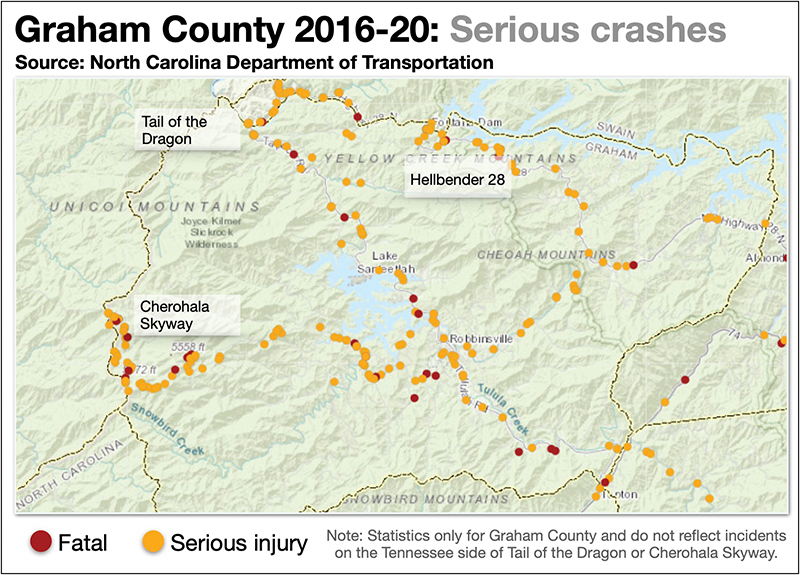
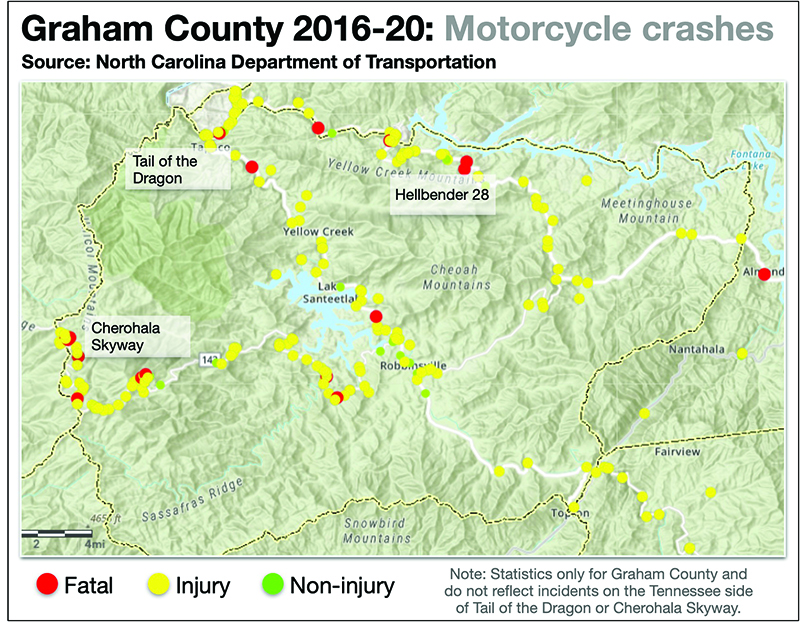
The Tail of the Dragon and Hellbender 28 may be famous for their thrills (and spills), but scenic Cherohala Skyway is the most dangerous of the three major touring routes in Graham County.
The trends were revealed by data collected by N.C. Department of Transportation from 2016-20.
Paradoxically, while alcohol-related accidents are fairly uncommon in Graham County – compared to other North Carolina counties – there were no alcohol-related injury accidents on the skyway during that time period, despite the relatively high number of major crashes.
Hellbender 28 (N.C. Highway 28, from the county line near Almond, until it intersects with U.S. Highway 129 at Deals Gap) is the second-most dangerous scenic route and had the highest number of alcohol-related crashes.
In 2019, there were 93 traffic crashes on the Tail of the Dragon – 57 percent of which involved a motorcycle. There were three deaths on that stretch in 2018, according to published reports.
The three routes had similar ranking for traffic deaths – seven for the skyway, and three each for the Tail of the Dragon and Hellbender 28.
Virtually all traffic deaths during that period involved motorcycles.
The number of fatalities may be attributed to the skyway’s path, which is less curvy and may tend to result in higher speeds and more severe crashes.
One curve on the skyway – just west of Big Santeetlah Road, near the Tennessee state line – accounted for seven major crashes alone, including three fatalities.
Alcohol-related
Hellbender 28 passes through the Town of Fontana Dam, where sale of beer and wine has been legal for years, whereas – except for resorts – the rest of Graham County has been dry.
That will change in Robbinsville, where voters approved beer and wine sales in an election last November.
First out the gate for a beer and wine license – which requires state approval – was the Ingles Supermarket off Sweetwater Road.
Other businesses in Robbinsville have also applied for beer and wine permits, but Ingles was first. Its application has been making its way through Raleigh bureaucracy, but should be in place by early summer, if not sooner.
Defenders of Robbinsville’s dry status will undoubtedly watch for any impacts beer and wine sales will have on traffic safety this coming tourist season.
Deadly year
Statewide, 2021 was the deadliest year on North Carolina in the past two decades, according to the N.C. Department of Transportation.
The 1,755 people killed in traffic crashes in 2021 exceeded the state’s previous record of 1,704 traffic fatalities in 2007, according to preliminary data from the N.C. Governor’s Highway Safety Program.
Last year’s numbers also represented a slight tick – upward of five percent – over the traffic fatalities recorded in 2020.
North Carolina’s data mirrors a national trend. The 31,720 people killed in the first nine months of 2021 represented more deaths on the nation’s roads than the first nine months of any year since 2006, according to data from the National Highway Traffic Safety Administration.
“Sadly, we have seen traffic fatalities moving in the wrong direction for a couple years in North Carolina and across the country,” said Mark Ezzell, director of the N.C. Governor’s Highway Safety Program.
“People are dying in record numbers on our roads, and it’s going to take an all-hands on deck approach from communities, organizations and individual drivers to reverse this trend.”
The 2021 data showed a decrease in some types of crashes compared to 2020 data. For instance, North Carolina saw a decrease in traffic fatalities related to pedestrians, cyclists and work zones.
However, the state saw an increase in other types of fatalities attributed to speeding, unbuckled occupants and distracted driving.
Also – over the past five years – almost all categories have shown a year-over-year increase in fatal crash totals.