
*First in a series
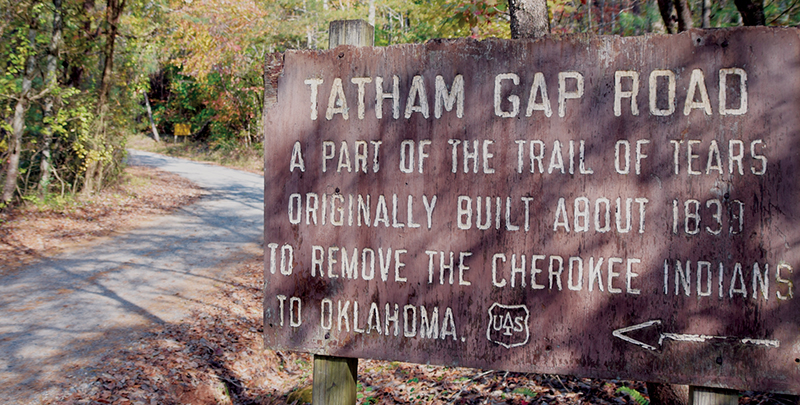
Robbinsville – There is an alternative route between Andrews and Robbinsville: one not burdened with traffic, but fraught with history.
Tatham Gap Road, known to sports enthusiasts as the “Gravel Dragon,” is a U.S. Forest Service road of between nine and twelve miles, depending on who is measuring, with six miles snaking through the Nantahala National Forest. The route switchbacks its way through 2326 feet of elevation, with steep drop-offs and intermittent wash-outs making for a gorgeous nail-biter of a drive.
Tatham Gap is a “dual-purpose/Jeep” road negotiable by most vehicles, but best suited to mules or four-wheel-drive trucks.
Of course, this road was built for anything but comfort.
For the Cherokee of the Cheoah Valley, this route was the beginning of the Trail of Tears.
The “Old Army Road” was originally a Cherokee trail. In 1836, James Tatham surveyed the route, then the U.S Army widened the trail to accommodate wagons. The Robbinsville-to-Andrews route was one of many road-building projects triggered by the 1830 Indian Removal Act. That legislation, written by Andrew Jackson’s allies in Congress and signed by Jackson himself, was the culmination of decades-long efforts to drive Native Americans from their land.
Junaluska – who had saved Jackson’s life at the Battle of Horseshoe Bend – was one of the thousands of Cherokee deported from his homeland.
After the battle in 1814, Jackson had said, “As long as the sun shines and grass grows, there shall be friendship between us, and the feet of the Cherokee shall be toward the east.”
Yet the U.S. government feared the potential for a Cherokee uprising, particularly in the rugged mountains of western North Carolina. In 1838, President Martin Van Buren ordered the U.S. Army into the Cherokee Nation to begin what would become known as “the removal.” The local Cherokee ignored the initial order to leave, but by June of 1838, the federal government began arresting, imprisoning and deporting Cherokee from their homeland.
The U.S. Army first held more than 500 Cherokee in stockades at Ft. Montgomery – later known as Robbinsville – before driving the deportees along the route to Ft. Delaney, in what would become the town of Andrews. Native Americans from all over the southeast were funneled to Ft. Butler, now known as Murphy.
After the removal, Tatham Gap Road became a route for settlers taking up U.S. government grants of Cherokee land.
Junaluska walked the Trail of Tears once more, returning to his home in 1842. He spent the rest of his life in western North Carolina.
“If I had known Jackson would drive us from our homes,” he said, “I would have killed him that day at the Horseshoe.”