
Big Oaks Stadium renovations near final phase
Robbinsville – For a project that has such a narrow window to be completed, everything thus far has been executed like a strategic Black Knights gameplan: to a “T.”
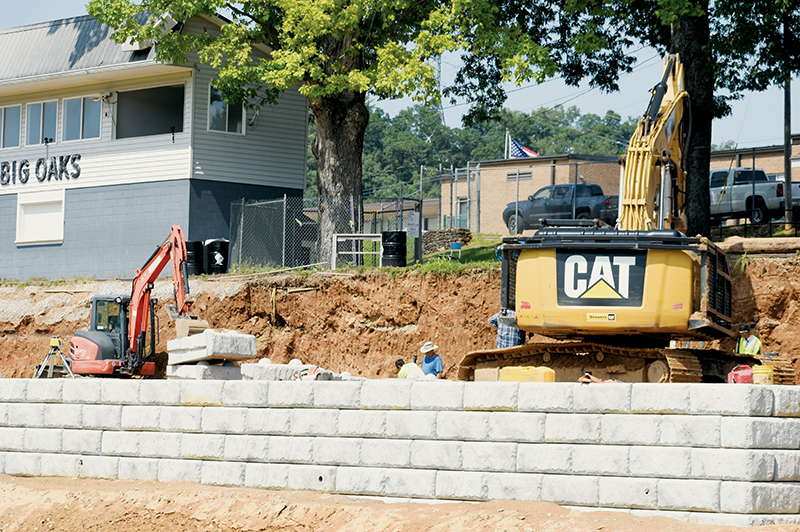
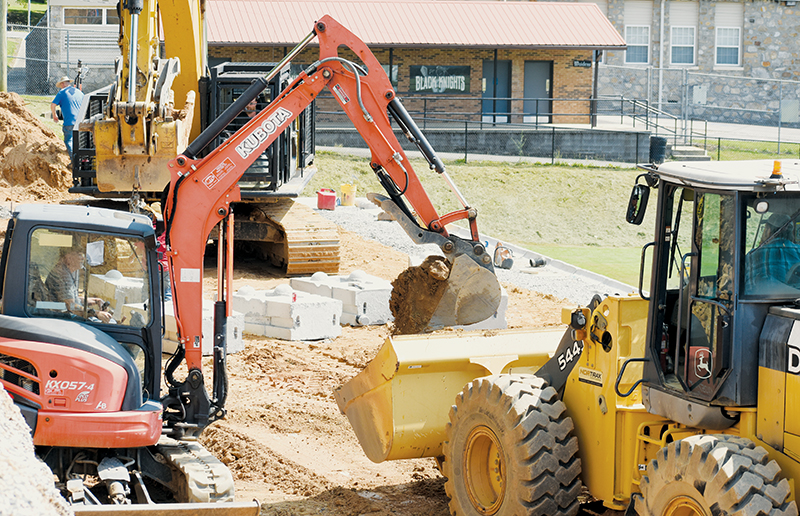
Separate retaining walls has been the latest focus of crews rushing to renovate the home bleachers at Modeal Walsh Memorial (Big Oaks) Stadium in time for the first contest of the 2023 season: a home junior-varsity matchup between Robbinsville and Mountain Heritage, penciled in for Thursday, Aug. 17. One day later, the varsity Knights will begin their quest for success against East Surry.
Time is of the essence, but the idea to streamline aluminum-bleacher installation is moving along quicker than a Robbinsville offensive drive on the famed Bob Colvin Field. Thanks to an estimated donation of $150,000 in equipment and labor from local entities Adams Contracting, K & B Land Clearing, and Lovin Contracting, work has rolled along smoothly under the brutal rays of summer.
At a special-called meeting of the Graham County Board of Education on July 10, Tennessee Erosion Control, LLC was awarded a $395,000 contract for completing the second phase of the project: pouring concrete.
The front retaining wall was finished last week, while the rear wall was forecasted to be poured this week.
Aluminum bleachers are expected to arrive from Tampa-based Southeastern Seating in early-August. The company provided a quote for 1,680 gross seats, in the form of aluminum bleachers – with a 168-foot span, 15 rows and four aisles, which will actually increase the home-side capacity by an estimated 100 seats – in the amount of $66,120.
Notably, the district is acquiring the seating on a “lease-to-own” basis – which could help offset some of the costs on a new stadium.
The only hiccup thus far occurred when the dirt from the demolition recently proved inadequate for packing standards required by the N.C. Department of Public Instruction – but the problem was quickly rectified: out with the old dirt, in with the new.
Graham County Schools’ maintenance workers found a myriad of cracks, gaps and shifts in the bleachers during a spring inspection, with Asheville-based Kloesel Engineering paying the May 15 visit and confirming the dangerous suspicions. First placed in 1981, the bleachers mostly crumbled as they were being cleared June 29.
Timeline
Demolition of the bleachers commenced roughly two hours after a special joint meeting of the Graham County boards of commissioners and education, who swiftly united in the wake of a troubling report from May about the state of the existing bleachers. The seating area was condemned May 15 – just nine days before a planned baccalaureate ceremony and 11 days shy of the 2023 graduation exercise. COVID had forced the year-end gatherings to be moved to the football field; in the wake of the engineer’s decree just three years later, those exercises were hastily shifted back to their former respective homes of Robbinsville First Baptist Church and the high school.
The concrete “bleachers” that were placed on the hill above the field were not actually bleachers at all – rather, they are believed to be bridge beams, donated to the cause. The first real maintenance work concerning the seating was performed around 2013, when the top rows were removed to allow a retaining wall to be poured for what was deemed “settlement issues.”
In 2021, the bleachers were professionally inspected and no shifting was found. Though not a requirement, Graham County Schools’ maintenance department typically inspects the bleachers 1-2 times a year: and it was during the fall 2022 walkthrough that dangers became apparent.
It is unclear just how many rows were improperly placed, but the beams were meant to extend over the row below onto a lip – which would support the stacked structure. Correct protocol would have dictated a roughly 1-foot space between a row and the connection of the row above; it appeared from the June 29 demolition that very few were set as needed to begin with.
The fall 2022 inspection revealed spots of daylight pouring through; cracks in the beams; and one area had actually dropped to the row below.
The bottom row was perhaps the most frightening to look at, with sizable gaps that came after shouldering a heavy 41-year load.