
Around 300 miles from Graham County, over 150 years ago, a Union Civil War veteran was murdered, triggering a family feud that “yellow journalists” would use to define an entire region and all of its inhabitants.
By the time the last victim of the Hatfield-McCoy War was killed in 1891, 13 people were dead and newspapers had cemented the stereotype of the “hillbilly” into the national consciousness.
Humble beginnings
On both sides of the Tug Fork River on the border between Kentucky and Virginia – at the edge of the frontier – the Hatfield’s and McCoy’s were among the earliest white settlers who moved onto Cherokee land.
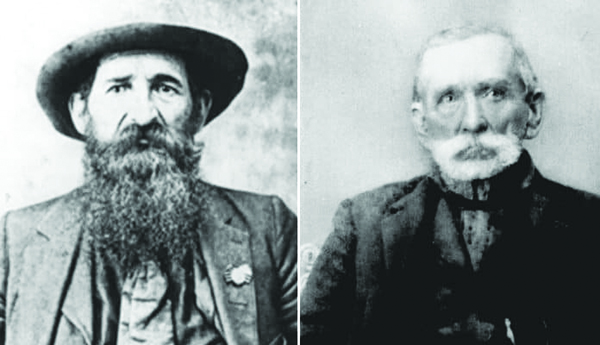
Family patriarch William Anderson Hatfield had formed a band of guerrilla fighters during the Civil War, which was known for his ruthless ambition and capacity for violence. Legend credited Anderson with killing a mountain lion with his bare hands while still a child, earning him the nickname of “Devil Anse” before he was even a man. By the late 1800s, Hatfield owned a successful timber company and was a prominent member of the community, in spite of being completely illiterate.
Randall McCoy, usually known as “Ole Ran’l,” was 10 years older than Hatfield and failed where the younger man succeeded. McCoy tried his hand at timbering, but only wound up losing money and land in the process. The woods that once provided a living were no longer a means of survival: they were a commodity to be harvested and sold.
Hatfield won at this new game, while McCoy floundered, barely managing as a subsistence farmer. Maybe McCoy’s failures put the chip on his shoulder that earned him a reputation as a stubborn and jealous old man.
Shots fired
Whether the feud started over a hog, trespassing or a court case, by 1865, the first McCoy blood had been shed. Over the next three decades, both Hatfield’s and McCoy’s would die. Shootings, stabbings, arson, arrests, pistol-whippings and raids would take their toll, with the violence only ending when the families moved far away from the Tug River Valley.
Though other feuds had higher body counts, the Hatfield-McCoy War garnered the most publicity.
An early New York Times article predicted that “more bloodshed is expected as the members of the families are numerous and vindictive.”
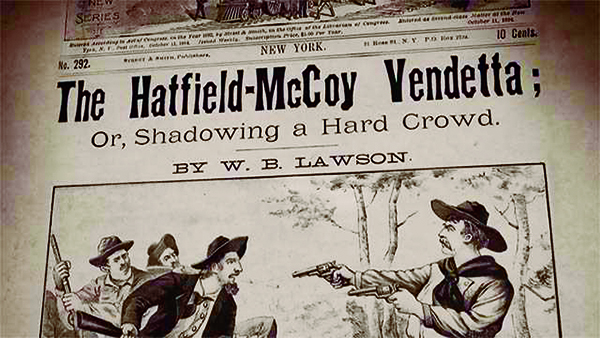
During the 1880s, the OK Corral and Jack the Ripper were reader favorites, so a generational feud between mountain-dwelling families was sure to sell papers. When T.C. Crawford published a series on the feud, called “Murderland,” the media frenzy began in earnest. Crawford turned the
series into a book, An American Vendetta and the legend was burnished into the American consciousness.
While the feud flared and faded over a 30-year span, Appalachia was changing. The seemingly endless forest was falling to big timber companies, while the railroads plowed through the mountains and coal companies turned pioneers into wage-earners.
In this new environment, the rural way of life of people like the Hatfield’s and McCoy’s was an impediment to progress. The more foolish and backward rural people were made to look, the easier it was for industrialists to justify taking the land that had been taken from the Cherokee earlier in the same century.
And the end of the feud did not signal the end of the story. The tale became a theme of pop culture, from Buster Keaton’s 1923 silent film to cartoons starring Betty Boop, Bugs Bunny and the Flintstones. Even today, the hugely popular Hatfield & McCoy Dinner Show plays in Pigeon Forge.
Who won?
At the end of the day, both sides lost family members.
Both families lost their livelihoods and homesteads.
The journalists sold their stories.
The railroads, the coal companies and the timber companies got the land.
And the people of Appalachia inherited a reputation that is still prominent more than a century and a half after the feud began.