
New road named in honor of hometown hero
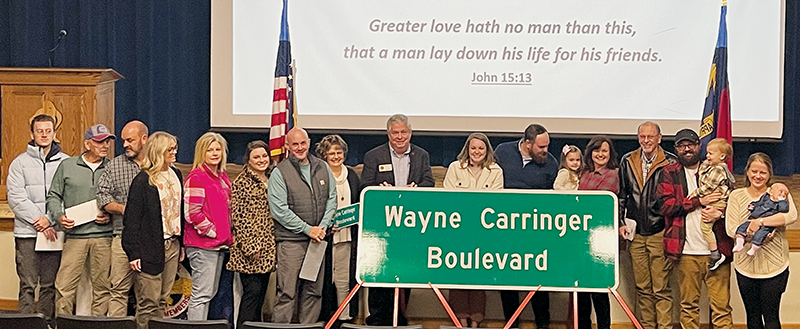

Robbinsville – In February, the N.C. Board of Transportation unanimously passed a resolution dedicating the new access road between N.C. 129 and Robbinsville High School as Wayne Carringer Boulevard.
“I hope you drive down the road and see the sign and remember freedom is not free,” Jimmy Millsaps, pastor at Grace Tabernacle Church, said at a dedication ceremony on Friday. “People have paid a great sacrifice to have this country we have today.”
Family, friends, students, N.C. Department of Transportation and local officials participated in the ceremony to dedicate the road, previously known as Black Knight Way, connecting Rodney Orr Bypass and Robbinsville High School.
Carringer, a lifelong resident of Graham County, died July 1, 2018 at the Asheville VA Community Living Center. He was 98.
Carringer joined the U.S. Army Air Corps in 1939. As the U.S. entered the war in December 1941, he was stationed in the Philippine Islands and was among those forced to surrender to Japanese troops. He survived the infamous Bataan Death March, sweltering conditions aboard prisoner ships, and 3 ½ years of brutal conditions as a prisoner of war and slave laborer working in a coal mine. He saw the mushroom cloud when the atomic bomb was dropped on Nagasaki.
A table at the ceremony Friday featured a picture of Carringer as a young man in his U.S. Army Air Corps uniform, along with a sketch of him later in life. Also on the table were a book titled “Ghost Soldiers,” a replica of the Enola Gay with a piece of metal from the historic plane that dropped the first atomic bomb on a strategic target, and the first POW license plate issued in North Carolina.
When the war ended, Carringer weighed just 75 pounds. He and other newly-released prisoners were transported to Angel Island in the San Francisco Bay to recover their health and weight.
He returned to Robbinsville and took up the mantle of community leader. He served three terms on the Graham County School Board and also served on the Robbinsville Board of Aldermen and as a deacon at his church, Robbinsville First Baptist Church. He was also a Master Mason.
As a community leader, he helped attract industry to the town.
In 1977, he received the first license plate designed for former prisoners of war. It reads “POW-101” with Prisoner of War stamped across the bottom. The Carringer-Webster VFW Post 8635 was in part named in his honor.
Carringer founded the annual Bataan-Corrigidor survivor reunion at Fontana Village.
“If he was still alive, Papa Wayne probably wouldn’t have accepted this honor,” said Robert Moody, one of Carringer’s grandsons. “He was a strong advocate for all veterans and didn’t really believe that he deserved special treatment more than anybody else.”