
1st tour of famed structure in 21 years conducted
Fontana Dam – As the chosen few clamored inside the visitors entrance to the Tennessee Valley Authority’s greatest architectural achievement Friday, a then-unidentified man stepped forward with a tool most today would not recognize, cupped in his right hand.
“Anybody know what this is?” said the man, later revealed to be Fontana Dam Tech 3 Keith Sparks.
Surprisingly, a few answered correctly. Unsurprisingly, those who were right tended to belong in an older age bracket.
“For the rest of you who don’t, Google it,” Sparks dryly challenged, as the room erupted in laughter.
Sparks clutched a slide rule, the latest and greatest in modern technology – when Fontana Dam was built, that is.
In today’s high-tech society, the reliance on updated means to undertake such a project has reached such a level of importance that configuring what it would take to build a 480-foot-tall, 2,365-foot-long dam without being able to design it on a computer might actually put its completion in danger.
Crews needed just 34 months to craft the marvel – all while relying heavily on a slide rule.
In mid-May, the Tennessee Valley Authority issued a press release that caused widespread excitement: a tour of Fontana Dam – completed between Jan. 1, 1942, and Nov. 7, 1944 – had been scheduled and the public was invited. Due to the anticipation of high demand, the TVA used a lottery system to decide who would receive the proverbial “Golden Ticket” (a reference one TVA tour guide made to the crowd, which also drew a chuckle from the audience).
More than 3,000 put their name in the queue. A scant 40 were selected – and five inexplicably no-showed the event, leaving three media personnel to comprise a 38-person showcase. Once as commonplace as the sustainability of the hydroelectric power churned out by the dam, tours were halted in the wake of the Sept. 11, 2001, attacks on the United States.
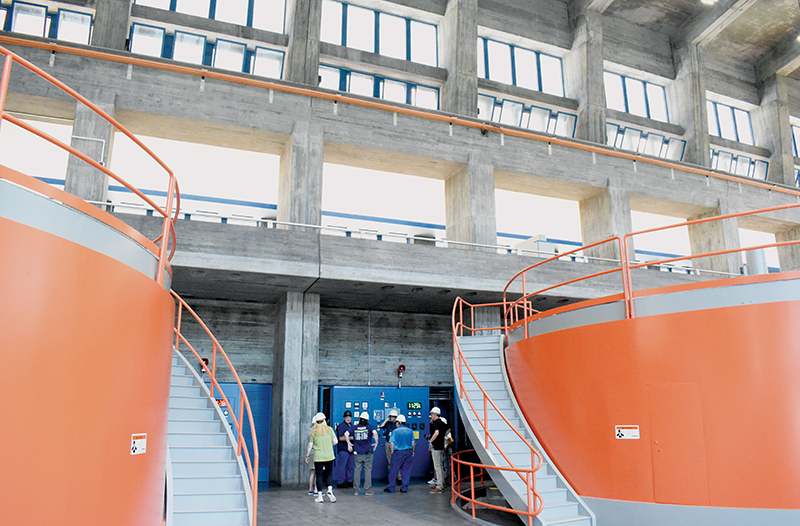
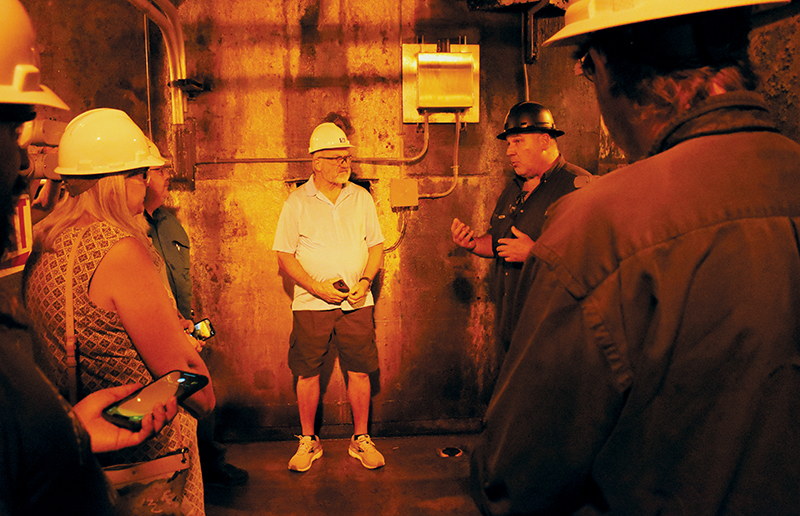
Four groups were given the works: walking into the dam itself, seeing the master-control room (and the innumerable amount of gauges staff keep an eye on at all times), peering at cooling rooms with fans large enough to provide a breeze through an entire valley, an above- and ground-level view of the three massive generators that operate the entire facility, and all the bells and whistles that lie beneath the imposing circles.
The tour even paused at the once-popular railcar, which would cart individuals from the visitors center at the top of the dam to the bottom. But since 9/11, the car has sat dormant and the groups buzzed with excitement about the potential of seeing it return to operation – once a cleaning that would require the purchase of several containers of Pledge and Windex, plus a handful of brooms to clear the cobwebs in the railcar’s holding area took place.
Attendees were given a wealth of knowledge to soak up, including:
* Of the 29 powered dams operated by the TVA, Fontana Dam is by far the largest. To put that into perspective, the dam is the largest east of the Rocky Mountains and the 20th tallest in the country;
* The concrete used to build the 375-foot-thick dam is still expanding today;
* Every 6-7 years, crews are summoned to cut slats across the span of the dam with a diamond blade, to ensure its structural integrity;
* The TVA provides direct power service to residents of the Bee Cove community near Fontana Village. Though only 12-15 homes exist in Bee Cove, each pay arguably the lowest power bills in the world since there is no go-between for service and billing;
* Until 2014, the control room was still comprised of equipment that was installed when the dam went online in 1945. A fire inside the room finally eliminated the still-functioning equipment and the TVA brought the technology into the 21st century;
* A backup room exists underground, with more than 100 massive batteries staying fully charged at all times. The batteries can power Fontana Dam for eight hours, if necessary;
* Tabs are kept on earthquake activity, thanks to an on-site seismograph. The last earthquake to measure high enough on the Richter scale in Graham County (believed to be a 4.2) to warrant a full-blown procedural inspection is estimated to have occurred in 2021.
Why restart tours now? After all, it has been nearly 22 years since the last public tour was held and aside from the railcar, the place is spotless. It almost feels like the crews on-site missed the public milling around throughout the course of the day, asking questions and often standing in awe when the totality of the work finally clicks.
It is simple, really: the TVA turned 90 this year and, after a worldwide pandemic shuttered many public locales for the better part of two years, it felt like the right time to see if the tours would be as popular as before.
The lottery proved the interest is there. Though it might be too early for others to get excited about seeing the inside of the dam this year, Friday’s excursion served as a trial run of sorts for 2024.
And when the TVA begins planning the tour schedule for its network in 2124 – long after Friday’s participants are gone – Fontana Dam will be standing by, waiting for a new generation to marvel at its feat.