
Robbinsville – After careful examination and testimony, the Graham County Board of Elections has decreed that eight separate voter challenges showed probable cause for an evidentiary hearing.
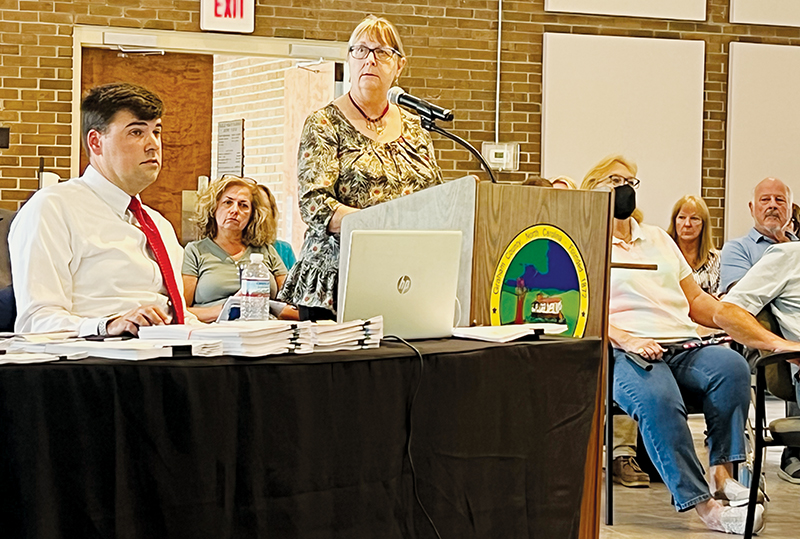
The three-hour session – held at the Graham County Community Building on July 7 – attracted a crowd of roughly 35 Town of Lake Santeetlah residents, as the election board sifted through a combined 465 pages of a filing compiled by Asheville-based attorney John Noor along with Santeetlah council members Diana Simon and Jim Hager. Simon and Hager spent about six months gathering evidence to prove that eight residents – Amelia, Dean, Kaylee, Linda, Olivia and Savannah, as well as John and Tina Emerson – not only did not seek Lake Santeetlah as their primary residence, but that all eight switched their county registrations just before the 2021 general election in an attempt to sway the outcome.
The challengers were allowed to testify about their filings, but those being challenged were not called to speak.
That will come at the evidentiary hearing, which had not been scheduled at press time – though election board chair Juanita Colvard informed the public at the end of the hearing that it could potentially occur in either August or September.
History
In late September, each of the eight voters being challenged sought to switch their registration from Buncombe (the Hutsells) and Mecklenburg (the Emersons) to Graham County.
The Hutsells had voted in Buncombe since 1992, while the Emersons switched their registrations to Graham for the 2017 and 2021 elections before immediately reverting back to Mecklenburg, where they have voted since 2004.
The Hutsells own a large home in Fairview (an Asheville suburb), while the Emersons have a residence in Matthews (a suburb of Charlotte). Both families also have homes in Lake Santeetlah – though the Hutsells’ structure burned several years ago and is still being rebuilt.
The November election sent shockwaves through the tiny municipality, as three write-in candidates – Emerson, Connie Gross and Ralph Mitchell – were each elected by voters with 14 nods of approval each. Simon received the most votes of any incumbent (22), while Hager tied with then council member Keith Predmore for the fifth and final seat at 11. Hager was later selected via a coin-flip tiebreaker.
Simon emailed Graham County Board of Elections director Teresa Garland shortly after the results were announced, stating that she was “surprised” by the voter turnout for the town.
There were 67 write-ins, or 52.37 percent of the total votes cast in the municipality.
Simon and Hager attempted to file voter “protests” – which differ from voter “challenges” – shortly after the November election, attempting to have the votes for Emerson and Gross thrown out, as well as asking that a new election be held.
The rush to file led to several errors, however – including not being filed within the correct timeframe and lines being left blank on the forms. Both were dismissed at both the local (Nov. 17) and state (Dec. 6) level by the board of elections.
Preliminary hearing
Much of the dispute falls on a gray area in N.C. G.S. 163-57, where someone can simply state an intent to reside in a county to be eligible to vote.
“All election officials in determining the residence of a person offering to register or vote, shall be governed by the following rules, so far as they may apply: (1) That place shall be considered the residence of a person in which that person’s habitation is fixed, and to which, whenever that person is absent, that person has the intention of returning …” reads the beginning of the statute.
Amelia, Kaylee, Olivia and Savannah each stated an intent to retire in Lake Santeetlah when changing their registration from Buncombe County to Graham.
Throughout the July 7 hearing, Noor broke down several key points on behalf of Hager and Simon’s challenges. Of note was an article published in a nonprofit, monthly newspaper that serves Fairview, which spotlighted 35 years of service at a local veterinary clinic by Dean Hutsell.
Included in the article are quotes from Dean – which Noor zeroed in on – where the doctor says, “Fairview has been a wonderful community and continues to be the best place to live.” The story ends with Dean stating, “I suppose that Fairview is best described as our family home and we look forward to serving our community for many more years.”
Each challenge was thoroughly reviewed by the board of elections, before Noor and Simon presented their case for each filing. As such, it was noted that – through social-media updates on LinkedIn and Facebook – the four Hutsell children list Asheville (Amelia), Fairview (Kaylee and Savannah) and Raleigh (Olivia) as their cities of residence. In the case of Savannah, she also posted May 5 about accepting a job with the Indianapolis branch of Eli Lilly, a pharmaceutical company.
Simon also took photos of the Hutsells’ Lake Santeetlah residence, under construction. In November 2021, the structure was still being framed; by January, siding was being added.
However, the permit for the rebuild lists the home as having three bedrooms (there are six Hutsells).
In the case of the Emersons, both Simon and Hager admitted at the hearing to combining forces in taking at least 85 photos of the Emersons’ home between November 2021 and May 2022 to prove the Emersons did not stay in Santeetlah very often.
Diana admitted during her testimony to seeing Tina in Lake Santeetlah in early March and John at a pair of later dates, but otherwise the presence of a silver Chevrolet Suburban dominated the driveway of the residence. The vehicle is not owned by John or Tina, but Colvard pointed out that the photographs show new trash liners in the cans outside the home, so someone maintained those during the six-month period.
One final piece of evidence discussed was a certified letter mailed from Simon to Emerson, which was returned as undeliverable to the Emersons’ Lake Santeetlah address in late March, but was accepted at their Matthews address March 28.
Noor also summed up the presentation of the certified letter by citing N.C. G.S. 163-185 (e): “The presentation of a letter mailed by returnable first-class mail to the voter at the address listed on the voter registration card and returned because the person does not live at the address shall constitute prima facie evidence that the person no longer resides in the precinct.”