
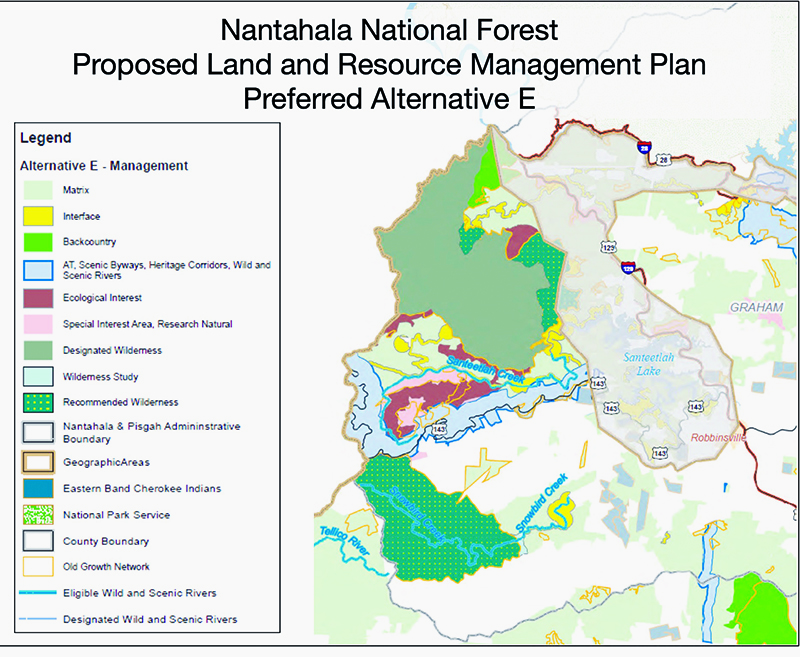
The National Forest Service is developing plans to restore Graham County woodlands that were clearcut a century or more ago – which might make environmentalists happy, but is not sitting well with many Graham County residents.
The plan would stake out wilderness areas in the county, as well as add “wild and scenic” designations for some of the county’s rivers and streams. In doing so, many roads and trails would be closed and active uses would be restricted or forbidden.
The area affected is roughly everything between U.S. Highway 129 and the Cherohala Skyway west of Lake Santeetlah.
In a county that is around ⅔ National Forest, Graham County already is subject to conditions that restrict its population and economic growth. Opponents say this new plan would have devastating consequences on things like tourism, tax base, private property rights, and even the ability of Graham County residents to move about their county freely.
“Not one more blade of grass,” said Connie Orr, chairman of the Graham County Board of Commissioners.
Alternative E
* Alternative A is the no-action alternative and would keep in place the management direction from the current forest plan, as amended.
* Alternative B responds to those who desire more flexibility for managing vegetation patterns, wildlife habitats, recreation, and access.
* Alternative C is intended to be responsive to those who desire more certainty defined in the forest plan and less project level flexibility for managing vegetation patterns, wildlife habitats, recreation, and access.
* Alternative D is an intermediate approach between Alternatives B and C in terms of plan restrictions versus project flexibility for vegetation management, recreation, and access.
* Alternative E, which is preferred by the National Forest Service, was added to be responsive to public comments.
Alternative E increases the emphasis on prescribed fire, using fire and mechanical harvest to restore open forest conditions, and nonnative invasive species treatments in tiered objectives; establishes an old growth network that is larger than any of the other alternatives, and sets the footprint of the network for the life of the forest plan.
It also addresses the challenge of trail management by “working collaboratively with partners” to focus on supply and demand issues in some geographic areas of the forest and ensuring that new trail miles are socially, ecologically and fiscally sustainable.
It also recommends more acres and areas for wilderness compared to alternatives A and C, but less than B and D, recommending areas with the strongest wilderness characteristics in combination with public comments and management needs for other multiple uses.
One more step remains before the Forest Service authorizes the revised planning document as its blueprint for the management of more than a million acres of public forest in Western North Carolina for the next two decades. A 60-day objection period started in late January, followed by a 90-plus-day resolution phase. The forest service said it will ultimately finalize the management plan in mid-2022.
More information is available at fs.usda.gov/Internet/FSE_DOCUMENTS/fseprd988846.pdf
Nantahala forest
It may be difficult to realize that Graham County’s rugged, thickly forested landscape and wild streams filled with crystal clear water could be anything less than healthy, but clearcutting logging practices a century ago and forest management practices since that time have resulted in middle aged woodlands that lack new growth and old growth, lack wildlife diversity, and are vulnerable to non-native factors including invasive plants.
The vast majority of the more than 531,000 acres that now comprise the Nantahala National Forest were subjected to extensive logging between 1880 and 1930.
The lands that became the Nantahala National Forest were held by private owners until they were acquired by the federal government after 1911, when the Weeks Act became law authorizing National Forests in the eastern United States. Management efforts by the Forest Service shifted since 1911. Originally focused on timber, fire suppression, game wildlife species, and developed recreation, it now focuses on practices designed to sustain multiple ecosystems – native vegetation, aquatic organisms, water resources, and non-game and game wildlife, “while also ensuring sustainable benefits to the citizens of western North Carolina.”
“As the pace and scale of Forest Service timber management slowed beginning in the 1990s, young forest habitat on the Nantahala National Forest grew into older age classes, and like old forest in the 1930s, has become scarce,” according to a National Forest Service report. “Based on the most recent Forest Service data, approximately 75 percent of the Nantahala National Forest is over 80 years of age.”
In 10 years, that is projected to increase to approximately 80 percent. By comparison, approximately one percent is in the 0-10 year age class and 0.9 percent is in the 11-21 year age class. As is the case with older forest, stands between the ages of 0 and 20 years are an important component of a healthy and diverse forest, according to the National Forest Service.