
County, region enduring severe drought
A heavy lack of rainfall in the area has wreaked havoc on conditions outdoors, which has sparked a pair of unrelated fires – one planned, one not – and the implementation of an outdoor burn ban.
The North Carolina Forest Service issued a ban for a 14-county area, which went into effect at 5 p.m. Sunday: Burke, Cherokee, Clay, Cleveland, Gaston, Graham, Henderson, Jackson, Macon, McDowell, Polk, Rutherford, Swain and Transylvania counties. At the local level, Graham County Emergency Management issued a Tuesday afternoon release to clarify that all open, outdoor burning within 100 feet of an occupied dwelling is also banned, per N.C. State Building Code, Fire Code 307.1.1.
The only exception is if someone is cooking food outdoors on a grill. Violation of the ban will result in the fire being immediately extinguished by the responding fire department.
The most glaring example of the drought can be found in the well-documented Collett Ridge Fire in neighboring Cherokee County. Believed to have been sparked by a lightning strike during the overnight hours of Oct. 21-22, the blaze had consumed 2,919 acres Tuesday and had zero containment – mainly due to its remote nature, which has made directly combating the fire difficult. A total of 112 personnel have worked the fire.
Additionally, Great Smoky Mountains National Park – which has a sliver of territory in the northeastern corner of Graham County – opted to begin a 1,200-acre, prescribed-burn operation in Cades Cove on Friday. The park implements the burns yearly to cut down on potential overgrowth, and ultimately improve the quality of life for wildlife and vegetation.
As expected, smoke from the burn drifted across Graham County over the weekend – which only intensified both air-quality and concern for local residents.
Monday, the park issued a ban on backcountry campfires within its borders.
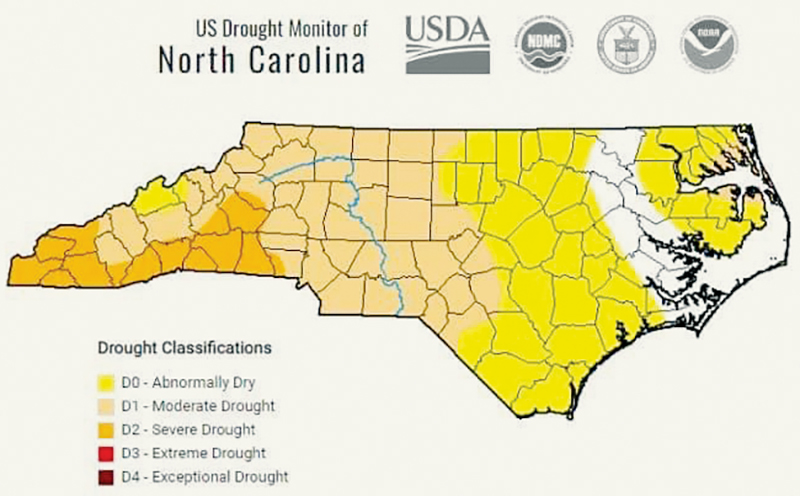
The N.C. Department of Environmental Quality noted in a Friday press release that the 14 western counties were under the D2 classification (Severe Drought) category. An additional 57 counties in western North Carolina are considered to be in Moderate Drought category (D1 classification). The categories are based on the U.S. Drought Monitor.
The department of environmental quality’s release also documented a deficit of 4-10 inches of rainfall across western North Carolina since the beginning of September, which has affected streamflow, groundwater levels, reservoir levels, soil moisture and fire danger.
“In southern mountain location such as Asheville and Murphy, the last time it was this dry at this time of year was in 2016, which was part of a memorably extreme and impactful drought,” N.C. State Climate Office Assistant Climatologist Corey Davis pointed out.
That same 2016 drought was felt within Graham County, most notably in the Joyce Kilmer Memorial Forest. Thousands of acres were burned, including the popular Maple Springs Observation Deck. The deck was repaired and re-opened in Oct. 2019.
The department of environmental quality also warned of “Code Red” air-quality conditions for Cherokee, Clay and Macon counties in a Monday release. “Code Red” indicates the air is unhealthy for anyone to breathe. Graham and Henderson counties are both under an “Code Orange” alert – or unhealthy to groups sensitive to air pollution.
“Children, older adults and people with asthma should limit prolonged or heavy exertion outdoors during Code Orange conditions,” the release added.
Despite the imminent danger, firefighters from Graham County, the N.C. Forest Service and U.S. Forest Service were called to a brush fire around 11 a.m. Saturday, just north of Robbinsville on U.S. 129. An unidentified resident attempt to burn debris before the flames quickly got out of control.
Fortunately, responders were able to contain the fire at less than an acre.
Tuesday afternoon, The Weather Channel was forecasting two days of rain this weekend: Friday had a 71-percent chance of rain; Saturday was predicted at 40 percent.
The forecast was the preeminent reason for Robbinsville football’s second-round playoff game to be moved up to 7 p.m. tonight, instead of the typical Friday designation.
The switch is an effort to protect Bob Colvin Field.
Marshall McClung also contributed to this report.