
Cherohala Skyway marks 25 years open
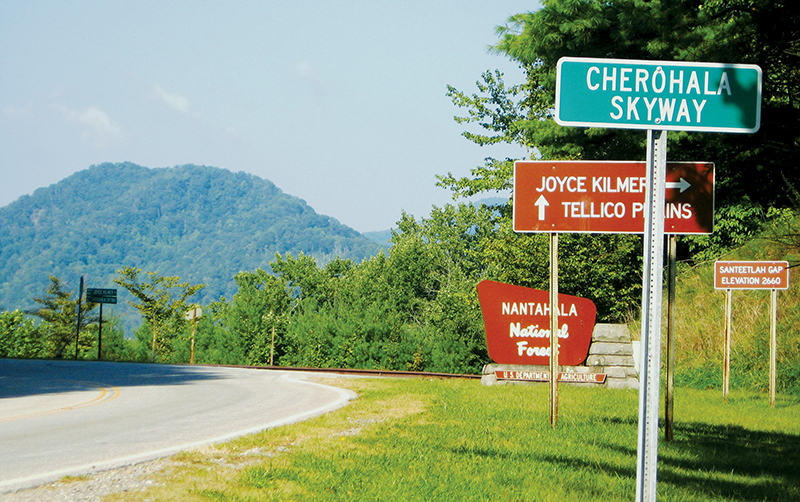
The Cherohala Skyway celebrated a major milestone earlier this month, marking a quarter century open on Oct. 12.
The road – which connects Robbinsville with Tellico Plains, Tenn. – was opened to travelers for the first time on Oct. 12, 1996 and is one of the country’s National Scenic Byways. In total, the project lasted more than 30 years and cost more than $100 million. At the state line, elevation reaches 5,400 feet. The road’s name refers to it connecting the Cherokee National Forest in Tennessee, with the Nantahala National Forest in North Carolina.
On Monday, the Graham County Travel & Tourism and Visit Monroe Tennessee held an online event honoring the occasion, encouraging motorists to drive the road’s 43-mile length and take in the fall foliage.
Retired Phillips and Jordan Construction employee Kenny McElderry was involved in the project, operating a rock crusher and working in other capacities.
He recalled the difficulties faced in building the road.
“I worked up there in 10 degree weather, liked to frozen to death a few times,” McElderry said. “It really got cold up there. They went up there and tried to work in that 10 degrees, but that didn’t work out too good sometimes.”
Retired Federal Highway Administration project engineer and Graham County native David Hyde also shared a weather-related memory from his time working on the project.
He recalls sitting in the cab of his pickup truck doing some paperwork in the parking lot near Hooper Bald when he received a radio call from a coworker telling him to look out the window.
“It was June 10 and it was snowing,” Hyde said.
Both Hyde and McElderry recalled the slow pace of construction due to the amount of rock the crews needed to negotiate.
Hyde also recalled the need for meticulous, environmental testing due to iron pyrite – or “fool’s gold” – being discovered as some of the rock was chipped away.
He said the ore could react with rainwater and create sulfuric acid that would then end up in nearby creeks.
Nearby water sources would have to be tested regularly in a lab set up in the project office. Eventually the University of Tennessee, Knoxville Department of Geology began to assist with the testing.
“Those areas of pyrite had to be located,” Hyde recalled.
Hyde also said blasting had to be used regularly, again due to the amount of rock below the soil.
“Somewhere along the way, you’re gonna hit rock,” Hyde said.
Hyde said he still went up to the skyway sometimes to enjoy the views, and talk to drivers and motorcyclists enjoying the road. He said he often talked with them about his role in building the skyway and told them to enjoy it.
His work on the project also earned him an award from the Federal Highway Administration, which he received in Washington, D.C.
“It really doesn’t feel like it was 25 years ago,” Hyde said. “It feels like it was not too long ago.”
Graham County Travel and Tourism Board Chairman Dale Wiggins emphasized that the skyway was constructed in large part by people and firms from Graham County, calling the road “literally homegrown.”
“Not only does it open the door for Graham County’s visitors to experience something spectacular, but it has enormous historical and cultural value for the people of Graham County,” Wiggins said. “The skyway allows easier access to the outdoor areas that generations of our folks have traditionally enjoyed.
“Anyone who travels on or across the skyway certainly understands the meaning of the old adage that ‘The journey is more important than the destination.’”