
Engineer’s report provides more detail on dangers of home seating
Robbinsville – ‘This should be good,’ quipped Graham County Board of Education Chair Rodney Nelson.
It was a light-hearted statement, meant to break the reality that assistant superintendent Robert Moody was prepared to deliver: barring nothing short of an engineering miracle, football will not be played at Modeal Walsh Memorial (Big Oaks) Stadium this fall.
The district quickly had to pivot May 15 on its original plans to hold both the baccalaureate and graduation ceremonies at the famed facility last week, after Asheville-based Kloesel Engineering visited the stadium amid concerns about the structural integrity of the home-side bleachers, which were first installed in 1981. With just nine days notice, the exercises returned to their former respective homes of Robbinsville First Baptist Church (May 24) and the high school gymnasium (last Friday) for the first time since 2019 as a result.
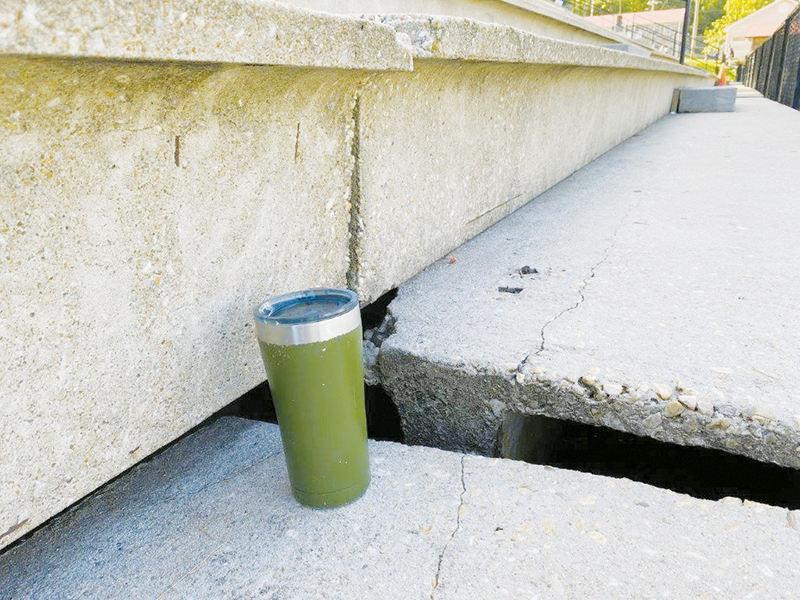
Kloesel’s report – sent to the system May 19 – maps out the seating arrangement, which is comprised of 14 rows of precast concrete, double-tee beams spanning roughly 35 feet between a pair of concrete-foundation walls. There are five bays (rows) of bleachers in totality.
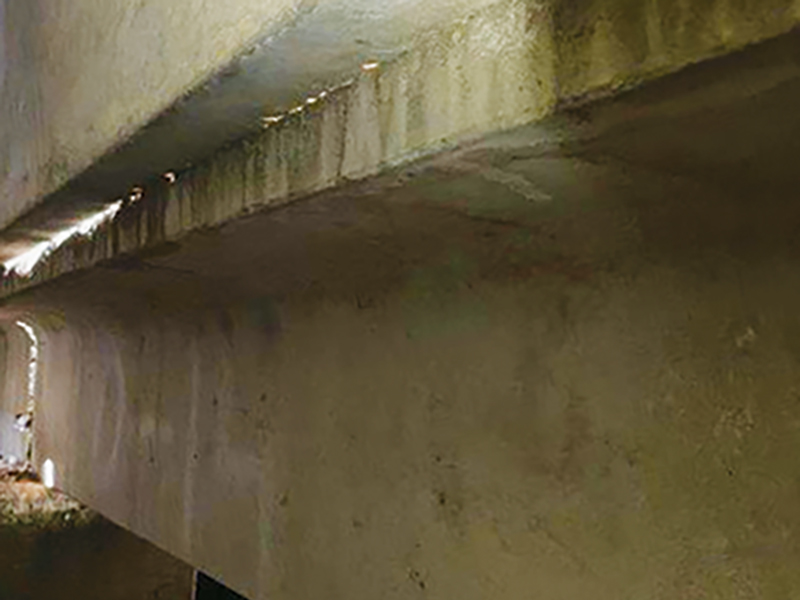
Shouldering the 41-year load of a rabid fanbase both packing the stands and celebrating the highs of Black Knights football, the bleachers have shifted forward and away from the original concrete bases underneath, which are only accessible by crawling through a small opening at the northern end of the seating. The shift has been caused by the crumbling of the pillars that support the set-up.
“The foundation at the top is eroding – to the point that you can reach up and grab pieces of rebar,” Moody illustrated. “The other problem is that they are built as stair-steps, where one row sits on top of another and another on top of that, and so on.”
The steps are staggered such that the ends of each section is sitting on the lip of another below, which has put a strain on the bottom row as a result.
“With the stress cracks and the shifts, if one of the bottom ones go (break away), it will create a domino effect and the whole thing will fall,” Moody explained.
Over the last few years, Graham County Schools has attempted to slow down the deterioration by installing steel tees in troublesome spots – but the clock has ran out on their lifespan. Kloesel concluded the nearly 2-page summary of its findings by recommending the bleachers not be occupied until “such time as a repair plan can be designed and implemented.”
The board also said that once a recommended plan for repair from Kloesel was received, an emergency meeting would be called to discuss the next steps.
“It’s going to be an ordeal. It’s not going to be easy and it’s not going to be cheap,” Moody stated about the repair process. “There’s nothing I can say right now until we receive the second report, but I just don’t see any other way around it without removing the bleachers – if it’s fixable – to fix what needs to be done under there.
“No matter what we do to fix it, it will be short-term.”
Robbinsville High School has already spoken with Cherokee and Hayesville as potential host sites for at least the first three “home” games (East Surry on Aug. 18, Franklin on Aug. 25 and Rabun Gap, Ga., on Sept. 22), due to both institutions’ football stadiums housing artificial turf.
This could buy the school system enough time to make any temporary repairs before the Smoky Mountain Conference portion of the schedule begins Sept. 29 – though Robbinsville would not host a divisional home game until Oct. 13, when Andrews is scheduled to visit to begin a run of three straight for the Knights at home to close the year.
“Time is our worst enemy,” Moody pointed out. “Football is the biggest money-making sport that we have and it helps fund all of the other sports for the rest of the year – not to mention that the band gets the home concessions (sales).”
The stadium’s abrupt closure also puts Robbinsville’s youth football program at-risk of having a season, since the majority of revenue comes from hosting 4-game home slates on Saturdays in the fall.
“We have a lot of people that want to help – but ultimately, this is school grounds,” noted Robbinsville High School Principal David Matheson. “Anything that we do is going to have go through engineering, an architecture firm. When a school does something, there’s red tape to go with it.”
The construction of another stadium will require a lot of work and is not an overnight endeavor, either. For example, the practice field at the high school – where a new stadium could be built and plans to that effect were drafted some 10 years ago – would have to be shifted north-south, rather than the east-west direction it sits now.
The track would also have to be torn up and removed.
“If we broke ground tomorrow, we would be lucky to be in a new stadium in two years,” Matheson said.
Moving a campus?
Then, there’s the matter of Robbinsville Elementary School.
The stadium was built on the school’s grounds, as it served as the high school until the current location opened in January 1993. Until just two years ago, the facility housed grades K-6; before sixth grade moved to Robbinsville Middle School.
Concerns about the overall safety and security of elementary students has had Graham County Schools seriously exploring the idea of setting up shop elsewhere – but finding a new home has presented challenges.
“There’s got to be serious talks sometime soon of moving this whole campus,” Moody said of the work that has already went into addressing issues at Robbinsville Elementary. “It’s horrible to protect; it’s a safe-schools issue; we’re putting a Band-Aid on a gushing wound.”
Moody pointed out that the North Carolina Department of Public Instruction requires at least a 30-acre parcel of land to construct a new elementary campus, to ensure appendages like outdoor playgrounds can be properly built and maintained.
“Right now, part of the elementary school needs a roof; there’s tons of leaks,” said Knight. “There’s going to have to be a major commitment to upgrading facilities. We’re very blessed to have some of the nicest facilities around, but at the same time, there are things we need to address. We’ve tried to address them as we’ve had the money to do so, but these big fixes are going to have to be a joint effort.”
Knight added that the district applied for a capital-needs grant to fund a new school, but was denied since the addition to the middle school was still an active job.
“Now that it’s completed, we can certainly re-apply every year,” Knight said. “We’re trying. We’re trying to do something, but land is our biggest issue at this point.”
CTE success
Matheson provided a positive report during the meeting, concerning the local impact of the CTE (Career Technical Education) program.
Data compiled by the state department of public instruction showed some remarkable statistics for county students that came through the program, including a couple of noteworthy accomplishments:
* Robbinsville High ranked first in the state in both CTE graduation rate (100 percent) and post-secondary job placement;
* A 99 percent credential-attainment rate. Of the 246 enrolled participants, 995 credentials were earned – which averages out to just over four credentials per student.
Additionally, Matheson reported that the facility’s agricultural barn was scheduled to be constructed over the summer.