

Marshall McClung
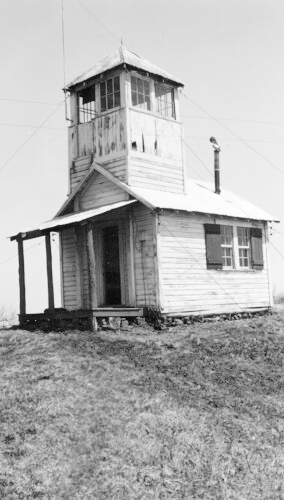
The early forest-fire lookouts – sometimes referred to as “Sentinels of the Forest” – were often buildings constructed of rough lumber by the Civilian Conservation Corps (CCC) and contained little of the comforts of home.
They served their purpose though and made it possible for forest fires to be detected much sooner. Before the lookouts were constructed, fires often burned out of control for some time before someone spotted them. Valuable time was lost trying to locate fires.
 Daniel Adams – once a forest supervisor – came up with the idea of a fire-detection system. He recommended placing fire lookouts on high mountain tops, where they had a commanding view of the mountainous terrain surrounding them.
When a fire was spotted, the tower operator would take a compass reading on it and relay this to another lookout. Wherever the bearings crossed on the map was where the fire was.
Adams returned to North Carolina in 1914 and remained until his death at age 84. He is buried in McDowell County, near Old Fort.
Graham County had three fire lookouts – though not all at one time. The first lookout was constructed on Haoe Bald – elevation 5,249 – by the CCC in 1938. There was no road access to the site, so material to construct the lookout had to be carried in by hand or pack horses. The structure was 25 feet high. The Haoe Bald Lookout went out of use in the early 1950s and began to fall into disrepair.
By 1967, it was on the ground. The ruins were removed in 1980.
The first Joanna Bald fire lookout was built in the 1940s by the CCC. The building sat astride the Cherokee/Graham County line at an elevation of 4,716 feet and was reached by a foot trail from Tatham Gap. The structure resembled closely the one that was on Haoe Bald and looked more like a country church than a fire lookout.
It is said to have been named for Joanna Moody, an early Graham County resident. It also has a Cherokee Indian name, “Teyahalee,” said to mean “Lizard” or “Lizard Place.”
The wood structure was replaced by the current 31-foot steel fire tower in 1952 by the U.S. Forest Service.
The Wauchecha Bald fire tower was built by the U.S. Forest Service in 1952 at an elevation of 4,380 feet and is 32 feet high. The Cherokee word is “Wachacha,” which is said to be the sound of a grasshopper.
A Cherokee named Jack Wachacha lived a short distance from where the fire tower now stands around 1913. He had a small cabin in a level spot below the summit of the mountain.
Marshall McClung is the historical columnist for The Graham Star. He can be reached via email, mcclungs@email.com.