
Marshall McClung
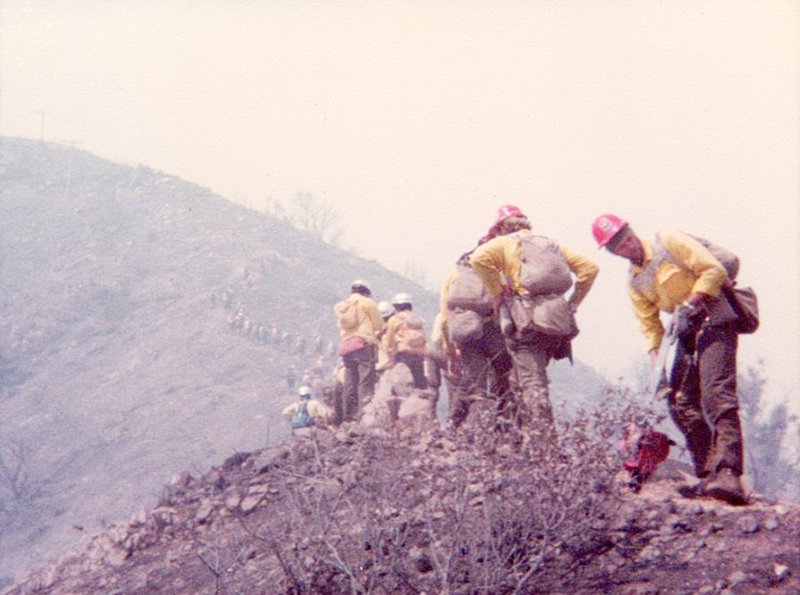
During my 50 combined years of fighting forest fires with both the United States and North Carolina Forest services, I spent a lot of time on large forest fires in the Western United States. Many of them were in excess of 100,000 acres in size.
When you were shipped to these fires you could expect a stay of at least two weeks – usually more. I remember one year I was gone all but 1-2 days of the month of August. As these fires were usually a “long way from nowhere,” fire camps was where you were for a few hours between shifts.
My first stay in a fire camp was in Washington State in August of 1970. Our stay in this one was short, as the fire ran us out of camp just as we lay down. Some of the meals were military type-C rations. The fire burned over the only road access to us and an inversion layer held the thick smoke down so no helicopters could reach us with food either. We ate lima beans for breakfast.
Our sleeping quarters were paper sleeping bags spread out on the ground. On one fire in Montana, the temperature dropped into the 20 degree range with a heavy frost. I had put a bottle of water in the sleeping bag with me and the next morning it had partially frozen.
Hoot Gibbs started to put his glasses on and remarked about how dirty they were. As he attempted to clean them he discovered that his breath had frozen on them.
In Oregon, there was a sandwich in our sack lunches we took on the fire that we called “mystery meat” – so named because no one could figure out what it was. No one would eat it due to its red, stringy, tough texture.
One firefighter remarked that he had solved the mystery. He said that there were horses in a meadow next to the fire camp when we first came – and that they were gone now.
One night when we were in the chow line, I noticed an abundance of loaves of bread, large containers of peanut butter and grape jelly. I quietly slipped out of line and began making me some “PB&J” sandwiches. The next day on the fire line at lunchtime, I pulled them out of the sack and immediately every firefighter in sight wanted to know where I got them. Out of pity, I told them, and that evening there were several firefighters in the line with me for the “PB&J” table. The next evening, there were more in that line than the chow line.
If you were on night shift on the fires, it was cooler than day shift of course, but trying to sleep during the day in 100-plus degree temperatures was miserable. In Southern California – or the bad lands of Arizona or New Mexico – shade trees were scarce as there was mostly scrub brush.
Marshall McClung is the historical columnist for The Graham Star. He can be reached via email, mcclungs@email.com.